A brand manager at a European furniture company called us last spring, frustrated. Their new sofa line — launched six months earlier with “premium leather upholstery” as the headline selling point — was generating warranty claims at 14% in the first year. The leather? Top-grain, sourced at a competitive price from a supplier who promised “durability comparable to full-grain.” The reality: the lightly sanded surface began showing visible wear patterns within 8 months of residential use.
Your leather choice isn’t just a material decision — it’s a brand promise. When that promise cracks at 14 months, the cost isn’t just replacement units. It’s eroded consumer trust, damaged retail relationships, and a marketing team forced to rebuild a narrative from scratch. Here’s how to evaluate leather materials so your brand story survives the warranty period.
The Leather Hierarchy: What “Your Leather” Actually Means
The leather industry uses a four-tier grading system that most B2B buyers encounter without fully understanding the performance gap between tiers. Here’s what each grade actually delivers:
- Full-grain: The complete top layer of the hide, unsanded. Retains natural grain, breathability, and maximum tensile strength. Develops patina over 10-20 years. Most expensive — requires flawless raw hides.
- Top-grain: Surface lightly sanded to remove imperfections, then finished with a protective coating. Smoother appearance but 15-20% less dense than full-grain. Shows wear at 3-5 years in commercial use.
- Genuine leather: A misleading marketing term. Typically refers to split leather (the lower layers) with an embossed grain pattern. Lowest quality that can legally be called “leather.”
- Bonded leather: Ground leather scraps mixed with polyurethane binder. Contains 10-20% actual leather fiber. Service life: 1-2 years before delamination.
The leather grading system isn’t standardized globally — suppliers routinely blur the lines between tiers (Tannery Talk, 2024). “Genuine leather” sounds premium to consumers but represents the third tier of quality. Understanding what defines good quality leather starts with recognizing that marketing language and material performance are two different things.

Leather sample rack showing the visible difference between full-grain, top-grain, and corrected-grain finishes
Full-Grain vs PU vs Silicone: 10-Year Real-World Performance
Here’s what actually happens to three common leather materials over a decade of B2B service:
| Material | Year 1-2 | Year 3-5 | Year 5-10 | Primary Failure Mode |
|---|---|---|---|---|
| Full-grain leather | Excellent | Good (if no UV) | UV cracking | UV embrittlement at 800+ hrs |
| PU leather | Good | Peeling starts | Failed | Plasticizer migration, surface flaking |
| Silicone leather | Excellent | Excellent | Excellent | No failure mode observed in testing |
Full-grain leather delivers 20+ years of service in ideal conditions — but “ideal conditions” excludes UV exposure, high humidity, and frequent cleaning cycles. In our UV aging tests, full-grain leather showed visible color shift and surface embrittlement at 800 hours of QUV exposure. The real-world equivalent: 3-4 years of direct sunlight through commercial windows.
PU leather — the most common B2B upholstery choice at 55% market share — starts peeling at 18 months as plasticizers migrate out of the polymer matrix. The surface that felt supple at delivery becomes brittle and begins flaking by year two. Silicone leather uses a Si-O polymer backbone with 452 kJ/mol bond energy — significantly higher than the C-C bonds in PU (347 kJ/mol). This chemistry translates to 1,000+ hours of UV resistance with no yellowing, and 200K+ Martindale abrasion cycles verified in our lab testing.

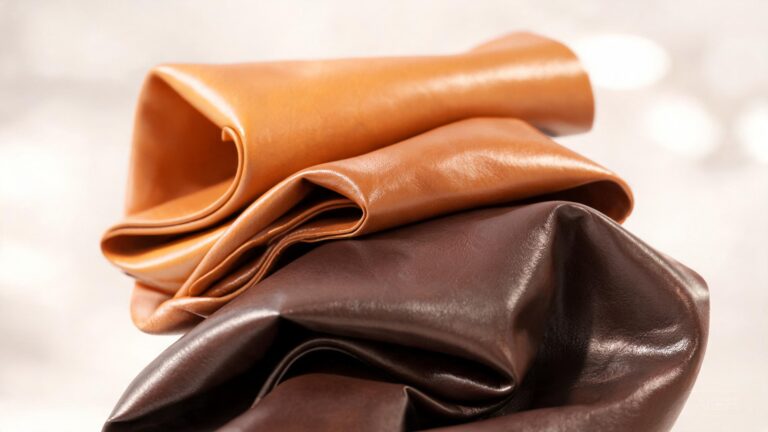
Color and texture consistency across leather swatches — a factor in brand-level material decisions
How Your Leather Choice Shapes Brand Perception
A material specification is a brand decision. Each leather type communicates something different to your customers:
- Full-grain signals heritage, craftsmanship, and premium positioning — but requires a price premium of 30-50% over top-grain and comes with natural variation that some buyers reject.
- PU leather signals affordability and design flexibility — but the 18-month peeling window creates warranty exposure that erodes brand trust faster than any marketing campaign can rebuild it.
- Silicone leather signals innovation, sustainability, and performance — but requires educating consumers about a material most haven’t encountered yet.
One of our clients, a Scandinavian furniture brand, shifted their mid-range line from PU to silicone leather after warranty claims exceeded 12% in year one. The switch added 15% to material cost but reduced warranty claims to under 2% — and the “10-year performance guarantee” became their headline marketing message.

Natural grain texture that defines premium leather — but UV stability varies by polymer chemistry
The Hidden Cost of Cheap Leather: When Warranty Claims Hit
Here’s the math most brand managers miss. If you source PU leather at $8/m² versus silicone leather at $14/m², the 75% premium seems prohibitive. But calculate the 5-year total cost of ownership:
5-Year TCO Reality: PU leather at $8/m² + 2 replacement cycles ($16) + warranty labor ($6) + brand damage = $30+/m² true cost. Silicone leather at $14/m² + 0 replacements + minimal warranty exposure = $14/m² true cost. The cheapest leather at sourcing is rarely the cheapest at the brand stage.
When you factor in sustainability claims verification — increasingly demanded by EU buyers — the gap widens further. PU leather cannot claim zero VOC production or microplastic-free performance. Silicone leather can verify both.
How silicone leather delivers long-term value across 10+ years of B2B service
Choosing Your Leather: Decision Framework
The right leather for your product depends on what your brand needs to deliver. Here’s how to decide:
- If you need heritage luxury positioning and can manage UV exposure → full-grain leather, but budget for conditioning and UV-protected display environments
- If you need budget flexibility for short-lifecycle products (under 3 years) → PU leather, but set aside 40-60% of material cost for warranty reserves
- If you need 10+ year performance with UV stability and sustainability claims → silicone leather, verified through Martindale 200K+ and 1,000+ hour UV testing
- If you need medical or food-grade compliance on top of durability → silicone leather with ISO 10993-5 biocompatibility certification
- If you need flame retardancy without chemical additives → silicone leather with EN 13773 Class 4 certification, LOI 26-30%
Your leather specification is the material foundation of your brand promise. Choose the one that won’t crack under the weight of it.
View Application-Specific Material Guide
What leather grade lasts the longest for B2B upholstery?
Full-grain leather has the longest theoretical lifespan (20+ years) but degrades under UV exposure within 3-4 years of commercial window sunlight. Silicone leather delivers 10+ years with verified UV resistance of 1,000+ hours and 200K+ Martindale abrasion cycles — making it the longest-lasting option for real-world B2B conditions where UV, moisture, and cleaning cycles are factors.
Is silicone leather better than full-grain leather for outdoor applications?
Yes. Full-grain leather absorbs moisture, requires regular conditioning, and degrades under UV — making it unsuitable for outdoor or marine environments without heavy chemical treatment. Silicone leather is inherently hydrophobic, UV-resistant to 1,000+ hours with no yellowing, and requires no protective coatings — making it superior for outdoor, marine, and high-humidity applications.