A London hotel group refurnished 40 suites with cream leather sofas in Q2 2025. The aesthetic was stunning — warm, soft, bouncing light into rooms that London’s overcast climate rarely illuminates naturally. By month 18, the finance department had flagged a problem: professional leather cleaning at $280 per suite every quarter, UV restoration at $420 per sofa after summer sun damage through south-facing windows, and two suites requiring full reupholstery after denim dye transfer. The total maintenance cost had exceeded the original purchase price of the furniture. Cream leather is the most-searched sofa color for modern homes in 2026 — but for B2B buyers in hospitality, furniture, and automotive, the color trend carries hidden lifecycle costs that don’t appear on a purchase order.
Request Free Cream Color Swatches
Why Cream Dominated the 2026 Design Palette
The shift away from grey toward cream leather is driven by a broader “warm neutral” design movement that defines 2026 interior trends. After a decade of cool grey dominance — in walls, sofas, and automotive interiors — designers and consumers have pivoted to warm tones that feel less clinical. Cream pairs with caramel, rust, terracotta, olive, and sage palettes that define the “quiet luxury” aesthetic: texture-led, personality-driven, and infinitely more marketable in showroom photography than flat grey.
For UK and Northern European markets, the color choice has a functional dimension. As one furniture retailer noted: “Grey is out. Every UK living room looked the same for years. It was cold. Cream works with UK light.” Cream leather bounces available light into spaces that receive limited direct sun, making rooms feel larger and warmer — a genuine selling point for furniture brands and interior specifiers targeting these markets.

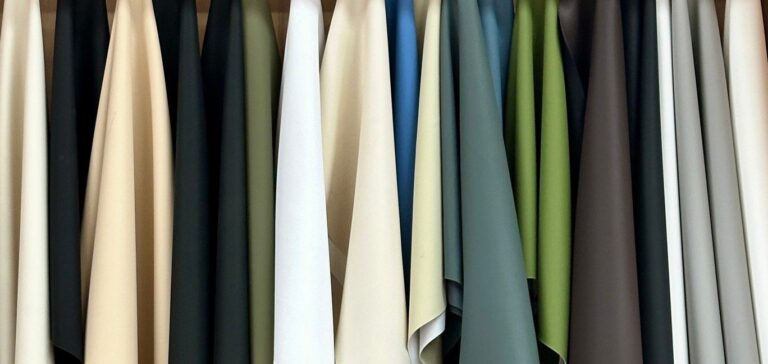
Off-white leather softness display — cream tones dominate 2026 furniture and automotive interior palettes but carry distinct staining and UV challenges
The Staining Problem: Standards You Need on Your Spec Sheet
Cream leather shows dirt, dust, and stains more readily than any dark color. This isn’t a matter of aesthetics — it’s a measurable performance gap. The denim dye transfer that forced the London hotel to reupholster two suites is a well-documented failure mode in light-colored upholstery. For B2B buyers, the defense is in the specification: require colorfastness standards explicitly on the purchase order.
The relevant standards for cream leather staining resistance are: EN ISO 11640:2018 for color fastness to rubbing (50 cycles requiring Grey Scale grade 3, 500 cycles requiring grade 4 for semi-aniline), ISO 11642:2025 for color fastness to water, and AATCC 16 for lightfastness. The American Home Furnishings Alliance (AHFA) sets the upholstery leather benchmark at Grey Scale grade 4 or higher at 500 cycles for semi-aniline finishes (AHFA Leather Standards). If your supplier cannot produce ISO 11640 test results showing grade 4 or higher, your cream leather upholstery will stain under normal use — and your warranty inbox will reflect it.
Specification rule: For cream leather in commercial applications, require: EN ISO 11640 grade 4+ at 500 cycles (rubbing fastness), ISO 105-B02 grade 6+ (lightfastness), and denim dye transfer resistance testing per GMW15377 (automotive) or equivalent. A supplier who cannot provide these results is selling a color, not a specification.
UV Degradation: The 37% Tensile Strength Loss
The most expensive hidden cost of cream leather is UV degradation. White and cream leather finishes use titanium dioxide pigment for opacity — the same compound used in sunscreen. But titanium dioxide is photosensitive: under prolonged UV exposure, it accelerates polymer chain breakdown in the coating. The result is that cream leather loses tensile strength at nearly double the rate of black leather.
Data from automotive interior testing shows that white leather loses 37% of its tensile strength after 36 months of average U.S. sun exposure, versus 19% for black leather (OEM Cover, Lightfastness Analysis). On the AATCC 16 lightfastness scale (1–5), grade 1 means visible fading within hours, while grade 5 means no significant fading for over a month of continuous exposure. For the ISO 105-B02 scale (1–8), grade 6 is considered high — only slight fading after long-term UV exposure. Cream leather should be specified at ISO 105-B02 grade 6 or higher for any application near windows or in automotive interiors.

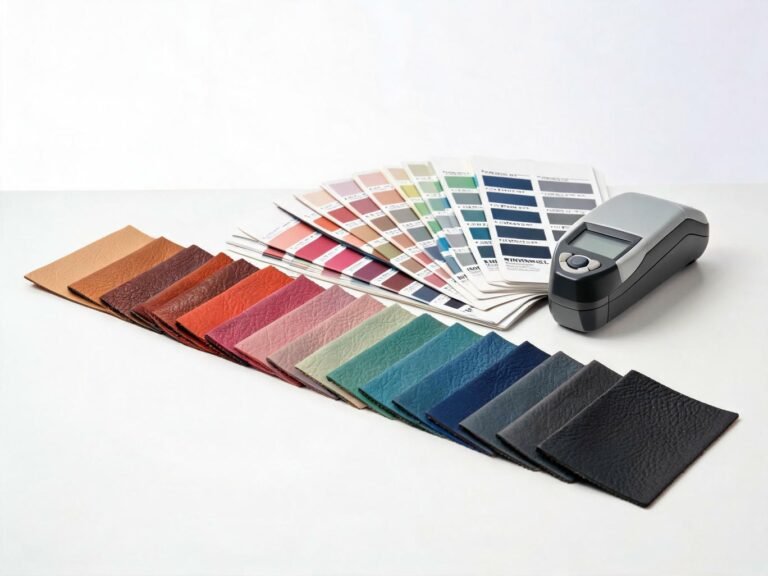
Custom color matching — cream leather requires precise pigment formulation to achieve UV stability without yellowing over time
Cream Leather Comparison: Genuine vs PU vs Silicone
| Property | Genuine Cream | PU Cream | Silicone Cream |
|---|---|---|---|
| Rubbing Fastness | Grade 3–4 (500 cycles) | Grade 3 (500 cycles) | Grade 4–5 (500 cycles) |
| UV Resistance | 37% tensile loss / 36 mo | Yellowing + cracking | Grade 6+ (ISO 105-B02) |
| Stain Resistance | Low (porous) | Moderate | High (non-porous) |
| Denim Dye Transfer | High risk | Moderate risk | Low risk |
| Cleaning Frequency | Monthly (commercial) | Quarterly | As needed (wipe clean) |
| Maintenance Cost/yr | $400–1,600/suite | $200–600/suite | $0–50/suite |
| Yellowing Over Time | Yes (UV oxidation) | Yes (PU degradation) | No (Si-O stable) |
The table reveals why the London hotel’s maintenance costs spiraled. Genuine cream leather in a commercial environment requires professional cleaning every 1–3 months at $100–400 per session, plus UV restoration at $300–650 per row for automotive applications. Over a 5-year period, maintenance costs can equal or exceed the original purchase price. By contrast, silicone leather’s non-porous surface resists denim dye transfer, wipes clean with water, and does not yellow because the Si-O backbone is chemically stable under UV. For a comparison of the underlying material differences, see our analysis of silicone vs PU properties.
The Commercial Maintenance Cost Calculator
For B2B buyers specifying cream leather in commercial environments, the total cost of ownership formula is: purchase price + (cleaning frequency × cost per session × years of service) + UV restoration cost + reupholstery cost for failed units. Here’s the calculation for a 40-suite hotel using genuine cream leather over 5 years:
- Purchase: 40 suites × $2,400/sofa = $96,000
- Cleaning: 40 suites × $280/session × 4 sessions/year × 5 years = $224,000
- UV restoration: 15 south-facing suites × $420 × 2 cycles = $12,600
- Reupholstery: 4 suites (denim transfer) × $1,800 = $7,200
- 5-year TCO: $339,800 — 3.5x the purchase price
The same 40-suite hotel using silicone cream leather: purchase at a modest premium ($108,000), cleaning with a damp cloth ($0–2,000 over 5 years), zero UV restoration, zero reupholstery. The 5-year TCO: $110,000 — a 68% reduction from the genuine leather scenario. For B2B buyers evaluating hospitality and furniture applications, the maintenance cost differential is the single most decisive factor in material selection.

Commercial leather sofa — hospitality environments amplify cream leather maintenance costs through high-traffic daily use and UV exposure through windows
Frequently Asked Questions
Does cream leather yellow over time?
Yes — genuine cream leather yellows due to UV oxidation of the tanning agents and finishing oils, while PU-based cream leather yellows from polymer degradation. Silicone leather is the only material that resists yellowing: the Si-O (silicon-oxygen) backbone is chemically stable under UV exposure and does not undergo the oxidation reactions that cause yellowing. For applications where color stability is critical — hospitality, automotive, showroom furniture — specify ISO 105-B02 grade 6 or higher on the purchase order and require test data from the supplier.
What is the best leather for cream-colored commercial furniture?
Silicone leather is the best material for cream-colored commercial furniture because it combines the aesthetic warmth of cream tones with non-porous stain resistance, UV stability, and wipe-clean maintenance. Genuine leather in cream tones requires monthly professional cleaning ($100–400 per session) and UV restoration ($300–650 per row) that can push 5-year maintenance costs to 3.5x the purchase price. PU leather yellows and cracks within 2–5 years. For the silicone leather introduction, our technical overview covers the composition that makes it resistant to the failure modes that plague light-colored leather.
Cream Is the Color. The Material Is the Decision.
Cream leather is not going away — the 2026 design trend is real, and B2B buyers who ignore it risk falling behind consumer preference. But the material choice beneath the color determines whether that trend is profitable or punitive. Genuine cream leather in a commercial environment generates maintenance costs that eclipse the purchase price within 5 years. PU cream leather yellows and cracks before the warranty expires. Silicone cream leather delivers the warmth and aesthetic that designers want, with the stain resistance, UV stability, and zero-maintenance profile that finance departments need.
The London hotel group that spent $339,800 over five years on genuine cream leather maintenance could have spent $110,000 on silicone cream leather and saved $229,800 — while delivering the same aesthetic to guests. The color is the trend. The material is the margin.
About TOPSUN
TOPSUN manufactures silicone leather in custom cream and off-white tones using a solvent-free dry coating process that produces UV-stable, non-porous, wipe-clean surfaces — giving B2B furniture, hospitality, and automotive brands the 2026 trend color without the maintenance cost penalty of genuine or PU-based cream leather.
500,000+ m monthly capacity · Custom Pantone color matching · 7–15 day lead time · MOQ 500m · ISO 105-B02 grade 6+ lightfastness · Free A4 swatches worldwide via DHL/FedEx