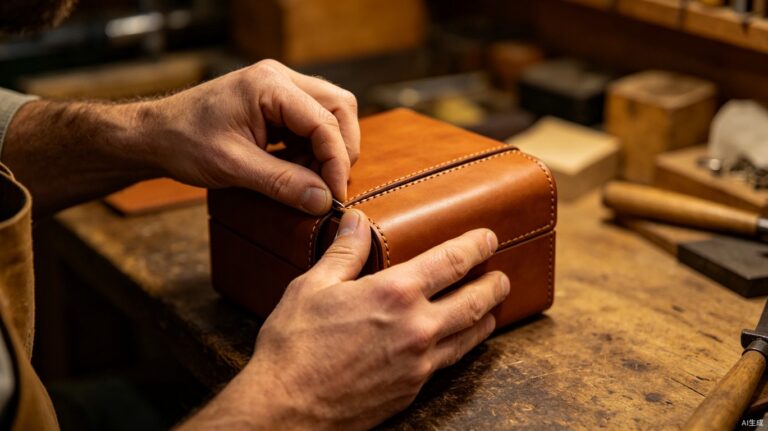
A wallet gets opened 30+ times a day. A cardholder rubs against keys, coins, and fabric in every pocket. Yet most B2B buyers still spec 0.6mm PU leather that cracks at 50,000 Martindale cycles — barely six months of real-world wear.
Small leather goods live in the harshest wear environment in the leather industry. They’re thin, they flex constantly, and they take direct skin contact with sweat and oils. The material you choose determines whether your product lasts two months or two years. Across fashion and sports applications, brands are shifting away from PU and PVC toward materials that can actually survive the pocket.
This article breaks down how four materials — silicone, PU, PVC, and genuine leather — actually perform in wear testing, what thickness ranges work for wallets and cardholders, and why 40% of premium B2B inquiries now demand RFID-compatible, eco-conscious materials.
Why Small Leather Goods Demand Ultra-Thin, High-Wear Materials
Small leather goods — wallets, cardholders, key fobs, phone cases, coin purses — sit in a unique material performance window. They need thickness between 0.5mm and 1.0mm for foldability and structural integrity, yet they face abrasion levels comparable to furniture upholstery. Industry research confirms that small leather goods are typically manufactured from hides 0.5–1.00mm thick, using calf, goat, or sheep skins.
But traditional animal hides come with batch inconsistency, ethical sourcing concerns, and price volatility that makes B2B scaling unpredictable. Here’s what actually matters when evaluating the best materials for small leather goods:
- Fold endurance — A bifold wallet flexes at the same crease line thousands of times. Materials must resist flex cracking, not just surface abrasion.
- Sweat and oil resistance — Direct skin contact means the material faces sebum, perspiration, and cosmetic residues daily.
- Edge integrity — Cut edges on small goods are often exposed or minimally finished. The material must not delaminate at cut edges.
- Color fastness — Small goods are carried in pockets alongside denim and dyed fabrics. Color transfer resistance is non-negotiable.
Silicone leather addresses all four factors. Our ultra-thin collection ranges from 0.23mm to 0.8mm, covering the full thickness window for small goods. The silicone coating is inherently hydrolysis-proof — it doesn’t absorb moisture, so sweat and oils sit on the surface and wipe clean. Cut edges remain stable because the silicone layer bonds molecularly to the substrate, unlike PU’s adhesive bond that can separate at edges over time.

Martindale abrasion tester used to evaluate wear resistance of thin leather materials for wallets and cardholders.
Silicone vs PU vs PVC: Wear Test Results for Wallets and Cardholders
The best materials for small leather goods share one trait: they survive repeated abrasion without surface breakdown. But the gap between “survives” and “fails” is wider than most buyers realize. For a detailed breakdown of material chemistry differences, see our silicone vs PU comparison.
In our Martindale abrasion testing, we’ve seen clear performance tiers emerge across materials at equivalent thicknesses (0.8mm):
| Material | Martindale Cycles | Thickness Range | Service Life | VOC Emission |
|---|---|---|---|---|
| Silicone Leather | 200,000+ | 0.23–2.0mm | 10+ years | Zero / Near-zero |
| PU Leather | 50,000–80,000 | 0.6–1.2mm | 3–5 years | Contains solvents |
| PVC Leather | 30,000–50,000 | 0.7–1.5mm | 2–3 years | Contains plasticizers |
| Genuine Leather | 100,000–150,000 | 0.5–1.5mm | 5–8 years | Varies by tanning |
PU leather’s 50K–80K cycle range is the industry’s open secret. It’s adequate for a product designed to last one season — but for B2B brands building reputation on durability, it’s a liability.
One of our clients switched from PU to silicone leather for their premium cardholder line after field returns showed surface cracking within 8 months. Post-switch, their return rate dropped below 0.3%. That’s the difference between 50K and 200K Martindale cycles in real-world terms.
PVC performs worse on every metric, and its plasticizer content raises compliance flags under REACH and RoHS. Genuine leather offers good abrasion resistance but brings sourcing inconsistency — no two hides are identical, and batch-to-batch color matching becomes a manual process that doesn’t scale for vegan leather small goods programs.

Lychee-texture silicone leather swatches in warm tones — a popular finish for premium wallet and cardholder programs.
Watch how silicone leather resists scratching under standardized test conditions — critical for pocket-carried goods.
The RFID Factor: Why 40% of Premium Programs Now Demand Shielding
B2B inquiry data shows that RFID-blocking versions now represent over 40% of premium program inquiries — a figure that was negligible three years ago. This changes material selection in ways that aren’t immediately obvious.
RFID shielding typically requires a metalized layer — usually copper or aluminum — laminated between the outer leather and the inner lining. The outer material must be thin enough (≤0.8mm) that it doesn’t add excessive bulk to the finished cardholder, but thick enough to protect the shielding layer from daily wear.
Silicone leather works well in RFID-compatible constructions because it bonds cleanly to metalized films without adhesive migration. The 0.23mm ultra-thin grade keeps total cardholder wall thickness under 1.2mm, and its thermal stability (-40°C to 250°C) means lamination temperatures won’t distort the surface. For brands prioritizing eco-friendly silicone leather, the zero-VOC chemistry also means no solvent off-gassing that could degrade the RFID film over time.
PU leather can work with RFID layers, but its solvent-based chemistry can interact with adhesive systems over time, causing delamination at the shielding interface. We’ve seen this failure mode in RFID blocking leather goods using PU covers — the RFID layer separates from the cover material after 12–18 months, creating visible bubbling that kills the product’s premium positioning.

Metallic-finish silicone leather sample strips — compatible with RFID shielding layers for premium cardholder programs.
Custom Texture and Color Matching for Small Leather Goods Brands
Custom small leather goods OEM programs live or die on visual differentiation. A cardholder that looks identical to a competitor’s product at the same price point has no margin advantage. Brands looking for guidance on supplier evaluation can refer to our B2B leather goods quality guide.
TOPSUN offers 100+ embossed textures — cowhide, pigskin, sheepskin, and custom patterns — with custom embossing rollers produced in 7–10 days. Color matching uses Pantone or RAL references with Delta E ≤ 1.0, meaning the color you approve on the swatch is the color you get across every production batch.
For one client launching a vegan leather goods line, we developed a pebble grain texture in six Pantone-matched colors. The program rolled from swatch approval to bulk production in 21 days — a timeline that’s difficult to match with genuine leather due to hide sourcing and dye lot variability.
Here’s what to specify when requesting custom samples for small goods programs:
- Target thickness — we recommend 0.6–0.8mm for wallets, 0.4–0.6mm for cardholders
- Texture reference — physical sample or high-resolution image
- Pantone or RAL color code
- Finish type — matte, satin, metallic, or pearlescent
- Substrate preference — fabric-backed for flexibility, rigid for structural items

Custom texture samples developed for OEM small leather goods programs — pebble grain, lychee, and smooth finishes.
Frequently Asked Questions
What thickness of silicone leather works best for wallets and cardholders?
For bifold wallets, 0.6–0.8mm provides the right balance of foldability and structural integrity. For cardholders where thinness is critical, 0.4–0.6mm keeps the finished product slim while maintaining edge stability. Our ultra-thin collection covers the full 0.23–0.8mm range for these applications.
Does silicone leather interfere with RFID-blocking technology?
No. Silicone leather is non-conductive and thermally stable, making it fully compatible with metalized RFID shielding layers. Its solvent-free chemistry means no adhesive interaction with the shielding film over time — a common failure point with PU leather covers.
Making the Right Material Call for Small Leather Goods
Small leather goods are the product category where material choice is most visible to the end user. A cracked wallet surface or a delaminating cardholder edge is a brand reputation event, not just a warranty claim. For a broader perspective on wallet material comparison across applications, our dedicated guide covers additional performance metrics.
Silicone leather’s 200K+ Martindale performance, ultra-thin availability down to 0.23mm, and zero-VOC chemistry make it the strongest candidate for B2B programs that need durability, compliance, and customization in the same material. The days of accepting 50K-cycle PU as “good enough” for small leather goods are ending — especially when 40% of premium buyers are already demanding more.
About TOPSUN
TOPSUN manufactures ultra-thin silicone leather for small leather goods applications including wallets, cardholders, phone cases, and key fobs, serving B2B brands across fashion, electronics, and lifestyle segments.
Available in 0.23–0.8mm thickness, 200K+ Martindale abrasion cycles, 100+ embossed textures with 7–10 day custom roller turnaround, and Pantone-matched color accuracy with Delta E ≤ 1.0. Free A4 swatches shipped worldwide via DHL/FedEx.