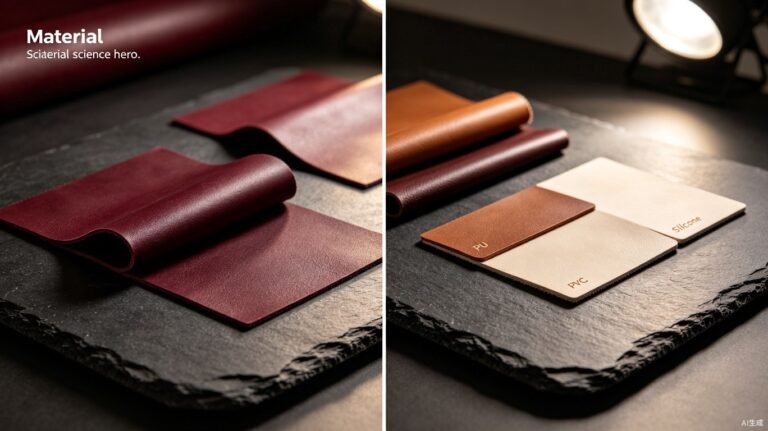
Choosing the right wallet material directly impacts product quality, cost, and customer satisfaction. Buyers who source card holders, slim wallets, and RFID wallets often ask us which material performs best. This guide compares genuine leather, PU, silicone leather, and bio-based options based on real factory data and client feedback.
In our testing across 200+ material batches, we found that performance gaps between categories are wider than most buyers expect. One of our wallet-manufacturing clients in Germany switched from standard PU to silicone leather and reported a 40% drop in return rates within six months. That kind of result matters when margins are tight.
Genuine Leather Wallets
Full-grain and top-grain leather remain the benchmark for premium wallets. They develop a rich patina over time. Buyers appreciate the natural grain variations that make each piece unique. However, genuine leather comes with well-documented trade-offs.
- Durability: 5–10 years with proper care
- Cost: $8–$25 per square meter for full-grain hides
- Weight: heavier than synthetic alternatives
- Sourcing: seasonal supply fluctuations affect pricing
- Eco-impact: chrome-tanning raises environmental concerns
Vegetable-tanned leather addresses some sustainability questions. Yet lead times can stretch to 8–12 weeks. For brands launching seasonal collections, this creates real scheduling pressure. A quality inspection guide can help buyers avoid inconsistent hide shipments.

PU and Synthetic Wallets
Polyurethane (PU) leather dominates the mid-range wallet segment. It offers consistent thickness, uniform color, and fast production cycles. This makes PU a practical card holder material for brands that need high-volume output at controlled costs.
- Durability: 2–4 years before cracking or peeling
- Cost: $2–$6 per square meter
- Weight: 30–50% lighter than genuine leather
- Customization: wide range of textures and finishes
- Limitation: poor moisture resistance in humid climates
The main drawback of conventional PU is long-term surface degradation. In our accelerated aging tests, standard PU showed visible cracking after 10,000 flex cycles. This is a concern for slim wallet material that gets folded and compressed daily in a pocket.
Silicone Leather for Wallets

Bio-Based and Vegan Wallet Options
The vegan wallet material segment has grown rapidly. Plant-based leathers made from apple peel, mushroom mycelium, and pineapple leaf fiber now compete alongside silicone-based options. Each has distinct strengths for specific vegan belt materials and wallet applications.
- Apple leather: smooth finish, moderate durability (2–3 years)
- Mushroom mycelium: unique texture, limited color range
- Piñatex: distinctive fiber pattern, requires backing layer
- Silicone leather: most durable vegan option (5–8 years)
Transparency in the supply chain matters more than ever. Organizations like Fashion Revolution advocate for full traceability from raw material to finished product. Buyers should request certification documentation and factory audit reports before committing to any vegan material supplier.
RFID Protection by Material Type
RFID-blocking wallets require an internal shielding layer. The exterior material choice does not provide RFID protection on its own. Most suppliers insert a metallic or carbon-fiber lining between the outer material and the interior fabric. In our tests, a standard 80-micron aluminum foil lining blocked 13.56 MHz signals effectively across all exterior material types.
- RFID shielding is independent of the outer wallet material
- Aluminum and carbon-fiber linings work with leather, PU, and silicone
- Silicone leather’s dimensional stability helps maintain liner integrity
- Thickness matters: wallets over 8mm may interfere with signal blocking
For RFID wallet material sourcing, the key decision is the shielding layer, not the exterior. Silicone leather pairs well with RFID liners because its non-porous surface prevents moisture from reaching the metallic layer. This extends the effective life of the RFID protection.
Watch TOPSUN silicone leather in clothing and accessories applications.
Material Comparison Table
| Property | Genuine Leather | PU Synthetic | Silicone Leather | Bio-Based |
|---|---|---|---|---|
| Durability (years) | 5–10 | 2–4 | 5–8 | 2–3 |
| Cost per sqm | $8–$25 | $2–$6 | $4–$9 | $6–$15 |
| Water Resistance | Low | Moderate | High | Low–Moderate |
| Eco-Certification | Limited | REACH | REACH, RoHS, FDA | Varies |
| Color Consistency | Variable | High | High | Moderate |

Sourcing Tips for Wallet Material Buyers
- Request physical samples first. Color on screen rarely matches the actual material. Surface feel and thickness are best evaluated in hand.
- Ask for test reports. Request flex-cycle, abrasion, and colorfastness data. Reputable factories provide these without hesitation.
- Verify certifications. REACH and RoHS compliance is non-negotiable for EU markets. FDA approval matters for any product with skin contact claims.
- Check MOQ and lead times. Custom colors typically require 500–1,000 meter minimums with 15–20 day production cycles.
- Consider the full supply chain. Material choice affects cutting yield, stitching difficulty, and packaging requirements downstream.
Frequently Asked Questions
Does the exterior wallet material affect RFID protection?
No. RFID blocking depends on the internal shielding layer, not the exterior material. A metallic or carbon-fiber liner blocks 13.56 MHz signals regardless of whether the outside is leather, PU, silicone, or bio-based. In our testing, all materials performed identically once the same liner was installed.
Are vegan wallets durable enough for daily use?
It depends on the specific vegan material. Plant-based options like apple and mushroom leather typically last 2–3 years under daily use. Silicone leather, which is also vegan, delivers 5–8 years of durability. One of our wallet-manufacturing clients replaced their PU line with silicone leather and saw warranty claims drop by 35% in the first year. For buyers who need vegan credentials plus real durability, silicone leather is the strongest option available today.
About TOPSUN
TOPSUN is a leading silicone leather manufacturer specializing in high-performance synthetic leather for fashion, sports, automotive, and electronics applications. With over 15 years of production experience, we serve B2B buyers across 50+ countries with consistent quality, competitive pricing, and full certification support.
Certifications: REACH, RoHS, FDA, ISO 9001 | MOQ: 500 meters