Prop 65 Leather Compliance: What Triggers a Warning Label
If your leather product ships to California without a Prop 65 warning and contains hexavalent chromium above 0.02 micrograms per day of exposure, you are already in violation. As a regulatory compliance officer who has managed chemical substance reporting across automotive, furniture, and fashion supply chains, I have seen the Proposition 65 enforcement landscape intensify dramatically — 2026 enforcement actions target leather footwear, handbags, and furniture components for chromium VI, phthalates, and lead content. The penalties start at $2,500 per violation per day, and 60-day notice letters from plaintiffs’ firms arrive without prior regulatory inspection. Prop 65 leather compliance is not optional, and for chrome-tanned genuine leather and plasticized synthetic leather, it is structurally difficult to achieve without warning labels.
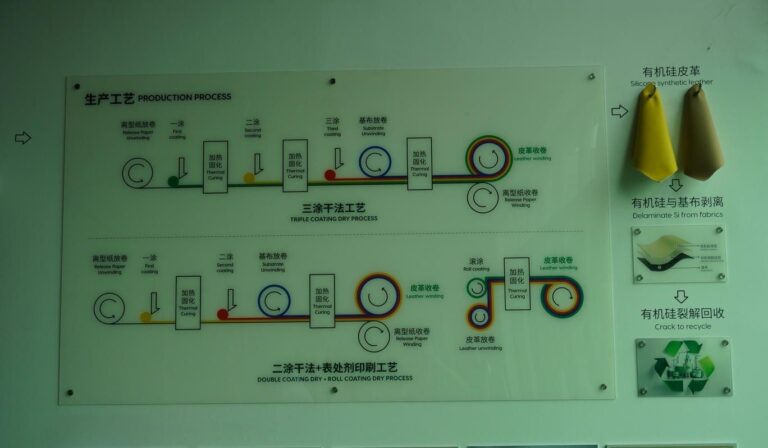
The core problem is that the chemicals Prop 65 regulates are the same chemicals that traditional leather production relies on. Chrome tanning produces trivalent chromium that oxidizes to hexavalent chromium (Cr VI) — a listed carcinogen. PVC leather uses phthalate plasticizers (DEHP, DBP, BBP) — listed reproductive toxicants. PU leather may contain residual formaldehyde and toluene — both listed. Silicone leather contains none of these substances. It is manufactured through a solvent-free dry coating process using 100% silicone polymer, producing zero VOC emissions and containing no chromium, no phthalates, no lead, no formaldehyde, no BPA, and no DMF. This makes Prop 65 compliance a material-selection decision, not a documentation exercise.

Prop 65 Chemicals in Leather: The Full Risk Map
California Proposition 65 maintains a list of approximately 900 chemicals known to cause cancer, birth defects, or reproductive harm. For leather products, the enforcement focus concentrates on six substance categories that appear routinely in chrome-tanned genuine leather and synthetic leather coatings.
| Prop 65 Chemical | Source in Leather | Prop 65 Listing | Silicone Leather |
|---|---|---|---|
| Hexavalent chromium (Cr VI) | Chrome tanning oxidation | Carcinogen (since 1997) | Not present |
| DEHP (phthalate) | PVC leather plasticizer | Reproductive toxicant | Not present |
| DBP, BBP (phthalates) | PVC/PU leather plasticizer | Reproductive toxicants | Not present |
| Lead (Pb) | Dyes, pigments in leather | Reproductive toxicant | Not detectable (RoHS compliant) |
| Formaldehyde | PU leather finishing agents | Carcinogen | Not present |
| Aniline / azo dyes | Leather dyeing process | Listed carcinogens | Silicone-based colorants only |

The Cost of Non-Compliance: Enforcement and Penalties
Proposition 65 is enforced through a unique mechanism: private citizens and advocacy organizations can file 60-day notices and pursue litigation without government involvement. This has created an active plaintiff’s bar that sends thousands of 60-day notices per year targeting consumer products sold in California. In 2020, the Center for Environmental Health secured a consent judgment against Bali Leather requiring warning labels on products containing hexavalent chromium from non-certified tanneries. In 2026, supplemental notices continue targeting footwear manufacturers for Cr VI in leather components.
The financial exposure extends beyond penalties. A single 60-day notice can trigger product recalls, retail delisting, reformulation costs, and legal fees that easily exceed $50,000 per case — even when the defendant ultimately settles. For B2B manufacturers shipping leather goods to California, the compliance question is not whether the material contains listed chemicals, but whether you can prove it does not. This is where the documentation chain matters: a supplier’s verbal assurance is not a defense. You need documented compliance evidence from third-party testing.
Silicone Leather: Zero Prop 65 Chemicals by Material Design
Silicone leather achieves Prop 65 compliance not through post-hoc testing and threshold management, but through material chemistry. The coating is 100% silicone polymer — a material that is inherently free from chromium, phthalates, lead, formaldehyde, and azo dyes. The production process uses no solvents, no plasticizers, and no chrome tanning. Colorants are silicone-based, not aniline or azo dyes. The material is REACH compliant, RoHS compliant (heavy metals not detected), and meets FDA 21 CFR 177.2600 for food-contact safety.
This means Prop 65 compliance for silicone leather is not a margin-management exercise — it is a structural property of the material. You do not need to negotiate safe harbor levels, calculate exposure doses, or affix warning labels. The certification documentation from SGS and Intertek confirms zero content of all listed substances, providing defensible evidence in the event of a 60-day notice. For manufacturers who ship to California, this eliminates an entire category of regulatory risk from the supply chain.


Video: Silicone Leather Eco-Certifications
See the certification process and compliance documentation that supports Prop 65-free claims for silicone leather:
Eco-certification overview — REACH, FDA, and RoHS documentation without Prop 65 chemicals.
About TOPSUN
TOPSUN manufactures silicone leather that is structurally free from all California Proposition 65 listed chemicals — no chromium (zero or hexavalent), no phthalates, no lead, no formaldehyde, no BPA, no DMF, no azo dyes. The solvent-free dry coating process uses 100% silicone polymer and produces zero VOC emissions. Materials carry ISO 10993-5 biocompatibility, FDA 21 CFR 177.2600 food-contact, REACH, RoHS, and EN 71 toy safety certifications — all documented with third-party test reports from SGS and Intertek. MOQ is 500 meters with 7–15 day lead time. Contact our compliance team at info@topsunsiliconeleather.com or WhatsApp +44 744 461 7933 to request Prop 65 compliance documentation.
Frequently Asked Questions
Does silicone leather contain any Prop 65 listed chemicals?
No. Silicone leather is manufactured using 100% silicone polymer coating applied through a solvent-free dry process. The material contains no chromium (the primary Prop 65 risk in genuine leather), no phthalates (the primary risk in PVC leather), no lead, no formaldehyde, no BPA, and no azo dyes. Third-party test reports from SGS and Intertek confirm zero detectable content of all listed substances. This compliance is structural — a property of the material chemistry, not a threshold managed through post-production testing.
What Prop 65 warning is required for chrome-tanned leather products in California?
Chrome-tanned leather products that expose users to hexavalent chromium above the safe harbor level of 0.02 micrograms per day must carry a clear and reasonable warning stating: “WARNING: This product can expose you to chemicals including hexavalent chromium, which is known to the State of California to cause cancer and birth defects or other reproductive harm.” The warning must be affixed to the product, its packaging, or displayed at the point of sale. Products certified as using leather from chrome-free tanning processes, or products made from silicone leather, are not subject to this warning requirement.
Eliminate Prop 65 Risk with Silicone Leather
If your leather products ship to California, Prop 65 leather compliance is not a legal technicality — it is a material selection decision. Replace chrome-tanned genuine leather or plasticized synthetic leather with silicone leather and eliminate the chemical exposure that triggers 60-day notices, warning labels, and settlement costs. Request free A4 swatches with full compliance documentation from SGS and Intertek, and verify the zero-content claims through your own testing protocol. Contact TOPSUN at info@topsunsiliconeleather.com or WhatsApp +44 744 461 7933 to request Prop 65 compliance documentation and material samples for your next production run.