The most specified color in commercial upholstery isn’t black — it’s leather dark brown. Walk into any hotel lobby, restaurant, or corporate lounge, and you’ll see why. Dark brown communicates warmth, durability, and understated luxury that no other shade matches. But here’s what designers learn the hard way: dark brown leather is also the color most likely to betray its age. UV exposure pulls reddish undertones to the surface. Body oils create dark patches. Cleaning products strip the topcoat unevenly. Within 3 years, that carefully curated warm brown sofa looks tired — and the replacement cycle starts over.
Request Dark Brown Leather Swatches
Why Dark Brown Leather Dominates Commercial Upholstery
The global upholstery leather market reached $14.8 billion in 2022 and continues growing at 5.6% CAGR. Dark brown accounts for a disproportionate share of that volume — and for good reason. Dark brown hides minor scuffs better than black, warms up clinical spaces better than gray, and pairs with virtually any wood tone or metal finish. For specifiers working on furniture and sofa applications, dark brown is the default — the safe, versatile choice that clients rarely reject.
But “safe” and “versatile” describe the color, not the material. The same dark brown specified in genuine leather, PU leather, and silicone leather will perform radically differently over a 5-year commercial lifecycle. The color choice is easy. The material specification underneath that color is where projects succeed or fail.

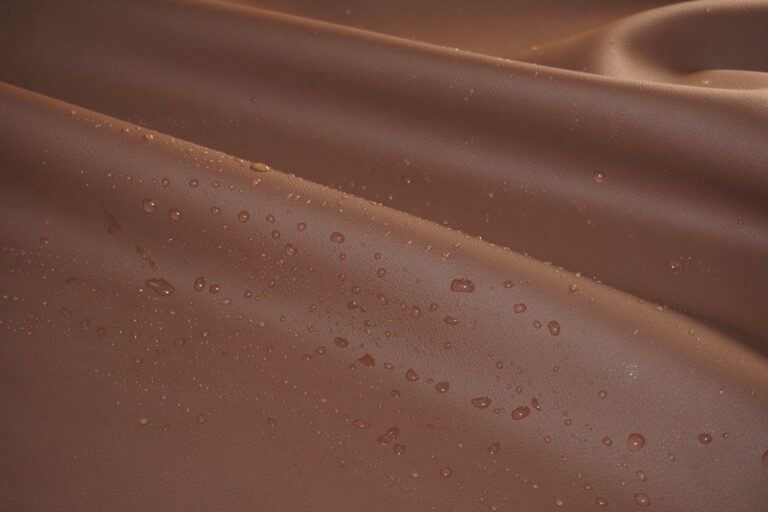
Water droplet test on dark brown leather — silicone leather’s non-porous surface repels liquids that stain conventional materials
The Color Stability Problem: Why Dark Brown Fades Differently
Dark brown leather fades — but not uniformly. Unlike black, which simply lightens, dark brown leather undergoes tonal shifts that are far more visible to the human eye. The brown dye molecules degrade at different rates, revealing reddish or yellowish undertones beneath. A sofa placed near a window develops a visible “sun stripe” within 18 months. The back of a chair darkens where heads rest, while armrests lighten from friction.
Color fastness testing per AATCC and ISO standards reveals the problem quantitatively. ISO 105-B02 xenon arc testing shows that conventional dark brown PU leather drops from Grade 4 to Grade 2–3 after 300 hours of accelerated UV exposure — a level easily reached in a sunlit restaurant within a year. Genuine dark brown leather performs slightly better initially but requires ongoing conditioning to maintain its color, adding maintenance cost and labor.
Silicone leather avoids this problem structurally. The pigment is locked into the silicone polymer matrix, which is inherently UV-stable. Our dark brown silicone leather maintains Grade 4.5 color fastness after 1,000+ hours of ISO 105-B06 testing — the equivalent of 5–7 years of real-world indoor UV exposure. For context on why this matters across material types, our silicone vs PU comparison breaks down the chemistry.

Martindale abrasion tester — dark brown leather is tested to 200,000+ cycles to verify color retention under friction
Genuine vs PU vs Silicone Dark Brown Leather: 5-Year Cost Analysis
Let’s quantify what dark brown leather actually costs per usable year in a commercial setting. The calculation includes material, installation, maintenance, and replacement — not just the invoice price.
| 5-Year Cost Factor | Genuine Leather | PU Leather | Silicone Leather |
|---|---|---|---|
| Material cost (per m²) | $20–60 | $3–15 | $10–25 |
| Expected lifespan (commercial) | 5–7 years | 3–4 years | 10+ years |
| Replacements in 10 years | 1–2 | 2–3 | 0 |
| Annual conditioning required | Yes ($2–5/m²/yr) | No | No |
| Cleaning method | Specialized products | Mild soap only | Water, bleach, alcohol |
| 10-year TCO (per m²) | $50–90 | $20–40 | $12–28 |
Over 10 years, dark brown silicone leather costs roughly 40% less than genuine leather and 30% less than PU — before counting the labor and downtime of each replacement cycle.
The genuine leather premium buys natural patina — but in commercial settings, that patina often looks like wear rather than character. PU leather’s low upfront cost evaporates with the first replacement. For projects where leather sofa quality must hold up under daily commercial use, the TCO math consistently favors silicone.

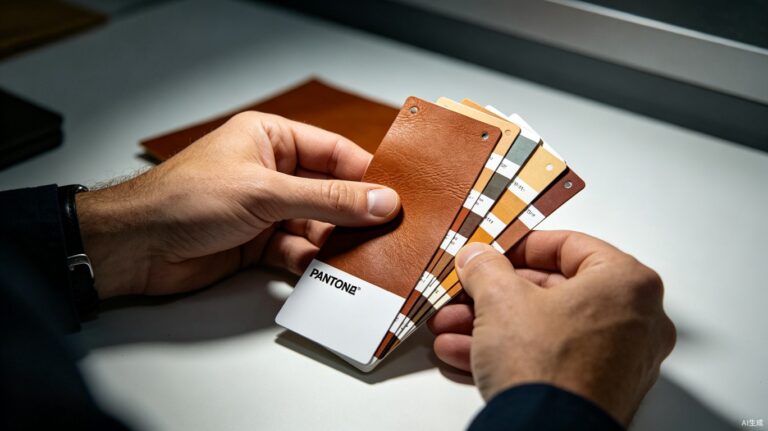
Warm-tone swatch set — dark brown variants are Pantone-matched for consistency across production batches
Design Specifications for Dark Brown Leather That Lasts
When specifying dark brown leather for commercial upholstery, include these performance requirements in your material spec sheet:
- Color fastness to light: ISO 105-B06 Grade 4.5 or higher (demand the lab report, not a data sheet claim)
- Color fastness to rubbing: ISO 11640 Grade 4–5, dry and wet
- Abrasion resistance: Martindale ≥ 100,000 cycles for light commercial, ≥ 200,000 for heavy traffic
- Color consistency: Delta E ≤ 1.5 across all rolls in a single order; ≤ 1.0 for reorders
- Cleanability: Specify bleach-safe and alcohol-disinfectant compatible — critical for hospitality and healthcare
- Color reference: Lock in a Pantone or RAL code, not a verbal description like “chocolate brown”
For multi-unit projects — hotel chains, restaurant groups, corporate campuses — color consistency across orders is the single biggest design risk. Specifying color for leather sofas without a locked Pantone reference guarantees shade variation between shipments. Our cleaning and maintenance guide provides additional specification criteria for long-term appearance retention.

Commercial sofa in dark brown leather — the color works in any setting, but material choice determines whether it stays this way
Frequently Asked Questions
Does dark brown silicone leather look like genuine leather?
Yes — with the right texture specification. Silicone leather can be embossed with cowhide, pigskin, or sheepskin grain patterns that closely replicate the visual and tactile experience of genuine leather. For dark brown specifically, the warmth and depth of color reads as natural because the silicone coating allows for subtle tonal variation in the surface. Most observers cannot distinguish dark brown silicone leather from genuine leather in a side-by-side comparison — and the silicone version maintains that appearance years after genuine leather would have shown wear.
How do you match dark brown leather color across multiple furniture orders?
Specify a Pantone or RAL color code and require Delta E ≤ 1.0 batch consistency with spectrophotometer verification on every production run. Archive a physical swatch from the first order and require the supplier to match against it for reorders. At TOPSUN, we maintain color sample archives for every client project — so a reorder 18 months later matches the original installation. This is particularly critical for phased projects where furniture is purchased in multiple tranches.
Designing for Permanence
Leather dark brown is the workhorse of commercial upholstery — warm enough for hospitality, professional enough for corporate, durable enough for high traffic. But the color alone doesn’t deliver longevity. The material underneath determines whether that dark brown sofa looks intentional in year 7 or exhausted by year 3. Specify color fastness data, lock in Pantone references, and run the 10-year TCO before you commit. The right dark brown leather should look better at year 5 than the wrong one looks at year 2 — and cost less over the project lifecycle.
Get a Dark Brown Leather Quote
About TOPSUN
TOPSUN manufactures dark brown silicone leather for commercial furniture, hospitality upholstery, and corporate interior projects where color stability and cleanability are design requirements, not afterthoughts.
Every dark brown order is Pantone-matched to Delta E ≤ 1.0, verified by spectrophotometer, and backed by ISO 105-B06 Grade 4.5 color fastness, 200K+ Martindale cycles, and bleach-safe cleaning certification. Free A4 swatches shipped worldwide via DHL.