Here’s what most procurement teams get wrong about artificial leather: they compare unit prices instead of cost per usable year. A $4/m² PU leather that needs replacing in 3 years costs more than silicone leather at $12/m² that lasts a decade. The math is simple — but the synthetic leather market, projected to hit $50 billion in 2026, is anything but. With PU, PVC, microfiber, and silicone all competing for your purchase order, choosing the wrong type doesn’t just waste budget. It creates warranty exposure, compliance risk, and supply chain headaches that compound for years.
The $50B Question: Why Artificial Leather Type Matters More Than Price
The synthetic leather market is on track to reach $50.26 billion in 2026 and $89.91 billion by 2034, growing at 7.54% CAGR according to Grand View Research. That growth signals demand — but it also signals fragmentation. PU leather alone holds 57% of global revenue share, yet it’s the material most likely to fail within 5 years of commercial installation.
The automotive segment is growing at 20.15% CAGR, driven by EV interior demands for low-VOC, durable materials. Footwear accounts for 29% of global artificial leather revenue. Each application has different performance requirements, and treating all synthetic leather as interchangeable is the most expensive mistake a sourcing manager can make. If you’re new to material categories, our silicone leather introduction breaks down the basics.

Artificial leather rolls on the production floor — each type (PU, PVC, silicone) requires different coating lines and quality protocols
PU vs PVC vs Microfiber vs Silicone: A Procurement Comparison
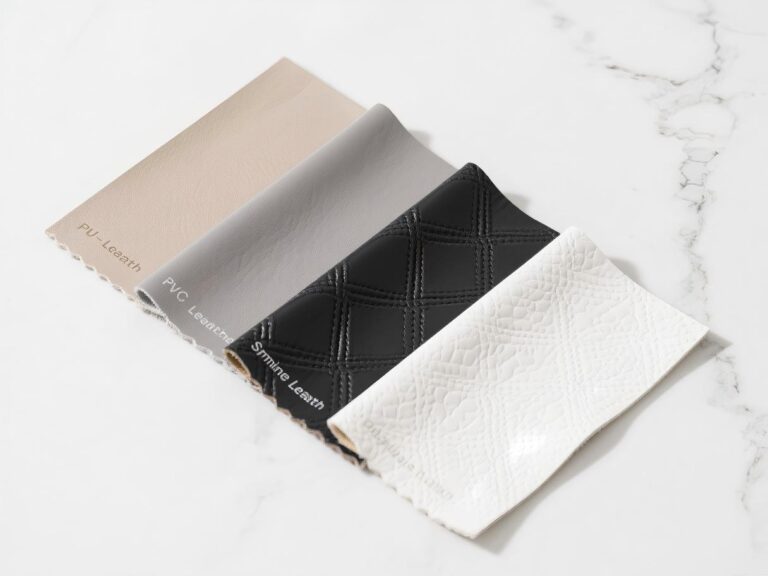
Four artificial leather types dominate B2B procurement. Each has a distinct cost-performance profile, and the cheapest option on paper rarely wins on total cost of ownership. Here’s how they actually compare when you’re buying 500+ meters for a production run.
| Procurement Factor | PVC Leather | PU Leather | Microfiber | Silicone Leather |
|---|---|---|---|---|
| Price range (per m²) | $2–6 | $3–15 | $8–20 | $10–25 |
| Expected lifespan | 2–3 years | 3–5 years | 5–7 years | 10+ years |
| VOC emissions | High (plasticizers) | Moderate (DMF) | Low–moderate | Zero |
| Hydrolysis resistance | Moderate | Poor | Moderate | Excellent |
| Temperature range | -10°C to 60°C | -20°C to 80°C | -20°C to 80°C | -40°C to 250°C |
| Recyclable | No | Limited | Limited | Yes |
The pattern is clear: you get what you pay for in upfront cost, but you pay again — and again — for cheaper materials. For a detailed chemistry breakdown, see our silicone vs PU comparison page.

Coating and calendering line — the production method differs significantly between PU, PVC, and silicone artificial leather
The 5-Year TCO Trap: Why Cheap Artificial Leather Costs More
Let’s run the numbers a procurement manager actually cares about. Say you’re sourcing artificial leather for 200 commercial sofa units in a hotel chain. Each unit needs roughly 8 m² of material.
PU leather scenario: At $5/m², material cost is $40 per sofa. But PU leather in hospitality environments typically needs replacement every 3–4 years due to peeling, cracking, and hydrolysis. Over 10 years, that’s 3 replacements — $120 in material alone, plus labor, downtime, and disposal costs. Real TCO: $200+ per sofa.
Silicone leather scenario: At $15/m², material cost is $120 per sofa. Silicone leather’s 10+ year service life means zero replacements in the same period. It’s also bleach-safe and alcohol-disinfectant compatible, so cleaning costs drop. Real TCO: $130–140 per sofa.
Across 200 sofas, the PU “savings” become a $12,000+ loss over 10 years — before accounting for guest complaints, maintenance labor, and brand damage from visible wear.
This calculation applies equally to furniture upholstery, automotive interiors, and commercial seating. The unit price gap shrinks every year as silicone leather production scales, but the lifespan gap remains structurally fixed — silicone polymers simply don’t hydrolyze, crack, or migrate plasticizers the way PU and PVC do.

Physical testing lab — every artificial leather batch undergoes Martindale, flexing, and tensile tests before shipment
VOC, Compliance, and Supply Chain Risks by Material Type
Compliance risk is where cheap artificial leather becomes genuinely dangerous. PVC leather contains phthalates and chlorine — both increasingly restricted under EU REACH and California Prop 65. PU leather production uses DMF (dimethylformamide), a reproductive toxicant subject to tightening occupational exposure limits. If you’re sourcing for automotive interiors, VOC compliance isn’t optional — it’s a homologation requirement.
Silicone leather sidesteps these issues entirely. It’s produced with a solvent-free dry coating process, contains zero plasticizers, and meets REACH, RoHS, and FDA 21 CFR 177.2600 food-contact standards. For buyers managing eco-friendly material specifications, that eliminates an entire category of compliance documentation.
Supply chain risk also differs sharply. PU and PVC prices fluctuate with petroleum markets. Silicone leather’s raw material base is more stable, and established manufacturers like TOPSUN maintain 500,000+ meters monthly capacity with 7–15 day lead times. When you’re managing a production schedule, predictable supply matters as much as predictable pricing.

Material structure comparison — silicone leather’s cross-section shows why it resists hydrolysis where PU breaks down
Frequently Asked Questions
Is silicone leather considered artificial leather?
Yes. Silicone leather is a synthetic, animal-free material — it fits the artificial leather category by definition. What separates it from PU and PVC is the polymer chemistry: silicone is inherently UV-stable, hydrolysis-proof, and solvent-free, while PU and PVC rely on additives that deplete over time. For procurement purposes, treat silicone leather as the premium tier within the artificial leather category — higher upfront cost, dramatically lower lifecycle cost.
What’s the cheapest artificial leather type that still meets automotive specs?
That depends on which specs you’re meeting. For FMVSS 302 flame retardancy alone, mid-range PU leather ($8–12/m²) can pass. But if you need to meet VDA 270 odor, VDA 277 VOC, and DIN 75201 fogging requirements simultaneously — standard for European OEMs — PU leather requires expensive post-treatment that erases the price advantage. Silicone leather meets all four standards inherently, with no additional processing. In our experience, once automotive buyers factor in testing failures and rework costs, silicone leather’s effective cost per accepted meter is actually lower than treated PU.
Choose Once, Choose Right
The artificial leather market gives you more choices than ever — and more ways to make an expensive mistake. PU, PVC, microfiber, and silicone each have legitimate use cases, but pretending they’re interchangeable on price alone is how procurement teams end up explaining warranty claims to their CFO. Run the 5-year TCO before you sign the PO. Demand VOC test reports before you commit to a material spec. And if longevity, compliance, and total cost matter to your project, artificial leather that costs more upfront and lasts three times longer isn’t the expensive option — it’s the smart one.
About TOPSUN
TOPSUN supplies silicone-based artificial leather to B2B manufacturers across automotive, furniture, healthcare, and consumer goods — with 500,000+ meters monthly capacity and 7–15 day lead times from three production bases in China.
Every shipment includes REACH, RoHS, FDA, and ISO 10993 compliance documentation, with Martindale abrasion (200K+ cycles), UV resistance (1,000+ hours), and VOC emission test reports verified by SGS and Intertek.