As a production manager who has sourced leather materials for furniture, automotive, and consumer goods manufacturing, I’ve seen the same costly mistake dozens of times: a buyer quotes “leather at $4.50 per yard” and another supplier quotes “$4.95 per meter” — and the buyer picks the cheaper-looking yard price without realising they’re paying 12% more per square foot. The yard looks cheaper. It isn’t.
The “leather by the yard” market is dominated by synthetic materials — PU rexine, PVC vinyl, and increasingly silicone leather — sold in continuous rolls measured by linear yard (36 inches) or linear meter (39.37 inches). But the unit you buy in isn’t the unit you use. Your production team cuts panels by square foot. Your finance team budgets by square meter. Your supplier quotes by yard or meter. Every conversion is an opportunity for error — and errors compound across 5,000-meter orders.
The sourcing principle: Never compare leather prices across different units without converting to a common denominator: cost per square foot or cost per square meter. The conversion formula is simple, but most buyers skip it — and overpay by 8–15% on volume orders.
The Unit Conversion Reference Every B2B Buyer Needs
Leather is sold in three primary units. Here’s how they convert:
| Unit | Length | Width (typical) | Area per unit | Conversion to sq ft |
|---|---|---|---|---|
| Linear yard (US) | 36 inches (0.914m) | 54 inches (1.37m) | 13.5 sq ft (1.254 m²) | 1 yard = 13.5 sq ft |
| Linear meter (EU/Asia) | 39.37 inches (1.0m) | 54 inches (1.37m) | 14.63 sq ft (1.359 m²) | 1 meter = 14.63 sq ft |
| Square foot (hide) | Variable (irregular) | Variable | 1 sq ft | 1 sq ft = 1 sq ft |
| Square meter (EU hide) | Variable (irregular) | Variable | 10.764 sq ft | 1 m² = 10.764 sq ft |
The Critical Difference: Linear vs. Square Measurement
This is where most conversion errors happen. Synthetic leather (PU, PVC, silicone) is sold by linear yard or meter — the length of the roll, regardless of width. Animal hide leather is sold by square foot or square meter — the actual area, because hides are irregular shapes.
When a supplier quotes “$4.50/yard” for synthetic leather at 54-inch width, and another quotes “$4.95/meter” at the same width, here’s the real comparison:
= $4.50 ÷ 13.5 sq ft = $0.333/sq ft
= $4.95 ÷ 14.63 sq ft = $0.338/sq ft
But on 5,000 meters (73,150 sq ft): difference = $366
Now reverse the scenario — what if the widths differ?
On 5,000 meters: savings = $2,052

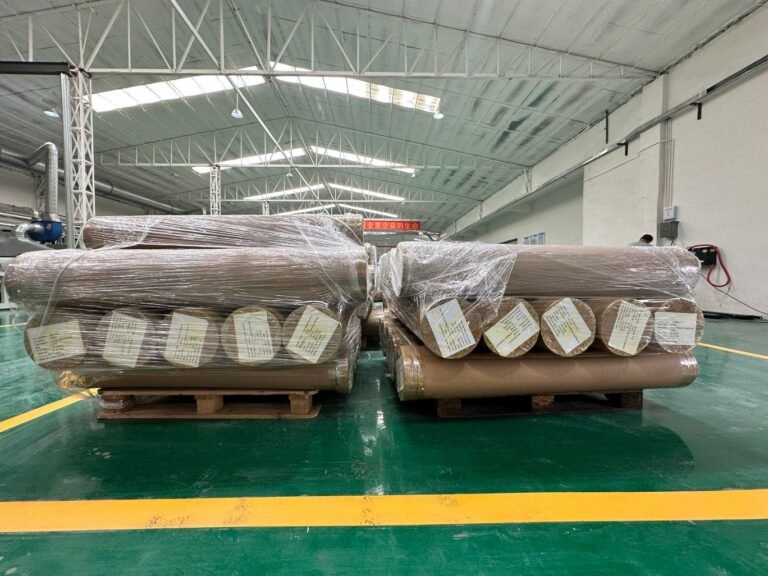
Standardized roll format — consistent width means predictable yard/meter conversion and accurate cost calculation.
Leather by the Yard: Pricing Benchmarks by Material Type
| Material | Price per Yard (54″) | Price per Meter (54″) | Effective per sq ft | MOQ |
|---|---|---|---|---|
| PVC vinyl leather | $1.00–$3.00 | $1.10–$3.30 | $0.07–$0.22 | 500–1,000m |
| PU faux leather | $1.50–$4.00 | $1.65–$4.40 | $0.11–$0.30 | 500–1,000m |
| Silicone leather (TOPSUN) | $6.00–$12.00 | $6.60–$13.20 | $0.44–$0.89 | 500m |
| Top-grain cowhide (by sq ft) | N/A (sold by hide) | N/A | $3.00–$8.00 | 500–2,000 sq ft |
| Full-grain cowhide (by sq ft) | N/A (sold by hide) | N/A | $5.00–$15.00 | 500+ sq ft |
Yield matters more than unit price: Synthetic leather sold by the yard yields 92–98% usable material (rectangular rolls, no defects). Animal hide sold by the square foot yields only 70–85% (irregular shape, natural defects). A $3/sq ft hide with 75% yield actually costs $4.00/sq ft usable — more than premium silicone leather at $0.89/sq ft with 97% yield.

Rewinding and slitting — rolls cut to buyer-specified widths, optimising yield for each production line.
5 Questions to Ask Before Buying Leather by the Yard
- What is the roll width? Never accept a per-yard or per-meter quote without knowing the width. A $4/yard at 54″ is 12% more expensive per square foot than $4/yard at 60″. Always calculate cost per square foot before comparing suppliers.
- What is the thickness specification? Thickness affects weight, shipping cost, and usability. TOPSUN offers 0.23–2.0mm with ±0.05mm tolerance. Wider tolerance means more waste in die-cutting and more rejected panels.
- What is the yield factor? For synthetic leather, ask: “What percentage of the roll is usable per your QC standards?” The answer should be 95%+. For genuine leather, ask: “What is the average hide size and what is your grading rejection rate?”
- Is the price FOB or landed? FOB (Free On Board) means you pay shipping and duties. Landed (DDP) means the supplier handles everything. A $4/yard FOB price can become $5.20/yard landed after ocean freight, duties, and customs clearance. Always compare landed costs.
- Can you provide a 12-month price lock? Leather prices fluctuate with raw material costs. A supplier who offers 12-month fixed pricing eliminates budget volatility — particularly valuable for long production runs.

Production-scale facility — volume capacity enables stable per-yard pricing and 12-month price locks for B2B accounts.
Substrate selection guide — how substrate choice affects yard pricing, yield, and end-product performance.
About TOPSUN
TOPSUN manufactures silicone leather sold by the linear meter (convertible to yards) at a 60,000+ m² facility in Dongguan, Yichang, and Xiangyang, China. We produce 500,000+ meters monthly across 10+ automated lines, with standard roll widths of 1350–1800mm (53–71 inches). Our pricing is transparent: $6.60–$13.20 per linear meter ($0.44–$0.89 per square foot), with volume tier discounts at 2,000m and 5,000m, and 12-month fixed-price quotes for annual contract accounts.
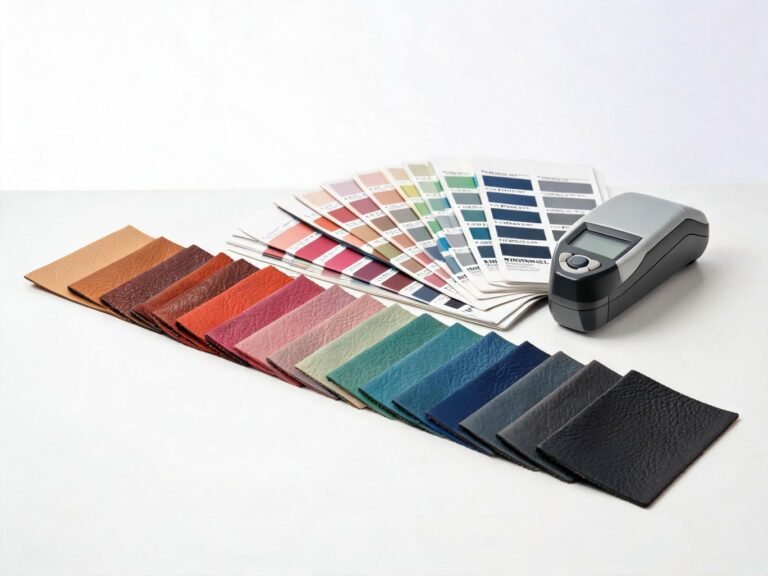
Material specifications: thickness 0.23–2.0mm with ±0.05mm tolerance, Martindale abrasion ≥200,000 cycles, yield factor 97%+ (rectangular rolls, no natural defects), Delta E ≤1.0 colour accuracy across batches. Custom slitting to buyer-specified widths available. Lead time 7–15 days standard. MOQ 500 meters. Free A4 swatch samples shipped worldwide via DHL/FedEx. Certifications: ISO 10993-5, REACH, FDA 21 CFR 177.2600, EN 13733 Class 4 — all SGS/Intertek verified.
Technical data sheets | Factory production capabilities | Request a per-yard quote
Frequently Asked Questions
Do you price silicone leather by the yard or by the meter?
We price by the linear meter (1 meter = 1.094 yards), which is the standard international B2B unit. For US-based buyers who prefer yard pricing, we provide converted quotes: simply multiply the per-meter price by 0.914 to get the per-yard equivalent. Our standard roll widths are 1350mm (53″) and 1800mm (71″), and we can slit to custom widths for your production line. All quotes include cost-per-square-foot conversion for easy comparison with other suppliers.
What’s the yield factor for TOPSUN silicone leather rolls?
Our silicone leather rolls have a yield factor of 97%+ — meaning 97% or more of the purchased material is usable in production. This is significantly higher than genuine leather (70–85% yield due to irregular hide shapes and natural defects) and higher than most PU/PVC leather (90–95% yield due to coating defects and edge trim). The high yield comes from our controlled manufacturing process: consistent rectangular rolls, ±0.05mm thickness tolerance, and 100% QC inspection of every roll before shipment.
Can I order custom widths to reduce waste in my production line?
Yes. We offer custom slitting services — our rewinding and slitting machine can cut rolls to your specified width, optimising yield for your specific panel cutting pattern. For example, if your furniture production uses 48-inch-wide cutting dies, we can supply 49-inch-wide rolls (1-inch trim allowance) instead of standard 54-inch rolls, eliminating 6 inches of waste per linear yard. Custom slitting adds 1–2 days to lead time. MOQ for custom-width orders: 1,000 meters.
Get a Per-Yard Quote with Square-Foot Conversion
Receive a transparent pricing quote with cost-per-square-foot conversion, yield factor data, and 12-month price lock options.
Download our technical data sheets for full specifications, or explore our product collections.