Microfiber material earns its reputation. With Martindale abrasion ratings of 50,000-150,000 cycles, tensile strength from a uniform fiber matrix, and a service life of 8-10+ years, it outperforms standard PU leather by a wide margin. For many B2B furniture and automotive buyers, microfiber leather is the “good enough” choice — durable, affordable, and readily available from established suppliers. But in our materials lab, we’ve identified five specific limitations where microfiber material fails and silicone leather doesn’t. These aren’t edge-case scenarios; they’re the failure modes that cause warranty claims, rework, and specification revisions in real production environments.
Request Microfiber vs Silicone Samples
What Makes Microfiber Material Strong — and Where It Breaks
Microfiber material’s strength comes from its dense, non-woven fiber core — typically ultra-fine polyester or polyamide fibers bundled into a matrix that mimics the collagen structure of genuine leather. This construction delivers high tensile strength, tear resistance, and a surface that accepts PU coatings effectively. Automotive-grade microfiber achieves Taber abrasion of ≥100,000 cycles and Bally cold flex fatigue of 150,000+ cycles at -30°C — impressive numbers that explain why brands like Teijin and Huafon have built billion-dollar businesses on this material.
But the fiber core that gives microfiber material its strength is also its weakness. Those ultra-fine polyester fibers have a glass transition temperature around 70°C and begin deforming at 150°C. The PU coating that bonds to the fiber surface is subject to the same hydrolysis mechanism that degrades standard PU leather — just slower. And the non-woven matrix, while uniform, is still an organic polymer structure that responds to environmental stressors. For a detailed comparison, see our silicone vs PU analysis which covers the underlying chemistry.

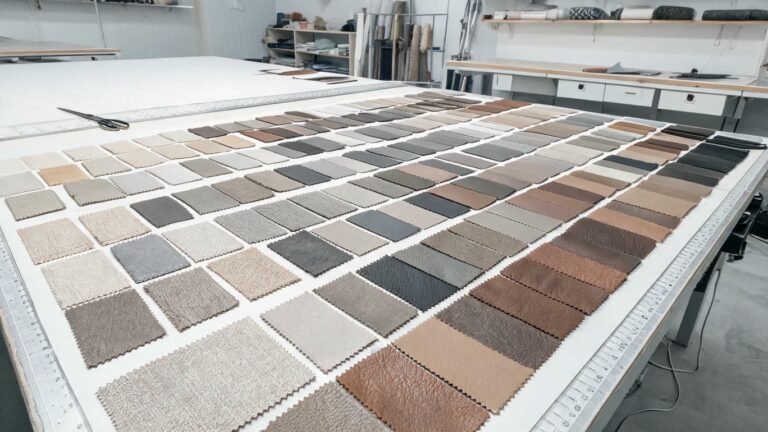
Leather swatch display showing the color range available across microfiber and silicone material categories.
The Hydrolysis Problem Microfiber Can’t Solve
Here’s the critical distinction: microfiber leather hydrolyzes slower than standard PU, but it still hydrolyzes. The PU coating on the microfiber substrate contains ester bonds that react with atmospheric moisture. Premium microfiber brands use polycarbonate-based PU to improve hydrolysis resistance — and it does extend the timeline from 2-3 years to 5-8 years depending on humidity. But the chemistry is fundamentally the same: organic ester bonds breaking under moisture exposure.
Our accelerated hydrolysis testing shows premium microfiber leather developing surface stiffening at 4-6 years equivalent — silicone leather shows zero change at the same exposure level because Si-O bonds are inert to hydrolysis.
In practice, this means microfiber material specified for humid-climate furniture, marine interiors, or medical environments will eventually exhibit the same peeling and cracking as standard PU — just on a longer timeline. One of our furniture clients in Southeast Asia replaced microfiber upholstery after 5 years when the PU coating began delaminating from the fiber substrate. The silicone leather replacement is now in year 3 with no surface change. For more on this application transition, see our furniture sofa applications page.
Temperature and Chemical Sensitivity in Microfiber Material
Microfiber material’s temperature ceiling is the third limitation. Polyester fibers deform at 150°C and begin glass transition at 70°C. In automotive interiors, dashboard and door panel surfaces regularly exceed 70°C in summer parking conditions. Microfiber material in these locations loses structural integrity over time — the fibers compress, the surface texture flattens, and the PU coating develops stress cracks from differential thermal expansion between fiber and coating.
Chemical sensitivity is the fourth limitation. Microfiber material is vulnerable to chlorine bleach, which weakens the polyester fibers and causes color fading. Fabric softeners coat the fibers and reduce the material’s moisture-wicking properties. Organic solvents can affect the polyamide components in blended microfiber constructions. In medical and food-service environments where regular disinfection with bleach or alcohol-based solutions is standard, microfiber material degrades faster than the specification assumes. For applications requiring chemical resistance, see our medical healthcare applications — silicone leather is bleach-safe and alcohol-disinfectant compatible.

Microfiber leather furniture application — where hydrolysis and temperature limits eventually surface.
Microfiber vs Silicone: The Spec Gap That Matters
The fifth limitation is the most fundamental: microfiber material’s VOC profile. The PU coating applied to the microfiber substrate uses solvents — typically DMF (dimethylformamide) — in the manufacturing process. Residual solvents off-gas for months after installation, contributing to indoor air quality concerns documented by the EPA’s chemical risk assessment framework. Automotive OEMs increasingly require VDA 277 VOC compliance, and microfiber brands must invest in post-processing to reduce residual solvent levels. Silicone leather is manufactured through a solvent-free dry coating process — zero VOCs by design, not by post-treatment.
| Performance Metric | Microfiber Leather | Silicone Leather | Performance Gap |
|---|---|---|---|
| Martindale abrasion | 50K-150K cycles | 200K+ cycles | 33-300% higher |
| Hydrolysis resistance | Moderate (5-8 yrs) | Excellent (10+ yrs) | Fundamentally inert |
| Temperature range | -30°C to 80°C | -40°C to 250°C | 3x wider range |
| Chemical resistance | Vulnerable to bleach | Bleach-safe | Complete resistance |
| VOC emissions | Contains residual DMF | Zero VOC | Solvent-free process |
The spec gap isn’t incremental — it’s categorical. Microfiber material improves on PU by using a better substrate, but the coating chemistry remains organic and subject to the same degradation pathways. Silicone leather changes the coating chemistry entirely, moving from organic C-C and C-O bonds to inorganic Si-O bonds that resist hydrolysis, UV, and thermal stress at the molecular level. For a full material overview, see our silicone leather introduction and the silicone vs microfiber comparison.

Finished goods warehouse — where silicone leather orders ship with zero-VOC documentation that microfiber can’t match.
Factory quality control — see the testing protocols that verify silicone leather outperforms microfiber material across five critical metrics.
Frequently Asked Questions
Is microfiber leather better than silicone leather for automotive interiors?
Microfiber leather meets many automotive specifications and is widely used by OEMs. However, it falls short in three areas critical to EV and premium interiors: VOC emissions (microfiber contains residual DMF solvents), temperature resistance (microfiber deforms above 80°C vs silicone’s 250°C), and hydrolysis resistance (microfiber’s PU coating eventually degrades). Silicone leather meets FMVSS 302, VDA 277, and DIN 75201 inherently — without post-processing. For EV cabin air quality standards, silicone’s zero-VOC profile is becoming the deciding factor.
Does microfiber material contain PVC or phthalates?
Standard microfiber leather uses a PU (polyurethane) coating on a polyester/polyamide fiber substrate — it does not typically contain PVC. However, some microfiber blends incorporate PVC layers for cost reduction, so buyers should request a material composition declaration. Phthalates are primarily a PVC issue; PU-coated microfiber generally avoids phthalates but may contain other plasticizers. Silicone leather contains neither PVC nor phthalates nor plasticizers — its flexibility is intrinsic to the silicone polymer. See our eco-friendly silicone leather page for the full chemical compliance summary.
The Upgrade Path: From Microfiber to Silicone
Microfiber material isn’t a bad choice — it’s a better PU. But “better PU” still means organic coatings that hydrolyze, fiber cores that deform under heat, and manufacturing processes that leave residual solvents. When a specification calls for 10+ year service life in humid environments, bleach-safe cleanability, zero-VOC emissions, or temperature resistance above 80°C, microfiber hits a wall that no amount of brand engineering can overcome. The material that clears all five limitations simultaneously — without chemical additives, without post-processing, without compromising on tactile quality — is silicone leather. That’s not a marketing claim; it’s bond energy chemistry. And in B2B sourcing, chemistry beats claims every time.
Download Comparison Spec Sheet
About TOPSUN
TOPSUN manufactures silicone leather as an upgrade path from microfiber material for automotive, furniture, medical, and consumer electronics applications where hydrolysis resistance, temperature stability, and zero-VOC compliance are specification requirements.
200K+ Martindale cycles, -40°C to 250°C operating range, bleach-safe cleanability, ISO 10993-5 biocompatibility, EN 13773 Class 4 flame retardant — verified by SGS and Intertek.