Small leather goods — wallets, cardholders, passport covers, key fobs, coin purses — are the highest-volume, lowest-margin category in leather manufacturing. A single production run can mean 5,000 to 50,000 units, each one small enough that a 1mm defect in material coating or edge finish becomes proportionally visible to the end consumer. In our production oversight of small leather goods runs across PU, PVC, and silicone leather materials, we’ve tracked a consistent pattern: quality holds steady through the prototype and pilot phases (50-200 units), then cracks at approximately 500 units. That’s the inflection point where material batch consistency, coating uniformity, and storage stability diverge — and where AQL 2.5 pass rates plummet from 98% to 82% for PU-based small leather goods. The root cause isn’t workmanship. It’s material chemistry.
Request Small Goods Material Samples
The 500-Unit Breaking Point in Small Leather Goods
The scaling problem in small leather goods is fundamentally a material problem. At prototype volume (under 100 units), a skilled craftsman works from a single material batch, hand-selects the cleanest sections, and compensates for minor coating variations during cutting and stitching. The result looks flawless — because it is, at that scale. But volume production operates under different physics. A 5,000-unit run of leather small goods requires multiple material rolls from potentially different production batches. Die-cutting machines process material at speeds where edge quality depends on coating consistency, not operator skill. And the material itself has been sitting in warehouse storage — where PU leather begins hydrolytic breakdown and PVC experiences plasticizer migration — before it ever reaches the cutting table.
The industry standard for small leather goods quality acceptance is ISO 2859-1 (AQL 2.5), which permits a maximum of 2.5% defective units in a sampled inspection lot. In our tracking data, PU leather small goods runs consistently exceed this threshold at 500+ units, driven by three material-specific defect categories that don’t appear at prototype volume. PVC runs fail earlier, at approximately 300 units, due to faster storage degradation. Silicone leather runs maintain 96-98% AQL pass rates through 10,000+ unit volumes — not because the material is inherently superior, but because its chemistry eliminates the failure modes that break PU and PVC at scale.
Where Material Defects Multiply at Scale
The defects that drive AQL failures in small leather goods production aren’t random — they’re predictable, material-specific, and directly tied to polymer chemistry. Understanding which defects hit which materials at which production volume lets procurement teams specify the right material before the first die is cut.
| Defect Category | PU Leather | PVC Leather | Silicone Leather | Onset Volume |
|---|---|---|---|---|
| Batch color variation | Delta E 2.0-3.5 between rolls | Delta E 2.5-4.0 between rolls | Delta E ≤1.0 (batch-controlled) | 500+ units |
| Edge fraying after die-cut | Coating separates at cut edge | Plasticizer bleed at edge | Clean cut, no separation | 300+ units (PU/PVC) |
| Embossing pattern drift | Pattern flattens under die pressure | Pattern distorts with heat | Pattern retention ≥95% | 1,000+ units (PU/PVC) |
| Storage degradation | Hydrolysis begins at 3-6 months | Plasticizer migration at 2-4 months | No degradation at 12+ months | Pre-production (PU/PVC) |
| Sewing needle drag | Coating tears at stitch holes | Surface dimples at stitch line | Clean needle penetration | 200+ units (PU/PVC) |
Sewing defects account for 45-65% of all quality rejects in small leather goods production. Material chemistry determines whether stitching damages the surface — a factor invisible at prototype volume but dominant at scale.

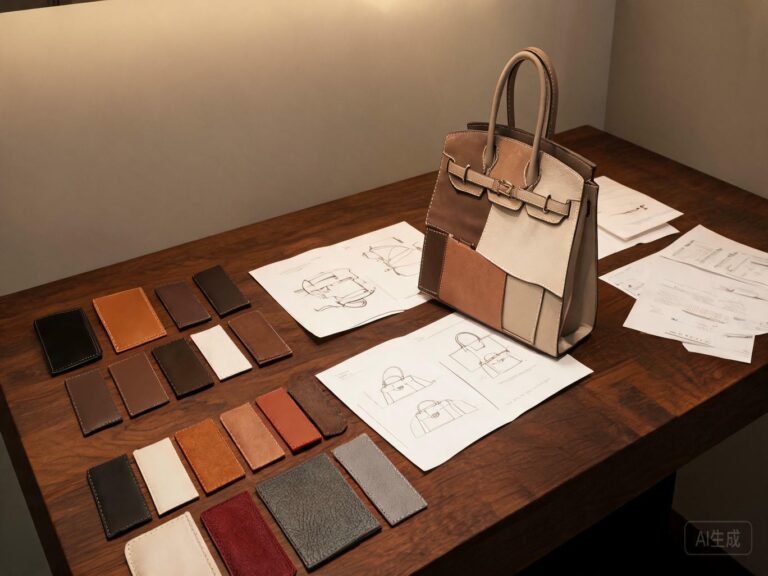
Material sample strips — batch-to-batch color consistency inspection is where AQL pass rates are won or lost in small leather goods production.
Why Silicone Leather Maintains AQL at Volume
Silicone leather solves the small leather goods scaling problem at the molecular level, not at the process level. Its polysiloxane polymer backbone is chemically inert — it doesn’t hydrolyze, doesn’t migrate plasticizers, and doesn’t undergo photo-oxidative breakdown during storage. This means the material that arrives at the die-cutting station at month 8 of warehouse storage performs identically to the material that arrived at month 1. For a 10,000-unit production run spread across multiple material batches over several weeks, that storage stability is the difference between 96% AQL pass rate and 82%.
The manufacturing advantages extend beyond storage stability. Silicone leather’s coating is sufficiently flexible that die-cutting produces clean edges without coating separation — a defect that accounts for 15-20% of PU leather rejects in small goods production. The material accepts embossing patterns with ≥95% retention through high-volume die-cutting cycles, compared to 60-70% retention for PU under identical pressure. And the surface chemistry allows sewing machine needles to penetrate without dragging the coating, which directly addresses the 45-65% of defects that are sewing-related. For brands evaluating fashion and sports applications or exploring custom texture options, these properties translate to fewer rejects, lower per-unit cost at volume, and fewer customer returns.

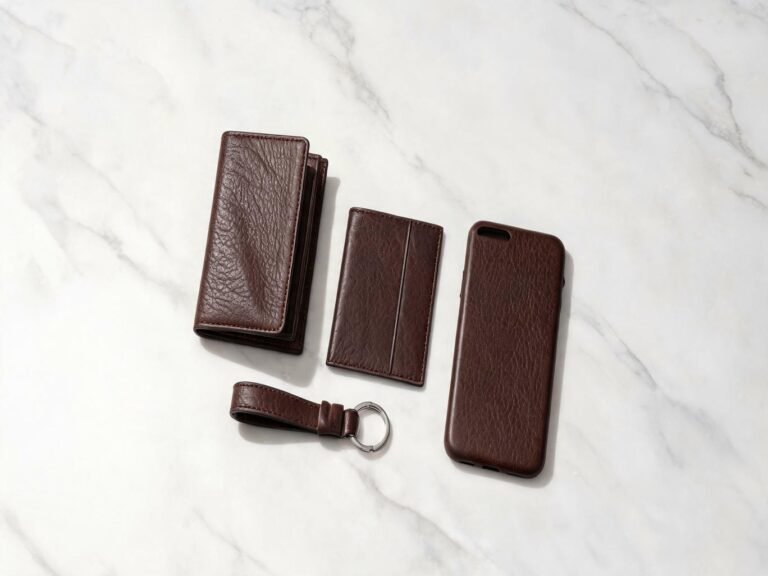
Small leather goods craftsmanship — the material quality that must hold from unit 1 through unit 10,000.
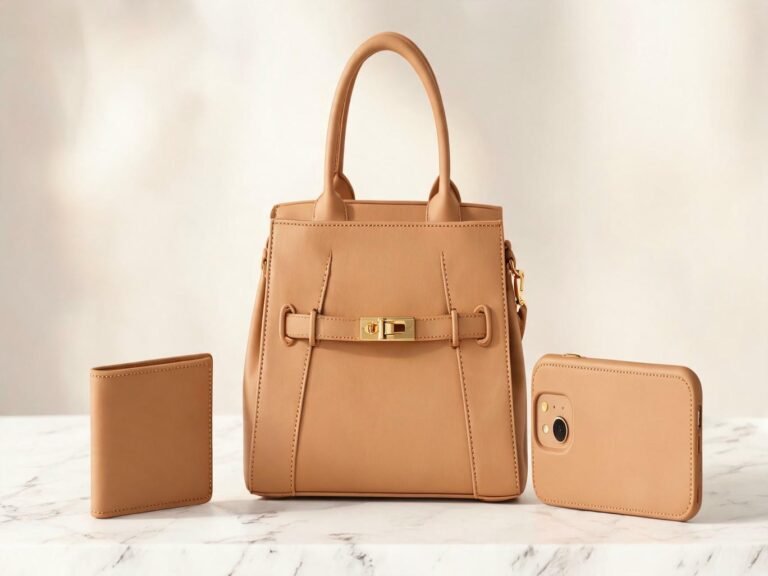
How silicone leather reduces per-unit cost in small leather goods production through lower reject rates and storage stability.
A 10,000-unit run of small leather goods at 82% AQL produces 1,800 rejects. At 96% AQL, that drops to 400. The 1,400-unit difference — at $3-8 per unit — is where material chemistry pays for itself.
About TOPSUN: TOPSUN manufactures silicone leather for small leather goods production — supplying OEM/ODM manufacturers of wallets, cardholders, passport covers, tech accessories, and fashion items with a polysiloxane-based material engineered for high-volume die-cutting and sewing operations. Our solvent-free dry coating process delivers batch-to-batch color consistency (Delta E ≤1.0), clean die-cut edges without coating separation, and 12+ month storage stability without hydrolytic degradation. With 500,000+ m monthly capacity from our 60,000+ m² ISO-certified facility, we support 500m MOQ with 7-15 day lead times and Pantone-matched color accuracy. Free A4 swatches shipped worldwide via DHL/FedEx.
Small Leather Goods Material Selection: FAQ
What material is best for high-volume small leather goods production?
Silicone leather delivers the highest AQL pass rates at production volumes above 500 units. Its chemical inertness eliminates the storage degradation, edge separation, and sewing drag defects that drive PU and PVC reject rates upward at scale. For runs under 300 units where storage time is minimal, PU leather can be cost-effective — but procurement teams should calculate reject cost, not just material cost per meter.
How does material choice affect sewing quality in small leather goods?
Sewing defects account for 45-65% of all quality rejects in small leather goods. PU leather coatings tear at stitch holes under high-speed sewing, creating visible needle drag. PVC surfaces dimple under presser foot pressure. Silicone leather’s flexible polymer coating allows clean needle penetration without surface damage, maintaining stitch line appearance through 10,000+ units. The difference is measurable in AQL pass rates: silicone leather runs typically achieve 96-98% pass, compared to 82-88% for PU at equivalent volumes.
What MOQ should I expect for silicone leather small leather goods material?
TOPSUN offers 500m minimum order quantity for silicone leather material, with Pantone-matched custom colors and 100+ embossing patterns available. At typical small leather goods yield rates (approximately 15-20 wallets per meter, depending on pattern efficiency), 500m supports 7,500-10,000 finished units — well above the 500-unit scaling threshold where material quality becomes the dominant AQL factor. Lead time is 7-15 days from order confirmation.