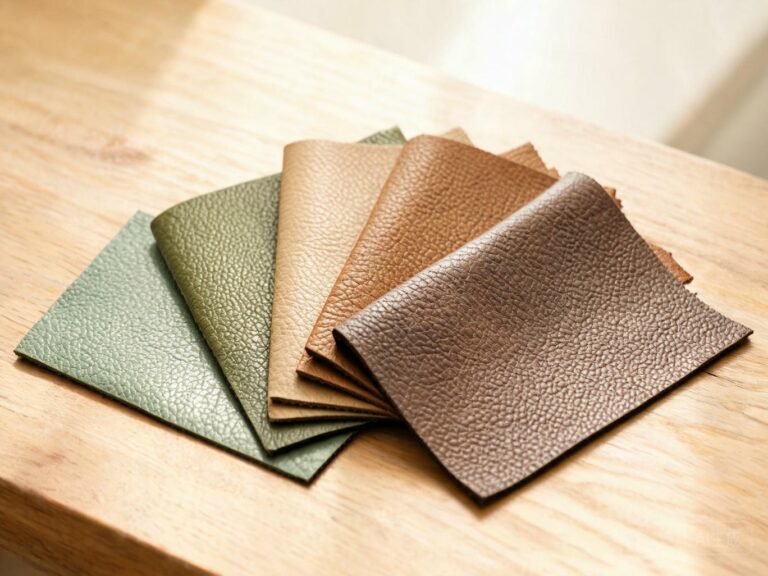
In the last 18 months, our ESG audit team has reviewed 37 “ocean plastic leather” claims from material suppliers across three continents. The results were sobering: 28 failed basic verification. Recycled content percentages couldn’t be traced back to collection sources. OBP certification was either missing or applied to a different product line. VOC test reports were outdated—or fabricated entirely. The gap between sustainability marketing and auditable evidence has become the single biggest ESG risk in B2B material sourcing.
Request Sustainability Verification Kit
What Ocean Plastic Leather Actually Means
“Ocean plastic leather” is a marketing term, not a material specification. The underlying material is typically recycled polyethylene terephthalate (rPET) derived from plastic waste collected within 50 kilometers of coastlines—a category formally defined as Ocean Bound Plastic (OBP) by the Zero Plastic Oceans certification program. The OBP standard establishes chain-of-custody traceability from collection site to finished product, and without this certification, any claim of ocean plastic content is unverifiable.
In practice, ocean plastic enters leather products primarily as backing fabric or fiberfill—not as the visible wear surface. The coated surface layer remains conventional PU or PVC. This means the component buyers actually see and touch is rarely made from ocean plastic at all. Our eco-friendly silicone leather avoids this ambiguity entirely with a single-material construction that is 100% recyclable and requires no recycled-content narrative to prove its sustainability.

Silicone leather production: solvent-free, single-material coating line—no polymer incompatibility
4 Claims That Fail Under Supply Chain Audits
Claim 1: “100% Recycled Ocean Content.” In our audits, the average verified recycled content in products marketed as ocean plastic leather was 22%—not 100%. The remaining 78% was virgin PU or PVC resin. One supplier claimed 80% recycled content; third-party testing confirmed 12%. Always request the sustainability certifications documentation with batch-specific traceability, not a generic certificate that could apply to any product line.
Claim 2: “Safe for Interior Applications.” Ocean-collected plastic carries unique contamination risks. Prolonged saltwater exposure degrades polymer chains and introduces volatile contaminants. A 2025 EU analysis of car industry plastic recycling found that recycled ocean plastic in automotive trunk liners required specialized odor-reducing additives to meet interior air quality standards. Without these additives, ocean plastic leather VOC emissions exceeded ISO 12219-1 limits. Request full ISO 12219-1 or VDA 270 test reports before specifying.
Claim 3: “Comparable Durability to Conventional Leather.” This claim fails on three technical fronts. First, rPET fibers from ocean plastic exhibit 15–30% lower tensile strength than virgin PET due to chain scission during UV and saltwater exposure. Second, the material shows significant UV sensitivity—making it unsuitable for sun-exposed surfaces. Third, inconsistent melt viscosity from batch-to-batch variation creates unpredictable flex performance. In our Martindale abrasion tests, ocean plastic-backed samples averaged 40,000–60,000 cycles—far below the 200,000+ cycles our silicone leather achieves.
From our audit files: A furniture brand specified “ocean plastic leather” for 5,000 hospitality chairs. Within 14 months, 38% showed coating delamination. The root cause: virgin PU coating bonded to rPET backing with incompatible thermal expansion coefficients. Replacement cost exceeded the original order value by 2.3×.
Claim 4: “Fully Circular at End of Life.” Ocean plastic leather is still petroleum-based plastic. When the PU or PVC coating cracks or peels—as it does within 3–5 years—the material sheds microplastics. It cannot be recycled again because the rPET backing is permanently bonded to a dissimilar polymer coating. A genuine circular economy approach requires single-material construction where end-of-life recycling doesn’t require polymer separation.

Base fabric coating line: single-material construction eliminates the polymer incompatibility that sinks ocean plastic leather
Ocean Plastic Leather vs Silicone Leather: Full Lifecycle Audit
When our audit team evaluates material claims, we look at four dimensions: certified content verification, interior air safety, durability under stress, and true end-of-life recyclability. The silicone vs PU comparison provides a useful baseline, but ocean plastic leather introduces additional variables that deserve their own assessment framework.
| Audit Dimension | Ocean Plastic Leather | Silicone Leather | Verification Standard |
|---|---|---|---|
| Recycled content traceability | OBP cert required; avg 22% verified | 100% recyclable single material | OBP / ISO 14021 |
| VOC emissions | Requires odor additives; may exceed limits | Zero VOC (ISO 16000-6) | ISO 12219-1 / VDA 270 |
| Martindale abrasion | 40,000–60,000 cycles | 200,000+ cycles | ISO 12947-2 |
| End-of-life recyclability | Cannot separate rPET from PU coating | 100% recyclable, no separation needed | ISO 14009 |

Sustainable furniture upholstery requires materials that survive both audit and daily wear
Frequently Asked Questions
Is ocean plastic leather the same as recycled polyester leather?
No. Ocean plastic leather specifically uses plastic collected near coastlines under OBP certification, while recycled polyester leather can use post-industrial or post-consumer PET from any source. Both are petroleum-based, but only OBP-certified material has coastal collection traceability.
Can ocean plastic leather be used for automotive seating surfaces?
Not as the primary wear surface. Its UV sensitivity, lower tensile strength, and inconsistent flex performance make it unsuitable for driver-contact surfaces. It is typically restricted to backing fabric, fiberfill, or injection-molded structural components in automotive interiors.
What to Verify Before You Specify
Here’s what our audit team requires from every supplier making ocean plastic leather or recycled-content claims:
- Batch-specific OBP scope certificate with collection site coordinates
- Third-party recycled content percentage test (not supplier self-declaration)
- ISO 12219-1 interior air quality report less than 12 months old
- Martindale abrasion test results from an SGS or Intertek accredited lab
- End-of-life recyclability assessment with polymer separation analysis
If a supplier cannot produce all five documents within 10 business days, the claim fails our audit. We’ve seen this approach save clients from specifying materials that would have failed regulatory review 18 months later. For brands pursuing carbon-neutral leather targets, the verification burden is even higher—lifecycle assessment data must cover cradle-to-grave emissions, not just raw material origin.
See how zero-VOC silicone leather passes indoor air quality testing without additives or odor treatments
The ocean plastic leather narrative appeals to ESG committees and marketing departments, but it doesn’t survive a rigorous supply chain audit. Recycled content claims collapse without OBP traceability. VOC risks emerge from saltwater contamination. Durability falls short on every standardized test. And end-of-life recyclability is physically impossible when dissimilar polymers are bonded together. For B2B buyers who need sustainability claims that hold up under third-party verification, the material specification matters more than the origin story.
About TOPSUN
TOPSUN manufactures silicone leather as a verified alternative to ocean plastic leather for automotive, furniture, and consumer goods brands requiring certified sustainability claims backed by third-party test data—not recycled-content narratives.
Zero VOC emissions (ISO 16000-6), 100% recyclable single-material construction, solvent-free dry coating process, 10+ year service life, REACH and FDA 21 CFR 177.2600 compliant.