Red is the hardest color to keep stable in faux leather. The pigments that produce vibrant reds — particularly quinacridone and diketopyrrolopyrrole families — have molecular structures that absorb high-energy UV radiation, accelerating degradation. In our ASTM G154 UV testing chamber, budget red faux leather samples show visible color shift within 800 hours. Premium red PU holds up better, but still fades. Red silicone leather is the exception — it holds its color past 1,500 hours with a ΔE below 1.0, meaning the human eye can’t detect any change. Here’s what drives that difference and how to specify red faux leather that actually lasts.
Request Red Faux Leather Swatches

Red faux leather swatches — color vibrancy varies dramatically by material type and pigment quality
The Red Faux Leather Fading Problem
Red faux leather fails faster than any other color. This isn’t opinion — it’s photochemistry. The red pigments used in synthetic leather absorb wavelengths between 400 and 520 nanometers, which carry enough energy to break polymer bonds in the coating layer. Once those bonds break, the pigment molecules degrade, and the red shifts toward orange, pink, or brown. The process is accelerated by heat, humidity, and the plasticizers commonly used in PVC and PU formulations.
The real-world consequences are expensive. We’ve tested red faux leather samples from over 20 suppliers across furniture, automotive, and fashion applications. In SAE J2412 accelerated weathering — the automotive industry standard for interior materials — budget PVC-based red faux leather shows ΔE values of 15.3 to 22.1 after 1,000 hours. That’s not “slightly faded.” That’s a visibly different color. PU-based red faux leather performs moderately better at ΔE 5–8, but still shows noticeable shift. Genuine red leather fades too — ΔE 8.2 to 12.6 — because the tanning process doesn’t stabilize red dye molecules against UV.

Bright red faux leather texture — color saturation depends on pigment chemistry and coating formulation
What ΔE Actually Means for Red Upholstery
ΔE (Delta E) is the industry-standard metric for quantifying color difference. A ΔE of 1.0 is the threshold of perceptible change for the average human eye — below 1.0, you won’t notice a difference. Between 1.0 and 3.0, the change is visible to trained observers under controlled lighting. Above 3.0, it’s obvious to anyone in normal conditions. Above 10.0, the material looks like a different color entirely.
For fashion and accessory applications, a ΔE of 3–5 after UV exposure might be acceptable — the product lifecycle is short, and consumers expect seasonal color changes. For automotive interiors and furniture upholstery, anything above ΔE 3.0 after 1,000 hours of accelerated testing is a field failure waiting to happen. The couch or car seat will look visibly different within 18–24 months of real-world use.
Specification tip: Always require both the ΔE numeric value AND the test duration in your purchase order. “Grade 4 color fastness” without a ΔE number and exposure hours is meaningless — it tells you nothing about how much the red will actually shift.
Red Faux Leather Material Types: UV Performance Compared
Not all red faux leather fades at the same rate. The base polymer — PVC, PU, or silicone — determines how well the red pigment is protected from UV degradation. The table below summarizes our testing data alongside published industry results from ASTM G154 and SAE J2412 protocols.
| Material | UV ΔE (1,000 hrs) | Color Fastness | Cold Crack | Service Life |
|---|---|---|---|---|
| Red Genuine Leather | ΔE 8.2–12.6 | Grade 3 | −22°F | 15–25 years |
| Red PVC Faux Leather | ΔE 15.3–22.1 | Grade 2–3 | +14°F | 2–3 years |
| Red PU Faux Leather | ΔE 5.0–8.0 | Grade 3–4 | −20°F | 3–5 years |
| Red Silicone Leather | ΔE ≤ 1.0 | Grade 4–5 | −40°C | 10+ years |

Custom color matching for red faux leather — batch-to-batch consistency is critical for B2B projects
The data tells a clear story: red PVC is the worst performer by every metric. Red PU is a middle ground — acceptable for short-lifecycle products but inadequate for furniture or automotive applications expecting 5+ years of service. Red silicone leather achieves ΔE ≤ 1.0, meaning the color after 1,000 hours of UV exposure is indistinguishable from the original to the human eye. This is because the silicone polymer matrix is inherently UV-stable — it doesn’t require UV stabilizers or topcoats that can wear off. For B2B buyers comparing silicone vs PU leather, the UV performance gap is one of the most quantifiable differences.
Watch the color fastness test — see how red silicone leather resists UV fading under accelerated aging

Color fastness testing machine — used to evaluate red faux leather UV resistance per ISO 105-B06
How Suppliers Skip Light Fastness Testing
Here’s the part of the red faux leather market that catches B2B buyers off guard. Most suppliers don’t perform ISO 105-B06 light fastness testing at all. It’s not that the test is expensive — it costs roughly $200–400 per sample at an accredited lab. The issue is that the results would disqualify their product from any spec-conscious buyer’s shortlist.
Instead, suppliers typically provide one of three evasions. First, they cite a generic “Grade 3” or “Grade 4” rating without specifying the test standard, exposure duration, or ΔE value. Second, they reference ISO 105-X12 (rubbing fastness) instead of ISO 105-B06 (light fastness) — these measure completely different properties, but buyers unfamiliar with the standard numbers don’t catch the switch. Third, they show a single test report from five years ago that doesn’t represent current production batches.
The fix is straightforward: specify in your purchase order that the supplier must provide a current (within 12 months) third-party test report from SGS or Intertek showing ISO 105-B06 results with a numeric ΔE value at a stated exposure duration. If they can’t produce this, walk away. For eco-friendly and premium applications, this verification step is non-negotiable.

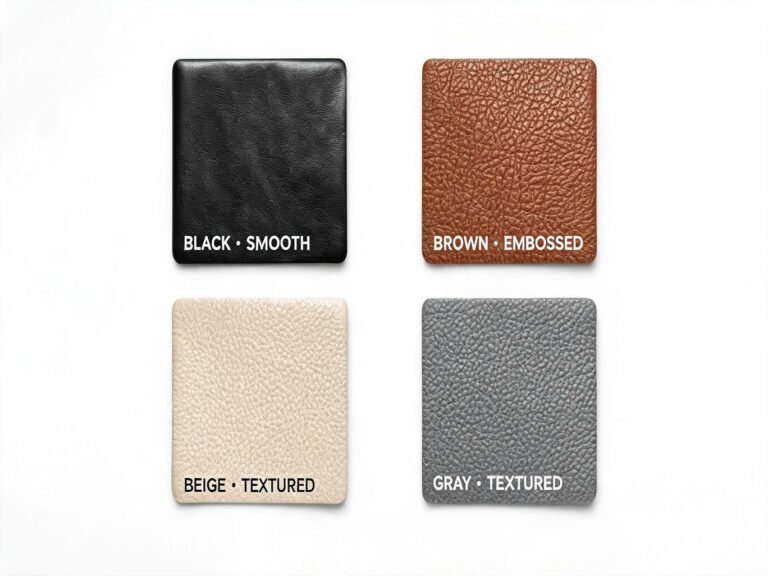
Warm-tone leather swatch collection — red variants require careful pigment selection for UV stability
Specifying Red Faux Leather That Lasts
If you’re sourcing red faux leather for a project where the color needs to hold for 5+ years — whether that’s furniture, automotive trim, or 3C electronic accessories — here are the four specifications that separate materials that last from materials that fade:
- UV ΔE ≤ 3.0 after 1,000 hours per ISO 105-B06 or ASTM G154. For high-visibility applications, tighten to ΔE ≤ 1.5. Require the numeric value, not just a grade.
- Pigment system: Ask whether the red comes from organic pigments (quinacridone, DPP) or inorganic (iron oxide). Inorganic reds are more UV-stable but offer fewer shade options. Silicone leather uses inherent polymer stability rather than pigment protection.
- Batch-to-batch ΔE ≤ 1.0. Red is the most difficult color to match consistently between production runs. A supplier that can’t guarantee ΔE ≤ 1.0 across batches will deliver couches or car seats in slightly different reds.
- Third-party test report within 12 months. From SGS or Intertek, specifying ISO 105-B06 with numeric ΔE. No grade-only reports, no rub-fastness substitutions, no expired certificates.
Frequently Asked Questions
What ΔE value is acceptable for red faux leather in commercial applications?
For commercial applications where red faux leather is exposed to natural or artificial light, specify ΔE ≤ 3.0 after 1,000 hours of accelerated UV testing per ISO 105-B06. For high-visibility applications like automotive interiors and showroom furniture, tighten this to ΔE ≤ 1.5. Silicone leather typically achieves ΔE ≤ 1.0, meaning the color difference is imperceptible to the human eye even after extended UV exposure.
How can I verify a supplier’s red faux leather color fastness claims?
Request a third-party test report from SGS or Intertek specifying ISO 105-B06 (color fastness to light) and the exact ΔE value after the stated exposure duration. A grade-only report (“Grade 4”) is insufficient — insist on the numeric ΔE. If the supplier cannot provide this, order a 30×30cm sample and commission independent testing before committing to bulk. For more on evaluating suppliers, see our reddish leather material guide.
The Bottom Line on Red Faux Leather Color Stability
Red faux leather doesn’t have to fade — but most of what’s on the market will. The difference between a red that holds for 2 years and one that holds for 10 comes down to polymer chemistry, pigment selection, and whether the supplier actually tests for light fastness. PVC and PU formulations degrade under UV because their polymer matrices aren’t inherently stable; the red pigment degrades along with the coating around it. Silicone leather solves this at the molecular level — the polymer itself resists UV, protecting the red pigment without relying on topcoats or stabilizers that wear off. Specify by ΔE, verify with third-party reports, and the color stability principles that apply to blue faux leather apply doubly to red.
Download Color Stability Report
About TOPSUN
TOPSUN supplies red faux leather with verified color stability for automotive interiors, furniture upholstery, and fashion accessories, using silicone-based formulations that resist UV fading without surface treatments or topcoats.
1,000+ hours UV stability per ASTM G154 · Grade 4–5 color fastness per ISO 105-B06 · Delta E ≤ 1.0 batch-to-batch accuracy · Free red A4 swatches shipped worldwide via DHL/FedEx