When a yoga mat loses grip mid-downward-dog, the problem isn’t the pose — it’s the surface chemistry. PVC dominates the budget segment of the global yoga mat market, projected to reach $20.66 billion by 2034 (Fortune Business Insights). Yet its closed-cell structure repels sweat instead of managing it, and the friction coefficient drops sharply once palms get damp. PU leather yoga mat surfaces are emerging as a performance upgrade — their moisture-absorbent top layer actually grips better when wet. But not all yoga mat leather performs equally. Here is what B2B sourcing teams need to verify before committing to a material supplier.
Why PVC Yoga Mats Lose Grip Under Sweat
The grip problem with PVC is simple chemistry. PVC is a closed-cell polymer — it repels moisture rather than absorbing it. When practitioners sweat, the moisture sits on the surface as a thin film, reducing friction between skin and mat. In hot yoga studios where room temperatures hit 40°C, this becomes a genuine safety issue, not just a comfort complaint.
We’ve seen sourcing teams specify “anti-slip” in their requirements without defining what that means quantitatively. A useful specification references a wet friction coefficient — typically measured per ASTM D1894 — and sets a minimum threshold. Materials scoring below 0.5 in wet conditions are unsuitable for fitness surfaces. For buyers evaluating sports and fitness applications, this number should be in the technical data sheet, not buried in marketing copy.
Yoga mat leather surfaces solve this differently. PU leather’s open-pore structure absorbs moisture into the material, maintaining surface contact and grip. Silicone leather takes a different approach: its inherent tackiness doesn’t depend on moisture at all, performing consistently whether palms are dry or dripping. The key question for yoga mat leather grip performance is whether the material’s friction coefficient is stable across moisture states — not just high in lab conditions.

Water beading test on leather surface — moisture management is the core differentiator for yoga mat performance
Over 300 million yoga mats are discarded globally each year, most ending up in landfills where PVC takes 500+ years to break down. A mat that lasts 10 years instead of 2 prevents 4 landfill-bound mats per practitioner.
Yoga Mat Leather Types: PU, Vegan, and Silicone Compared
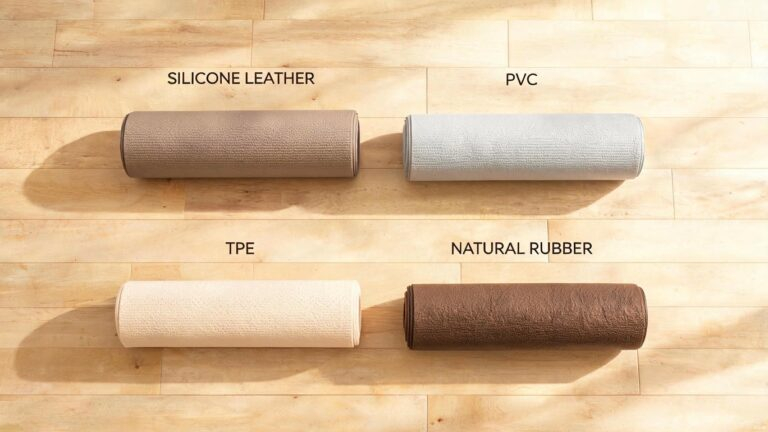
Three leather-type materials currently compete for yoga mat surface applications. Each has distinct performance, cost, and environmental profiles that directly affect the finished product’s market position.
PU leather yoga mat surfaces dominate the premium segment. The polyurethane top layer absorbs sweat for grip, and production costs are moderate. The trade-off: conventional PU production uses solvents like DMF, and the material typically lasts 3–5 years before surface cracking appears. Vegan leather is a marketing term, not a material specification — most vegan leather yoga mats use a PU base with plant-derived additives (cork, apple, cactus). These improve the eco-narrative but don’t change the underlying chemistry.
Silicone leather is the newest entrant. Its chemistry is fundamentally different: no solvents, no plasticizers, zero VOC emissions. The material is inherently flame-retardant, stable from -40°C to 250°C, and lasts 10+ years. For a deeper silicone vs PU comparison, the performance gap widens dramatically in applications involving heat, moisture, and repeated cleaning. Here is how the three compare on metrics that matter to sourcing teams:
| Material | Wet Grip | VOC Emission | Lifespan | Recyclable |
|---|---|---|---|---|
| PVC | Poor (moisture repelled) | High (phthalates) | 2–3 years | No |
| PU Leather | Good (moisture-absorbent) | Moderate (DMF-based) | 3–5 years | Limited |
| Silicone Leather | Excellent (inherent tack) | Zero | 10+ years | Yes |

Silicone leather yoga mat surface — maintaining grip regardless of moisture level
Durability Data: What 100K Martindale Cycles Reveal
Abrasion resistance is the single best predictor of yoga mat lifespan. The Martindale test — ISO 12947-2 — subjects the material surface to repeated circular abrasion under controlled pressure. The cycle count at which visible wear appears tells you how long the surface will last under daily use. This matters because replacing mats at scale is a logistics cost, not just a material cost.
Standard PVC yoga mats show surface degradation within 20,000–30,000 Martindale cycles. PU leather surfaces typically reach 50,000–80,000 cycles before cracking. In our Martindale abrasion testing, silicone leather surfaces maintained structural integrity past 200,000 cycles — verified by SGS-CSTC Guangzhou. That is not a marginal improvement. It is an order of magnitude.
For sourcing teams, this means a PVC mat replaced every 2 years over a decade equals 5 replacement cycles. A silicone eco-friendly leather surface lasting 10+ years means zero replacements. The total cost of ownership favors the higher upfront material by a factor of 3–5×, and the leather yoga mat durability gap compounds when you factor in warranty claims and brand damage from premature product failure.

Scratch resistance testing — the same equipment used for Martindale abrasion cycle verification
Watch how silicone leather maintains grip under sweat, water, and repeated flexing — the same anti-slip performance yoga mat surfaces require
B2B Sourcing: 5 Specs to Verify in Yoga Mat Leather
Before placing an order for custom yoga mat leather surfaces, verify these five specifications — in writing, with lab reports. Suppliers who reference silicone vs PU performance data without providing lab reports are asking you to take claims on faith.
- Wet friction coefficient: Request ASTM D1894 test data for both dry and wet conditions. Minimum threshold: 0.5 wet.
- VOC emissions: Demand ISO 16000-6 chamber testing results. Silicone leather should show zero or near-zero VOC; PU should disclose solvent residues.
- Skin-contact certification: For surfaces in direct prolonged skin contact, ISO 10993-5 biocompatibility testing is non-negotiable — the same standard used for medical devices.
- Abrasion resistance: Specify minimum Martindale cycle count per ISO 12947-2. 100,000+ cycles is a reasonable floor for commercial-grade mats.
- UV color fastness: Request ISO 105-B06 testing data. Mats used in studios with natural light will fade — the question is how fast.
In our experience, factories that invest in third-party testing also invest in consistent production quality. If a supplier cannot produce these reports, that itself is a data point about their quality system. For broader context on gym equipment upholstery material sourcing, the same verification framework applies across fitness product categories.

Color and texture options for custom yoga mat leather surfaces — Pantone matching with batch-to-batch consistency
Frequently Asked Questions
Does yoga mat leather contain harmful plasticizers like PVC?
Quality silicone and PU leather surfaces are phthalate-free. But PVC mats contain plasticizers that can leach with sweat and heat exposure. Always request REACH compliance documentation — specifically Annex XVII restricted substances testing — before approving a material for skin-contact fitness products.
Can leather yoga mat surfaces be cleaned with disinfectant?
Silicone leather surfaces tolerate alcohol disinfectants and bleach solutions without surface degradation. PU leather surfaces may degrade with repeated chemical exposure — always check the supplier’s cleaning compatibility data before specifying cleaning protocols for commercial yoga studios.
The Bottom Line for Yoga Mat Leather Sourcing
The yoga mat leather sourcing decision comes down to three factors: grip performance under sweat, lifespan, and environmental footprint. PVC is cheap but fails on all three. PU leather improves grip but carries solvent concerns and a 3–5 year ceiling. Silicone leather delivers verified performance across every metric — 200K+ abrasion cycles, zero VOC, ISO 10993 skin-safe certification, and a 10+ year lifespan that keeps mats out of landfills. For B2B sourcing teams, the question isn’t whether to upgrade from PVC. It’s which leather surface material delivers the verified specs your brand can stand behind.
About TOPSUN
TOPSUN manufactures silicone-coated leather materials engineered for sports and fitness surfaces, including yoga mat applications that demand sweat-resistant grip and direct skin-contact safety.
ISO 10993-5 biocompatibility certified · FDA 21 CFR 177.2600 food-contact compliant · Zero-VOC solvent-free coating process · 200K+ Martindale abrasion cycles verified by SGS