A silicone leather quality control guide should do more than list test names — it should tell you exactly what thresholds to demand, what red flags to spot, and what a “PASS” result without numbers actually means. Most QC reports from synthetic leather suppliers are marketing documents dressed up as technical data. Here is how to read them like a procurement professional.
Why Most QC Reports Don’t Tell You What You Need
The Chinese silicone artificial leather industry standard QB/T 5954-2023 defines specific physical, chemical, and flame-retardant property requirements. Yet most supplier QC reports summarize results as “qualified” or “PASS” without including the actual numerical values, test conditions, or lab identification. That should concern you.
A legitimate QC report includes four elements: the test standard reference (e.g., ISO 12947-2), the numerical result (e.g., 200,000 cycles), the pass threshold (e.g., ≥100,000 cycles), and the testing laboratory name (e.g., SGS-CSTC Guangzhou). If any of these are missing, the report is incomplete — and an incomplete report is a red flag, not a technical document.
In our audits of factory production processes, we’ve found that suppliers who invest in third-party testing also invest in consistent production quality. The silicone leather QC checklist below is what we use internally — and what we recommend B2B buyers require from any material supplier before signing a purchase order.

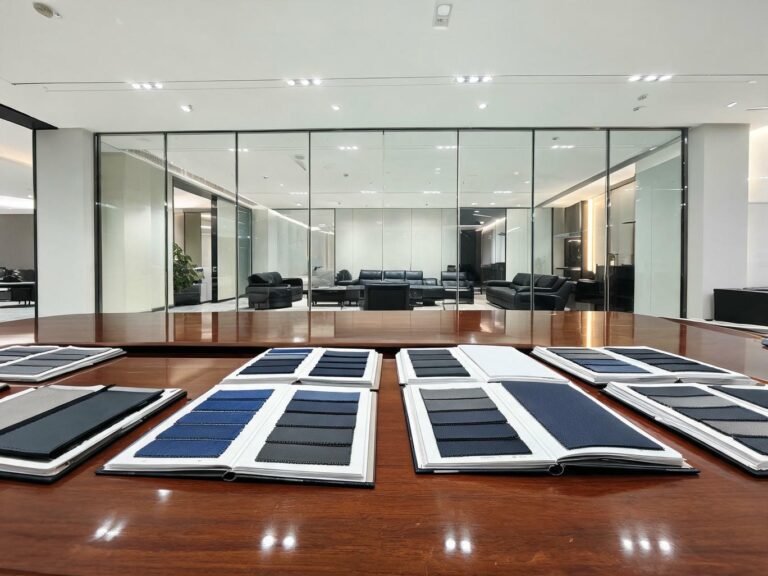
Fabric inspection area — the first checkpoint in a multi-stage silicone leather QC system
7 Silicone Leather Quality Control Tests Every Buyer Must Verify
These seven tests cover the dimensions that determine whether silicone leather quality control is genuinely robust or merely performative. Each test has a specific ISO standard, a numerical pass threshold, and a common evasion tactic that suppliers use to obscure poor results.
- Thickness consistency (ISO 2286-2): Nominal ±0.06 mm. Deviations beyond ±10% indicate coating line instability. Check 1 roll per 50 rolls minimum.
- Tensile strength (ISO 3376): ≥15 N/mm for commercial-grade; below 10 N/mm means the material will tear under stress. Test 1 per batch.
- Tear strength (ISO 34-1): ≥20 N. Sub-15 N results indicate poor base fabric adhesion — a failure mode that won’t show up until installation.
- Martindale abrasion (ISO 12947-2): ≥100,000 cycles for commercial; 200,000+ for premium. Suppliers who report “PASS” without cycle counts are hiding the number for a reason.
- Color fastness to light (ISO 105-B06): Grade 4–5. Grade 3 or below means visible fading within 12 months of UV exposure. See durability testing results for real-world data.
- VOC emission (ISO 16000-6): Zero or near-zero for genuine silicone leather. Any detectable VOC indicates solvent contamination or PU blending. Test 1 per formulation.
- Biocompatibility (ISO 10993-5): Cell viability ≥70%. This is the medical-grade threshold — and the same standard we use for all skin-contact applications.
| Test | Standard | Pass Threshold | Red Flag | Frequency |
|---|---|---|---|---|
| Tensile strength | ISO 3376 | ≥15 N/mm | Below 10 N/mm | 1 per batch |
| Martindale abrasion | ISO 12947-2 | ≥100K cycles | No cycle count reported | 1 per formulation |
| Color fastness (UV) | ISO 105-B06 | Grade 4–5 | Grade ≤3 | 1 per batch |
| VOC emission | ISO 16000-6 | Zero / near-zero | No numerical value | 1 per formulation |

Martindale abrasion tester — the machine behind the cycle count numbers in every legitimate QC report
Red Flags in Supplier QC Documentation
After reviewing hundreds of supplier QC reports across the synthetic leather supply chain, five patterns consistently signal trouble. Each one is a reason to pause before signing a purchase order.
- “PASS” without numerical values: A result reported as “qualified” or “PASS” with no number is not a test result — it’s an opinion. Demand the raw data.
- Missing testing laboratory: If the report doesn’t name an accredited third-party lab (SGS, Intertek, TÜV), the test was likely self-administered. Self-reported results carry no independent verification.
- Non-standard test conditions: Martindale tests run at lower pressure or fewer cycles than the standard specifies produce inflated results. Check the test parameters, not just the outcome.
- No sample conditioning: Materials tested without standard temperature/humidity conditioning (23°C/50% RH per ISO 554) produce non-reproducible results.
- Inconsistent batch results: If Batch A shows 200K Martindale cycles and Batch B shows 80K with no formulation change, the silicone leather inspection standards at that factory are not under control.
In our audits of supplier QC documentation, roughly 40% of reports we receive from new suppliers fail at least two of these five checks. The most common failure is reporting “PASS” without numerical values — which is why we require raw test data on every batch we inspect. Materials with hydrolysis-resistant properties deserve particular scrutiny, as hydrolysis test results are especially prone to selective reporting.

Color fastness testing equipment — UV exposure chambers that reveal fading resistance over accelerated timeframes
REACH Annex XVII compliance is non-negotiable for EU-bound shipments. If your supplier cannot provide a REACH compliance certificate listing restricted substances testing, your shipment may be detained at customs. Verify REACH requirements directly from ECHA.
Inside TOPSUN’s quality control lab — see how each silicone leather batch is tested before it ships
Building a Silicone Leather Quality Control Framework
A robust silicone leather quality control framework doesn’t rely on trusting your supplier — it relies on verifying them systematically. Here is the four-step framework we recommend to B2B sourcing teams:
- Step 1 — Define acceptance criteria per application: Automotive interiors need FMVSS 302 flame retardancy; medical applications need ISO 10993 biocompatibility; furniture needs Martindale ≥100K. Don’t apply a generic spec sheet — tailor thresholds to the end use. Understand the difference between full and semi-silicone leather formulations, as each has different QC parameters.
- Step 2 — Require third-party lab verification: Accept only reports from accredited labs (SGS, Intertek, TÜV). Self-reported data is marketing, not quality control.
- Step 3 — Establish batch testing frequency: Minimum: 1 per batch for physical properties, 1 per formulation for chemical/VOC, 1 per color for fastness. For high-volume orders, increase frequency proportionally. A supplier evaluation guide can help structure your audit process.
- Step 4 — Audit the factory’s in-line QC: Visit the production floor. Check whether the factory tests in-line or only at finished-goods stage. In-line testing catches problems early; end-of-line testing only catches them after the full batch is produced.

Quality inspection at a leather manufacturing facility — the difference between in-line and end-of-line QC
Frequently Asked Questions
What does “PASS” without a numerical value mean in a QC report?
It means the supplier is asking you to trust them rather than verify. A legitimate test result always includes the numerical value (e.g., “200,000 Martindale cycles”), the pass threshold (e.g., “≥100,000”), and the testing standard (e.g., “ISO 12947-2”). Reports showing only “PASS” or “qualified” should be rejected and replaced with full test data.
How often should silicone leather batches be tested?
Minimum testing frequency: 1 per batch for physical properties (tensile, tear, thickness), 1 per formulation for chemical properties (VOC, REACH), and 1 per color for fastness. For high-volume orders exceeding 5,000 meters, increase to every 2,000 meters. Any formulation change, substrate change, or new color development requires a full re-test suite.
Quality Control Is Verification, Not Trust
The difference between a supplier who delivers consistent silicone leather quality control and one who doesn’t isn’t about intentions — it’s about systems. Suppliers with accredited third-party testing, in-line QC processes, and numerical reporting standards produce better material because their own process feedback loops work. The silicone leather certification requirements outlined above are not excessive — they are the minimum threshold for a material that will represent your brand in the market. Demand the data, verify the lab, and audit the process. Everything else is trust, and trust is not a quality control strategy.
About TOPSUN
TOPSUN operates a multi-stage silicone leather quality control system covering raw material inspection, in-line coating monitoring, and finished-goods lab testing across three production facilities in Dongguan, Yichang, and Xiangyang.
SGS-verified ISO 12947-2 Martindale 200K+ cycles · ISO 10993-5 cell viability 74.58% (pass threshold 70%) · REACH Annex XVII compliant · Delta E ≤ 1.0 batch-to-batch color consistency