USD 4.89 billion. That is where the eco-friendly leather market lands by 2032, compounding at 15.8% a year from USD 1.79 billion in 2025. More than 68% of fashion shoppers told researchers in 2025 that they prefer brands aligned with environmental values. The demand side has spoken.
What has not caught up is the language. Sustainable leather fabric has no ISO definition, no agreed test method and no mandatory disclosure format. Which makes it the least audited phrase in modern sourcing.
As a brand-side product manager, that gap is not an academic annoyance. It is the difference between a claim you can defend in an ESG review and one that quietly becomes a liability. This article audits the term across four dimensions — inputs, process, lifespan and end of life — and names the documents that turn a marketing word into a procurement-grade spec.
| Audit Dimension | The Question to Ask | Red Flag | Proof Document |
|---|---|---|---|
| Inputs | What share of the material is synthetic polymer, and which polymer? | “Plant-based” with no polymer fraction stated | Composition declaration |
| Process | Are solvents, DMF or plasticizers used at any stage? | “Low-impact” with no chemistry disclosure | REACH SVHC screening (247 substances) |
| Lifespan | How many service years before replacement? | No accelerated-aging data offered | Hydrolysis (85°C/85%RH) + QUV reports |
| End of life | Recyclable, compostable, or landfill? | “Biodegradable” with no conditions named | Recyclability / compostability statement |
What Is Sustainable Leather Fabric — and Why Nobody Agrees Yet
The fastest-growing material category in soft furnishings is also the most loosely defined. Ask a tanning-industry association and you will hear that genuine hide, a byproduct of the meat chain, is the original sustainable material when tanned responsibly. Ask an academic review — such as the 2026 Materials survey of bio-based alternatives. The answer pivots to plant composites built on pineapple leaves, cactus and grape waste, plus mycelium sheets grown from fungal biomass.
Both camps use the same word for different things, and neither definition arrives with a test method attached. For a product manager, the practical consequence is simple. You cannot copy anyone’s “sustainable” label, you can only verify the four dimensions underneath it. The market will keep rewarding brands that can show the receipts.
Inputs and Process: Where Green Claims Go to Hide
The input story is the easiest to tell and the easiest to overstate. Plant-based leathers genuinely do start with agricultural byproducts — that part is real innovation. But the finished sheet is usually a composite: fiber mat plus binder plus topcoat. And the synthetic fraction can dominate the weight.
The process story hides even better, because it happens behind factory doors. A pineapple-leaf surface carried by a solvent-borne PU binder and a DMF-wet supply chain inherits the solvent problem the leaf was supposed to solve. That is why we treat process chemistry as its own audit line. Our dry coating line runs solvent-free end to end — no DMF, no plasticizers, no formaldehyde or heavy metals — with TVOC measured below 0.01 mg/m³ and REACH screening covering 247 SVHC substances, all with report numbers a reviewer can check.
If you are comparing suppliers, the document that separates a clean process from a clean story is the eco-compliance file behind each claim, not the icon on the swatch card.

The input story is visible on the moodboard; the process story only shows up in documents.
Request the Four-Dimension Audit File
Lifespan: The Multiplier Your Sustainable Leather Fabric TCO Is Missing
Here is the arithmetic most sustainability decks skip. A material replaced every two to three years multiplies every upstream impact — extraction, processing, shipping, installation — by every replacement cycle. Longevity is not a comfort feature. It is the largest lever in the environmental account.
Our silicone-based material is rated for 10–15 years of service, roughly three times the typical PU lifecycle. The accelerated data behind that rating is transferable across suppliers. Coupons complete 14 weeks at 85°C and 85% relative humidity with zero delamination. Standard PU controls crack around weeks 3–4.
Over a 15-year horizon that difference compounds to about 67% less material waste versus PU. It is also why a higher per-meter quote often wins the total-cost comparison — the hydrolysis-resistance data is the single most useful page to attach to that internal debate.

Longevity is engineered at the coating stage — bond quality here decides the replacement cycle downstream.
The 15-year math, visualized: why service life converts directly into avoided waste and avoided spend.
End of Life: Recyclable Beats Compostable in a B2B Context
End-of-life claims deserve the same skepticism as input claims. “Compostable” sounds like the best possible answer. Industrial composting requires facilities, temperature profiles and certification scopes that most furniture programs will never touch. A material that only breaks down in a facility your customer cannot reach is, functionally, landfill with better marketing.
Recycling is the more practical loop at commercial scale, which is why we specify our material as 100% recyclable within a closed-loop lifecycle and keep halogen chemistry out of the formula entirely. Burning PVC releases dioxins precisely because of the chlorine in its backbone, a problem a silicone polymer does not carry.
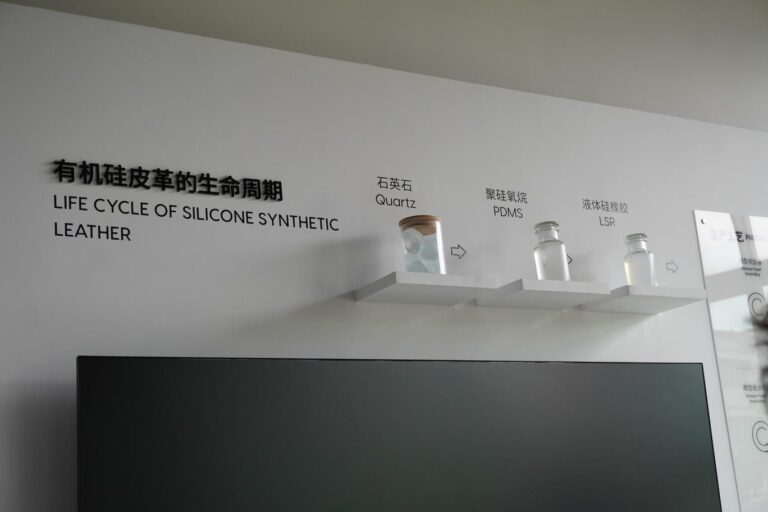
When we brief design teams on what silicone leather actually is, the end-of-life slide always lists the destination first: reprocessing stream, not landfill. The comparison below is the one worth keeping on file.

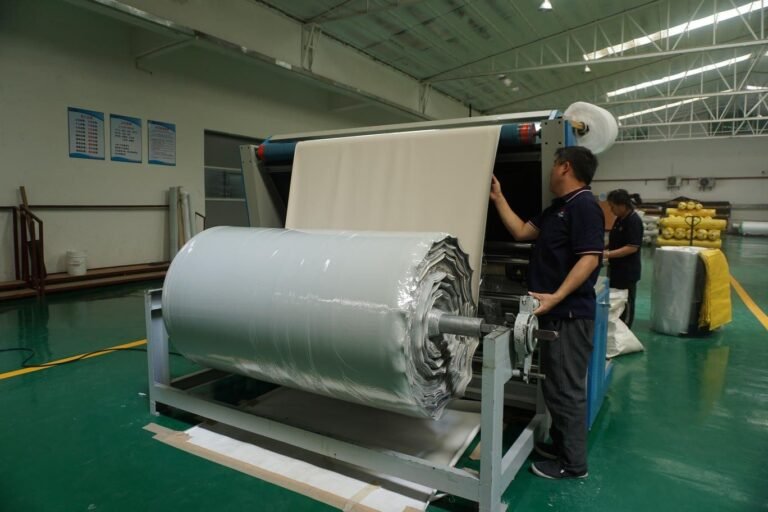
Audit discipline runs through the whole chain — from chemistry intake to how finished rolls leave the building.

The two numbers that decide the sustainability case: replacement cycle and end-of-life destination.
The Four-Step Audit to Run Before Your Next Sustainable Fabric Order
Turn the framework into paperwork on your next RFQ — four steps, one afternoon:
- Write the four dimensions into the RFQ template: composition, process chemistry, accelerated-aging data, end-of-life pathway.
- Accept only third-party documents with verifiable report numbers — SGS, Intertek or TÜV — never an in-house summary alone.
- Price the fabric on a 15-year TCO, not a per-meter quote, and make the replacement-cycle assumption explicit.
- File every claim and its proof document into your brand’s ESG evidence chain before the material reaches production.
Sustainable leather fabric is not a property you can read off a label. It is a verdict a buyer reaches after reading the file. Suppliers who volunteer the four documents are telling you how they behave when nobody is asking. Those are the partnerships that survive an ESG review.
Get Audit-Ready Material Samples
References
1. https://www.statsmarketresearch.com/global-ecofr… — Eco-friendly Leather Market report: USD 1.79B (2025) to USD 4.89B (2032), 15.8% CAGR; 68% shopper preference data
2. https://pmc.ncbi.nlm.nih.gov/articles/PMC130275… — Oleksińska-Merida et al., Materials 2026, 19(6):1198: bio-based and sustainable alternatives to conventional and synthetic leather