Light brown leather is the most specified warm-tone color in furniture, automotive, and interior design — and the hardest to keep consistent across batches. The human eye can detect color differences as small as Delta E 1.0 in warm mid-tone shades, meaning a shift of just one Pantone TPG step between production runs becomes a visible defect on the final product. For B2B buyers managing multi-season product lines, this is not a cosmetic issue. It is a supply chain failure that triggers rework, returns, and brand damage. This guide breaks down how to specify, verify, and enforce light brown leather color consistency from any supplier.
Why Light Brown Leather Is the Hardest Color to Match
The problem is physics. Warm mid-tone colors sit in the 400–500 nanometer wavelength range where the human eye has peak sensitivity. Research from the Rochester Institute of Technology’s Munsell Color Science Laboratory shows that observers can discriminate hue differences as small as 1.0 Delta E in the yellow-brown spectrum — roughly half the discrimination threshold for dark blues or blacks. Translation: your customer will see a light brown color mismatch that your QC instrument might flag as “within tolerance.”
Compounding the problem: PU and PVC leather use solvent-based pigment systems that shift between batches due to temperature, humidity, and mix ratio variations during coating. A batch produced on a humid Tuesday will not match a batch produced on a dry Thursday — even from the same supplier, same formulation, same machine. This is why most B2B buyers receive light brown leather that “looks right” in the swatch but shows visible panel-to-panel variation when assembled into a finished sofa or car interior.

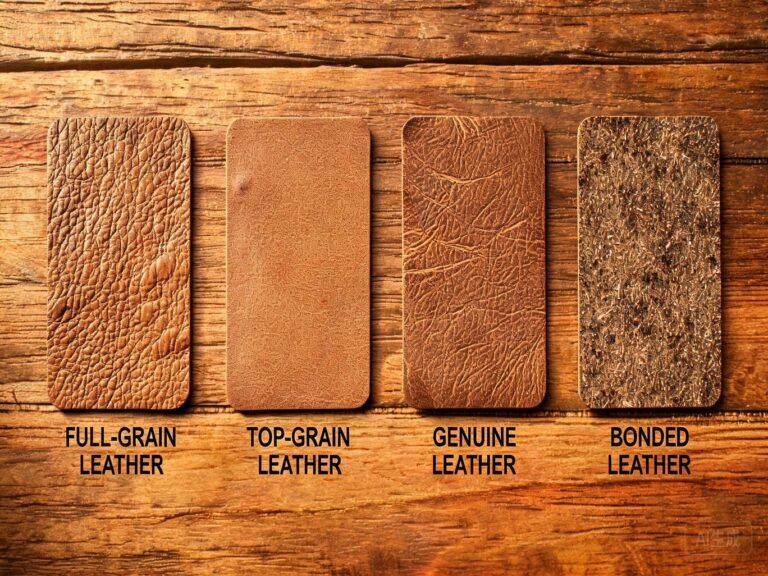
Warm-tone leather swatches — the eye catches color drift between these samples that instruments may classify as “within tolerance.”
Delta E: The Only Metric That Matters for Color Consistency
Delta E (ΔE) is the industry-standard metric for quantifying the difference between two colors. The CIE (International Commission on Illumination) defines it as the Euclidean distance between two points in CIELAB color space. Here is what the numbers mean for your purchase order:
| Delta E Range | What It Means | B2B Risk Level | Acceptable? |
|---|---|---|---|
| ΔE ≤ 1.0 | Imperceptible difference | None | Yes — spec this |
| 1.0 < ΔE ≤ 2.0 | Barely noticeable (side-by-side) | Low — but visible on large panels | Marginal |
| 2.0 < ΔE ≤ 3.5 | Clearly visible difference | High — customer complaints | No |
| ΔE > 3.5 | Different color entirely | Critical — batch rejection | Never |
Most PU leather suppliers ship at Delta E 2.0–3.5 and call it “within tolerance.” That tolerance was designed for dark colors where the eye is less sensitive. For light brown leather, the acceptable threshold is Delta E ≤ 1.0 — and your spec sheet needs to say so explicitly.
TOPSUN produces light brown silicone leather at Delta E ≤ 1.0 batch-to-batch, verified by spectrophotometer on every production run. The solvent-free dry coating process eliminates the humidity-driven color shift that plagues PU leather — meaning the light brown you approve in March is the same light brown you receive in November.
The Color Matching Process: From Pantone to Production
A proper color matching workflow has five stages. If your supplier skips any of them, you will get color drift:
1. Pantone TPG Reference. You provide a Pantone TPG (Textile Paper Guide) number — not a physical sample, not a photo, a standardized reference code. TOPSUN matches to Pantone TPG and RAL systems. This eliminates the “my monitor looks different from your monitor” problem.
2. Lab-Scale Formulation. The color lab creates a silicone pigment formulation and coats a test swatch on the actual base fabric you will use in production. The swatch is measured against the Pantone reference using a spectrophotometer — not eyeballed.
3. Delta E Verification. The test swatch must measure Delta E ≤ 1.0 against the reference. If it does not, the formulation is adjusted and re-tested. This typically takes 1–2 iterations.

Custom color matching workflow — every light brown formulation is verified by spectrophotometer before production approval.
4. Production Run with In-Line QC. During production, samples are pulled every 500 meters and measured. If Delta E drifts above 1.0, the line is stopped and the pigment dosing is recalibrated. This is where most suppliers fail — they set up the color once and never check again.
5. Batch Certificate. Each shipment includes a color conformance certificate with the spectrophotometer readings. You should be able to cross-reference the certificate values against your own incoming inspection. For more on our customization capabilities, see our color customization page.
Why Silicone Leather Solves the Light Brown Color Drift Problem
The fundamental reason PU leather drifts in color is its solvent-based coating process. Solvents evaporate at rates that vary with ambient temperature and humidity — meaning the pigment-to-binder ratio shifts from batch to batch. A PU supplier can produce perfect light brown on Monday and ship a mismatched batch on Wednesday, through no fault of their own. The process is inherently unstable.
Silicone leather uses a solvent-free dry coating process. The silicone elastomer is applied as a solid film and cured thermally — no evaporation, no humidity dependency, no pigment ratio drift. This is why TOPSUN can hold Delta E ≤ 1.0 across production runs separated by months. The polymer chemistry is also inherently UV-stable, meaning the light brown color you approve will not yellow or shift over the product’s 10+ year service life. For a technical comparison, see our silicone vs PU analysis.

Light brown silicone leather during waterproof testing — the uniform color surface shows zero pigment migration or mottling.
Color Fastness: Keeping Light Brown Brown Over Time
Color consistency at delivery is only half the battle. The color also has to stay stable under UV exposure, abrasion, and cleaning. ISO 105-B06 tests color fastness to light under artificial daylight (D65) with heat exposure — the standard protocol for simulating real-world fading. ISO 105-X12 tests color fastness to rubbing, which predicts whether the pigment will transfer to adjacent materials.
Standard PU light brown leather typically tests at Grade 3 on ISO 105-B06 — meaning visible fading after 200–300 hours of accelerated UV. Worse, the warm pigments used in light brown PU are more UV-sensitive than the carbon black used in dark colors, making fading faster and more noticeable. Silicone leather tests at Grade 4–5 on the same protocol, sustaining 1,000+ hours with no visible color shift. For existing analysis on color stability in leather, see our color stability guide.
Specifying Light Brown Leather: Your Purchase Order Checklist
Put these five requirements on your purchase order. If the supplier cannot meet all five, find another supplier:
| Requirement | What to Specify | How to Verify | TOPSUN Standard |
|---|---|---|---|
| Color reference | Pantone TPG code (not photo) | Cross-reference swatch to TPG guide | Pantone TPG + RAL matching |
| Batch tolerance | Delta E ≤ 1.0 (not “close match”) | Spectrophotometer reading on certificate | ΔE ≤ 1.0, every batch |
| In-line QC frequency | Every 500m during production | Request QC log with batch records | Every 500m spectrophotometer check |
| Color fastness (light) | ISO 105-B06 Grade 4–5 minimum | Third-party test report (SGS/Intertek) | Grade 4–5, 1,000+ hrs |
| Color fastness (rubbing) | ISO 105-X12 Grade 4–5 | Dry and wet rub test report | Grade 4–5, dry and wet |
Watch how TOPSUN’s custom OEM/ODM process ensures Pantone-accurate color matching — from lab formulation to production-line QC.
Frequently Asked Questions
What Delta E tolerance should I specify for light brown leather?
Delta E ≤ 1.0. Light brown sits in the wavelength range where human color discrimination is most sensitive — a ΔE of 2.0 that would be invisible in dark blue is clearly noticeable in light brown. Write “Delta E ≤ 1.0 per CIELAB spectrophotometer measurement” on your purchase order. Do not accept “close match” or “within visual tolerance” as a specification.
Can I get a Pantone-matched light brown leather sample before ordering?
Yes. TOPSUN provides free A4 swatches matched to your Pantone TPG reference, shipped worldwide via DHL/FedEx. The lab formulation process takes 3–5 days, and you receive a physical swatch with a spectrophotometer certificate showing the Delta E reading against your reference. Request samples through our samples center.
Light Brown Leather Done Right
The difference between a product line that looks consistent across 10,000 units and one that looks mismatched after 500 comes down to one number: Delta E. If your supplier cannot guarantee ≤ 1.0 on every batch, cannot provide spectrophotometer certificates, and cannot explain their in-line QC frequency, you are buying color lottery tickets. Light brown leather demands the tightest color control of any shade in the catalog — and silicone-coated technology, with its solvent-free process and UV-stable polymer backbone, is the only material system that can hold that tolerance across seasons.
About TOPSUN
TOPSUN manufactures light brown silicone-coated leather for B2B clients who need Pantone-accurate color matching with batch-to-batch consistency verified by spectrophotometer on every production run.
With Delta E ≤ 1.0 color accuracy, ISO 105-B06 Grade 4–5 color fastness, and a solvent-free dry coating process that eliminates humidity-driven color drift, our light brown silicone leather maintains exact color consistency across multi-season production runs.