Specifying faux leather for upholstery without understanding the testing standards behind the material is how products fail in the field. Standard PU leather achieves 30,000–80,000 Martindale abrasion cycles — adequate for residential use but insufficient for commercial environments that need 100,000+ cycles to qualify as “very heavy duty”. The gap between a material that passes incoming inspection and one that survives five years of daily use comes down to eight specification thresholds. This guide covers each one — with the test standards, pass values, and failure modes that every B2B furniture manufacturer needs on their purchase order.
Spec 1: Martindale Abrasion Resistance (ISO 12947-2)
The Martindale test measures how many abrasion cycles a material withstands before visible wear or breakthrough occurs. A standard abradant (wool felt) rubs the sample in a figure-eight pattern under a defined load. The result determines whether the material is rated for light, general, heavy, or very heavy commercial use. Per ISO 12947-2, the thresholds are:
| Use Category | Martindale Cycles | Typical Material | Application |
|---|---|---|---|
| Decorative / light use | < 20,000 | Thin PU, bonded leather | Accent pillows, headboards |
| General domestic | 20,000–40,000 | Standard PU, PVC | Residential sofas, dining chairs |
| Heavy domestic / light commercial | 40,000–100,000 | High-spec PU, microfiber | Hotel rooms, office furniture |
| Heavy commercial | 100,000+ | Silicone leather, premium PVC | Hotel lobbies, public seating |
Most faux leather for upholstery is sold at the 30,000–50,000 cycle level — which means it will pass residential use but show visible wear in commercial environments within 18–24 months. TOPSUN’s silicone leather tests at 200,000+ Martindale cycles, placing it in the heavy commercial category. For more on durability testing, see our faux leather durability analysis.

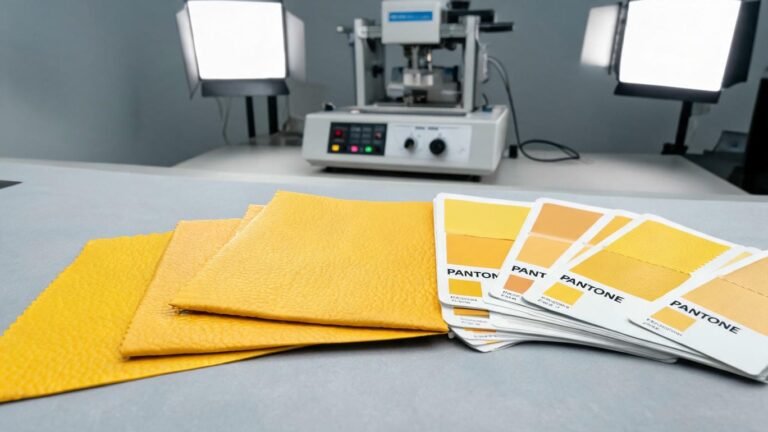
Tensile strength testing — every batch of faux leather for upholstery should pass ISO 3376 verification before entering production.
Specs 2–4: Tensile, Tear, and Flex Resistance
Beyond abrasion, upholstery faux leather must survive the mechanical stresses of daily seating: the pull of someone sitting down (tensile), the stress at seam and staple points (tear), and the repeated flexing at seat edges and cushion breaks (flex). Three ISO standards define these:
Tensile strength (ISO 3376): The force required to break the material per unit width. Standard PU faux leather tests at 6–10 N/mm. Commercial-grade silicone leather tests at 10–15 N/mm. Lower tensile strength means the material tears at stress points — typically where it is stapled to the frame or sewn at seams.
Tear strength (ISO 34-1): The resistance to propagation of a cut or tear. Standard PU tests at 10–15 N. Silicone leather tests at 15–20 N. A material with low tear strength will develop runs from minor cuts — a stitch hole becomes a tear, and a tear becomes a split.
Flex resistance (ISO 5402): The number of flex cycles before visible cracking appears. Standard PU cracks at 20,000–50,000 cycles. Silicone leather sustains 50,000–100,000+ cycles. This is the test that predicts whether seat edges and cushion breaks will crack over time — and it is the one most commonly omitted from spec sheets.
Require all three test results on your purchase order. A supplier who provides only Martindale data is hiding the mechanical property that will fail first. In our experience, flex cracking is the #1 failure mode in commercial faux leather upholstery — and it is the spec most buyers never ask for.
Specs 5–6: Hydrolysis and UV Resistance
Two environmental factors destroy faux leather for upholstery faster than mechanical wear: moisture and sunlight. Hydrolysis is the chemical breakdown of PU polymer chains in the presence of water vapor — it causes the coating to delaminate from the backing fabric, producing the “peeling” effect that everyone recognizes as failed faux leather. UV resistance determines whether the color fades and the surface embrittles under window light.
Standard PU leather shows hydrolysis damage within 2–3 years in humid environments — particularly in tropical and coastal markets. The hydrolysis test (ISO 11507) accelerates moisture exposure to predict real-world degradation. PVC is more hydrolysis-resistant than PU but has poor UV stability. Silicone leather is inherently hydrolysis-proof (the Si-O bond does not hydrolyze) and UV-stable for 1,000+ hours per ASTM G154. For a material comparison, see our silicone vs PU guide.

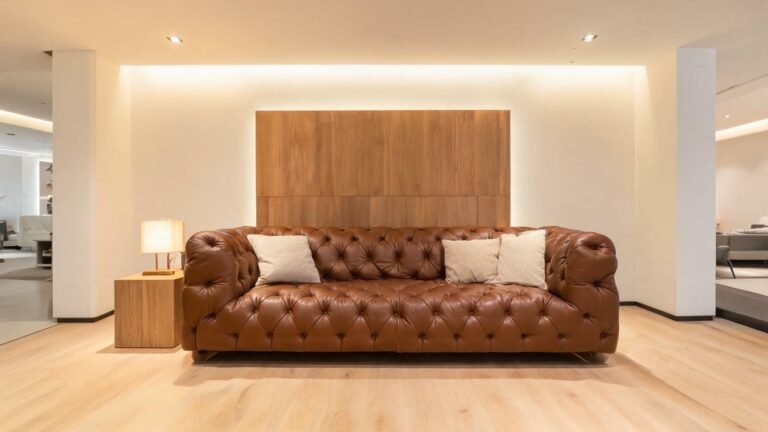
Faux leather sofa upholstery — hydrolysis and UV are the environmental factors that determine whether this sofa lasts 3 years or 10.
Specs 7–8: Cleanability and VOC Emissions
The final two specifications address post-installation performance: can the upholstery be cleaned without degrading, and does it emit chemicals into indoor air?
Cleanability: Commercial upholstery requires disinfection — not just cleaning. In healthcare, hospitality, and education environments, the material must withstand repeated cleaning with alcohol-based disinfectants, bleach solutions, and commercial cleaning agents. Standard PU leather degrades under bleach exposure — the surface becomes sticky and eventually cracks. Silicone leather is bleach-safe and alcohol-compatible, with no surface degradation after repeated cleaning cycles.
VOC emissions: PU and PVC faux leather contain solvents and plasticizers that off-gas volatile organic compounds into indoor air. ISO 16000-6 and VDA 277 measure VOC emissions — and EU E1 and similar standards set maximum limits. Silicone leather produces zero/near-zero VOC emissions because its solvent-free dry coating process does not introduce volatile compounds. For indoor air quality compliance, this is the difference between pass and fail. For more on total cost of ownership in upholstery, see our upholstery TCO guide.

Fabric inspection area — incoming material QC is the last line of defense against specification non-conformance before it reaches the upholstery production line.
The Complete Specification Checklist
Here is the full specification sheet you should attach to any purchase order for faux leather for upholstery. If the supplier cannot provide test data for all eight, you are buying an untested material:
| Spec | Test Standard | Commercial Min | TOPSUN Spec |
|---|---|---|---|
| Abrasion | ISO 12947-2 | 100,000 cycles | 200,000+ cycles |
| Tensile strength | ISO 3376 | ≥ 10 N/mm | ≥ 10–15 N/mm |
| Tear strength | ISO 34-1 | ≥ 15 N | ≥ 15–20 N |
| Flex resistance | ISO 5402 | ≥ 50,000 cycles | ≥ 50,000–100,000 cycles |
| Hydrolysis resistance | ISO 11507 | No delamination at 5+ yrs | Inherently hydrolysis-proof |
| UV resistance | ASTM G154 | 500+ hours | 1,000+ hours |
| Cleanability | AATCC 127 | Alcohol-compatible | Bleach-safe, alcohol-compatible |
| VOC emission | ISO 16000-6 | EU E1 compliant | Zero/near-zero VOC |
Comprehensive sofa features — see how silicone leather meets all 8 specification thresholds for commercial faux leather upholstery.
Frequently Asked Questions
What Martindale rating do I need for commercial upholstery?
For commercial upholstery — hotel lobbies, office common areas, restaurant seating, public transit — you need a minimum of 100,000 Martindale cycles per ISO 12947-2. This qualifies the material as “very heavy duty” for contract environments. Residential upholstery can use materials rated at 20,000–40,000 cycles, but specifying the same material for commercial use is the most common cause of premature furniture failure. TOPSUN’s silicone leather tests at 200,000+ cycles, exceeding the commercial threshold by 2×.
How do I verify a supplier’s test data without visiting the factory?
Request third-party test reports from SGS, Intertek, or TUV — not the supplier’s own in-house data. The report should reference the specific ISO/ASTM standard number, the testing laboratory’s accreditation, and the date of testing (within 12 months). Cross-reference the test values against the standard’s published thresholds. If the supplier cannot provide third-party reports, treat their spec sheet as marketing material, not engineering data. For our certifications, see our certification portfolio.
Specify to Survive
The difference between faux leather for upholstery that lasts a decade and material that peels in two years is not luck — it is specification. Eight test standards, eight pass values, and a third-party report for each one. If your purchase order does not include all eight, you are leaving the performance of your product to chance. Silicone leather meets every threshold in this guide with margin to spare — and does it without VOC emissions, without hydrolysis risk, and without the environmental compliance burden of traditional synthetic leather. That is not just a better material. It is a better specification.
About TOPSUN
TOPSUN manufactures faux leather for upholstery that meets all eight B2B specification thresholds — providing furniture manufacturers with silicone-coated material verified to 200,000+ Martindale cycles, 1,000+ UV hours, and zero VOC emissions.
With ISO 12947-2, ISO 3376, ISO 34-1, ISO 5402, ISO 11507, ASTM G154, AATCC 127, and ISO 16000-6 test data from SGS and Intertek, our silicone leather provides the complete specification package that commercial upholstery requires — with third-party verification on every batch.