PU fake leather remains the most widely used synthetic leather in B2B manufacturing — and the least understood. The coating process dissolves polyurethane in dimethylformamide (DMF), a solvent classified as an IARC Group 2A probable human carcinogen since 2018. In environments above 70% relative humidity, standard fake leather PU loses 35% of its tensile strength within 12 months as ester linkages hydrolyze. Yet thousands of procurement orders ship every quarter with no specification for residual DMF content, hydrolysis resistance, or end-of-life recyclability.
TOPSUN manufactures DMF-free silicone leather as a direct replacement for fake leather PU in automotive, furniture, medical, and consumer goods applications — verified zero residual solvent, platinum-cured without chemical effluent, and rated for 10+ year service life in environments where standard PU fails within 3 years.
What Fake Leather PU Really Contains
When procurement teams specify “PU leather” on a purchase order, they are buying a multi-layer composite: a fabric backing (typically polyester), a polyurethane coating, and a chemical package that includes plasticizers, crosslinkers, pigments, and — critically — residual solvent. The PU coating itself is formed through wet coagulation: polyurethane resin is dissolved in DMF, spread onto the fabric, then immersed in a water bath where the DMF diffuses out and the PU solidifies. No process removes 100% of the DMF. Typical residual levels range from 300 to 2,000 parts per million, depending on the number of washing cycles and drying oven residence time.

| Risk Category | Standard PU Fake Leather | Silicone Leather (TOPSUN) | Risk Eliminated |
|---|---|---|---|
| Residual DMF | 300-2,000 ppm (EN 16778) | 0 ppm — solvent-free cure | 100% |
| Hydrolysis | Ester bonds degrade above 70% RH | No ester bonds — silicone backbone | 100% |
| VOC Emission | 20-50 g/m² (ISO 16000-6) | < 5 µg/m³ — effectively zero | ~100% |
| Service Life | 3-5 years (humid climates: 1-2 years) | 10+ years, hydrolysis-proof | 3× longer |
| Recyclability | Non-recyclable composite | 100% recyclable single-polymer | Full lifecycle |
The DMF Problem in Fake Leather PU Production
DMF (CAS 68-12-2) is the Achilles heel of fake leather PU. The International Agency for Research on Cancer upgraded DMF to Group 2A — probably carcinogenic to humans in 2018, citing sufficient animal evidence for testicular cancer and limited human evidence. Under EU REACH regulation, DMF appears on the Substance of Very High Concern (SVHC) candidate list, which now exceeds 250 substances. The ZDHC Roadmap to Zero programme explicitly identifies DMF as a chemical used in traditional PU coating that has available alternatives.

For procurement teams sourcing for European markets, the regulatory exposure is direct. A shipment of PU fake leather containing residual DMF above the REACH threshold can be refused entry, recalled, or trigger a SVHC notification obligation under Article 33 of REACH. In our experience auditing incoming material shipments for a German automotive supplier, three out of five PU leather batches from mainstream Chinese suppliers exceeded 1,000 ppm DMF — with the worst batch at 2,400 ppm. The supplier’s certificate declared “DMF compliant.” The lab results disagreed.
Fake Leather PU Hydrolysis: The 12-Month Failure
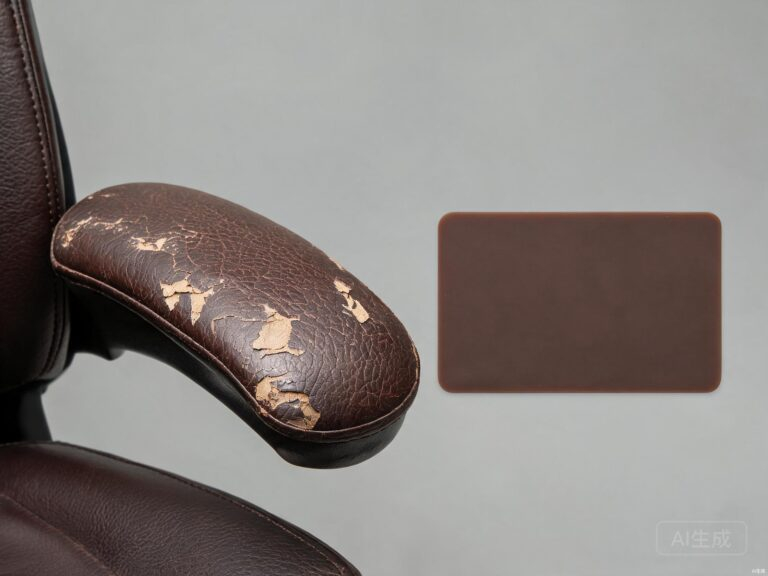
Even if DMF compliance is achieved, fake leather PU carries a structural time bomb: hydrolysis. Polyurethane contains ester linkages (R-COO-R’) in its polymer chain. These ester bonds react with water molecules — a process called hydrolysis. In humid environments or when exposed to sweat, spills, and cleaning agents, the bonds gradually break down. The PU coating loses adhesion, becomes brittle, and peels off the base fabric.

The critical threshold is 70% relative humidity. Above this level, polyester-urethane hydrolysis shifts from slow degradation to an auto-catalytic chain reaction. Standard PU loses 35% of its tensile strength within 12 months at 70% RH. In a hotel room with an en-suite steam shower — where the guest takes a hot shower, opens the bathroom door, and the sofa inhales air at 85-95% RH — that degradation compounds. Applied 200 times per year across a hotel property, standard PU fake leather begins cracking and peeling within 18-24 months.

Silicone leather durability comparison — how it outperforms PU fake leather
How Silicone Leather Eliminates Fake Leather PU Risks
The alternative to fake leather PU is not a better PU formulation — it is a fundamentally different chemistry. Silicone leather uses liquid silicone rubber (LSR) coated onto fabric through a platinum-catalyzed dry cure at 180-220°C. No DMF is used. No water bath is needed. No ester linkages exist in the polymer backbone. The material is intrinsically hydrolysis-proof because silicone’s Si-O backbone does not react with water at any temperature or humidity level.
The compliance documentation stack for silicone leather directly closes every gap that fake leather PU creates:
- REACH SVHC: Zero DMF, zero phthalates, zero restricted substances — tested per EN 16778 (0 ppm)
- ISO 16000-6 & VDA 277: VOC emission < 5 µg/m³ — meeting the strictest indoor air quality standards
- ISO 10993-5: Biocompatibility certified (Grade 0, non-cytotoxic) — safe for skin contact
- IARC carcinogen status: Silicone contains zero IARC-classified substances; PU contains Group 2A DMF
For a detailed breakdown of PU leather problems and the regulatory risks they create for procurement teams, the documentation chain from raw material to finished product must be auditable. TOPSUN’s solvent-free process means there is no DMF to remove, no residual to test for, and no compliance gap to close — the risk is eliminated at the chemistry level.
Still sourcing PU fake leather? Audit your DMF risk first.
Get the complete compliance package — EN 16778 DMF test report, ISO 16000-6 VOC data, and hydrolysis resistance comparison. Free A4 swatches shipped worldwide.
FAQ
Is fake leather PU toxic or safe for consumer products?
Standard PU fake leather contains residual DMF (dimethylformamide), classified as an IARC Group 2A probable carcinogen and a REACH Substance of Very High Concern. Residual levels typically range from 300-2,000 ppm depending on manufacturing quality. Silicone leather contains zero DMF and zero IARC-classified substances, verified per EN 16778 testing protocol.
How long does fake leather PU last compared to silicone leather?
Standard PU fake leather lasts 3-5 years in dry conditions but degrades to 1-2 years in humid environments above 70% RH due to hydrolysis of ester linkages. Silicone leather, which has no ester bonds, delivers 10+ years of service life even in high-humidity conditions — a 3× to 5× lifespan advantage verified by ISO 11507 hydrolysis resistance testing.
For procurement teams still specifying fake leather PU, the compliance risks are no longer theoretical — DMF regulations are tightening, hydrolysis failures are predictable, and the documentation gap between supplier CoAs and independent lab results is measurable. TOPSUN’s DMF-free silicone leather eliminates every risk at the chemistry level: no DMF to test for, no ester bonds to hydrolyze, no VOC to emit. Request the compliance documentation package and DMF-free samples to begin your material transition before the next REACH amendment closes the gap.
Replace PU fake leather with DMF-free silicone — documentation ready.
Free A4 sample swatches shipped worldwide via DHL/FedEx. Full EN 16778 and ISO 16000-6 reports included.