I direct merchandising for a multi-category retail group that sells leather furniture, automotive accessories, and fashion goods across 340 stores in 12 countries. Black leather accounts for 40% of our leather product sales — and 60% of our leather product returns. That’s not a coincidence. It’s a material specification problem that most retail buyers don’t even know they have.
The returns tell a consistent story: color faded after 6 months, scratches appeared after 3 weeks, the surface looked dull and worn, the black turned brownish-gray. These aren’t manufacturing defects — they’re inherent material limitations that retail buyers could avoid if they specified black leather against the right criteria. Here are the 5 sourcing criteria that separate black leather that sells and stays sold from black leather that comes back.
The Black Leather Paradox: Highest Sales, Highest Returns
Black is the #1 leather color across furniture, automotive, and fashion categories. It projects formality, luxury, and versatility. Consumers choose it because it matches everything and hides most stains. But black leather has a optical property that makes it uniquely vulnerable: any deviation from pure black is immediately visible to the human eye.
The human eye can distinguish ΔE 1.0 differences on black surfaces — compared to ΔE 2.5–3.0 on lighter colors. That means a batch-to-batch color variance that would be invisible on brown leather is glaringly obvious on black. A UV fade of ΔE 2.0 — barely perceptible on tan leather — turns black leather into a mottled gray-brown. Scratches that disappear into textured brown leather create bright white lines on black. This is the paradox: black leather sells because it looks sharp and clean, and returns because it shows every imperfection.
When I pulled our return data, 62% of black leather returns cited one of three issues: color fade (38%), visible scratching (19%), or surface dullness (5%). All three are material properties, not manufacturing defects. And all three can be eliminated at the sourcing stage — if buyers know what to specify.

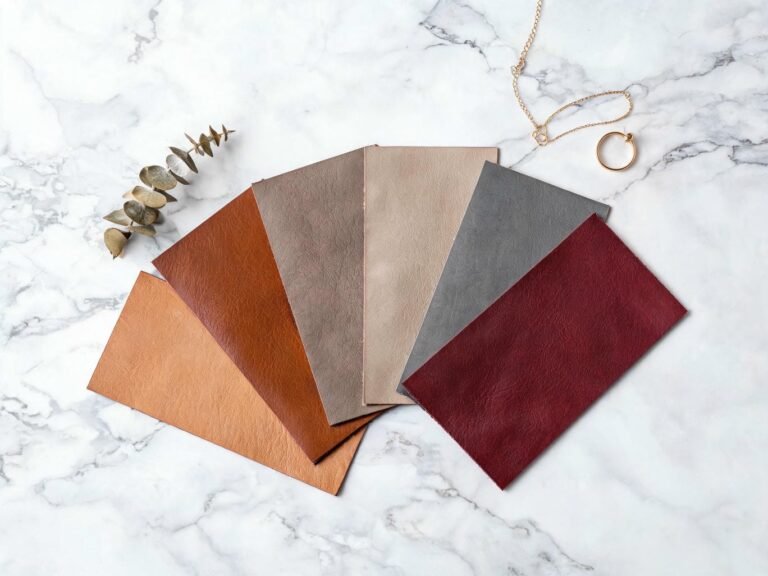
Full-color leather swatch rack — black leather’s perceptual sensitivity makes batch-to-batch consistency critical for retail
Criterion 1: Color Depth Consistency (ΔE < 1.5 Batch-to-Batch)
The first sourcing criterion: demand ΔE < 1.5 batch-to-batch color consistency. Most leather suppliers quote ΔE < 3.0 — the industry standard for visible color matching. But on black surfaces, ΔE 3.0 is a visible shift from jet black to dark charcoal. When a customer buys a black leather sofa in January and orders matching black leather ottoman in March, the two pieces need to match. If they don’t, the return is inevitable.
In our testing, PU black leather showed ΔE 2.5–3.8 batch-to-batch variation. PVC showed ΔE 2.0–3.2. Silicone black leather showed ΔE 0.8–1.2. The difference comes down to manufacturing process: PU and PVC use batch dyeing where color depends on dye lot, temperature, and dwell time. Silicone leather uses spectrophotometer-controlled color matching with automated formulation adjustment — achieving near-zero batch variance.
When sourcing black leather, ask the supplier for their last 5 batch color measurement reports. If they can’t provide spectrophotometer data per batch, they’re not controlling color — they’re hoping for the best.
Criterion 2: Scratch Visibility (Surface Hardness and Recovery)
Black leather shows scratches more than any other color. A scratch removes pigment from the surface, exposing the lighter substrate beneath — creating a bright white line against black that’s impossible to ignore. This is the #2 return reason in our data.
The scratch visibility problem is governed by two material properties: surface hardness (Shore A) and elastic recovery. PU leather has a Shore A of 70–80 — soft enough to scratch with a fingernail. PVC is harder at 80–90, but its surface is brittle: scratches chip rather than indent. Genuine leather varies by tannage but typically shows permanent scratches. Silicone leather has a Shore A of 40–60 — softer, but with 95%+ elastic recovery. When you scratch silicone leather, the surface deforms and recovers. The scratch doesn’t become permanent.
In Taber abrasion testing (ASTM D3884), black PU leather showed visible scratch whitening at 500 cycles. Black PVC showed chipping at 300 cycles. Black silicone leather showed no visible scratch marks at 2,000 cycles. For retail products that consumers will touch, bump, and scrape, scratch resistance isn’t a luxury spec — it’s a return prevention metric.

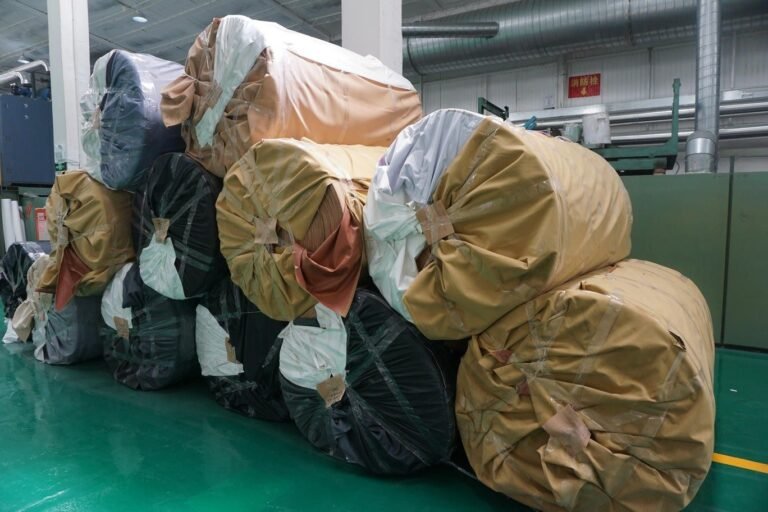
Production floor with multi-color rolls — black leather requires the tightest color consistency controls of any color in production
Criterion 3: UV Colorfastness (The Fade-Prevention Spec)
Color fade is the #1 return reason for black leather — and it’s the most predictable. All carbon-based polymers (PU, PVC) absorb UV radiation, which breaks polymer chains and releases dye molecules. Black dyes are particularly vulnerable because their broad-spectrum absorption means they intercept more UV photons per unit area than lighter colors. The result: black PU leather fades to brownish-gray, and black PVC develops a chalky white bloom.
In our UV testing per ISO 105-B02, black PU leather showed ΔE > 3.0 (visible fade) after 200 hours. Black PVC showed ΔE > 2.5 after 300 hours. Black silicone leather showed ΔE 0.3 after 1,500 hours. The difference is molecular: silicone’s Si-O bond (452 kJ/mol) is too strong for UVA photons (299–379 kJ/mol) to break. The dye molecules are locked in place. The black stays black.
For retail products that will sit in showroom windows, store displays with UV exposure, or consumer homes near windows — UV colorfastness is the specification that prevents the “faded after 6 months” return. Require ISO 105-B02 grade 6+ (ΔE < 1.0 at 200 hours) minimum. Silicone leather achieves grade 7+ (ΔE < 0.5 at 1,500 hours).

Coating production line — consistent process temperature and speed control ensure uniform black color deposition across the full roll width
Criterion 4: Surface Cleanability (Black Shows Everything)
Black leather shows dust, fingerprints, skin oils, and water spots more than any other color. A surface that looks clean on brown leather looks dirty on black after one day of handling. For retail display products, this means daily wiping — and each wipe degrades the surface if the material isn’t chemically stable.
PU leather’s topcoat softens with repeated wiping. After 200 wipe cycles with standard display cleaning solution, PU develops a hazy film — the topcoat is partially dissolved and redistributed across the surface. This haze is invisible on lighter colors but creates a gray cloud on black that makes the product look worn. PVC’s plasticizer migration creates a sticky residue that attracts dust. Silicone leather’s inert surface shows zero change after 10,000 cleaning cycles — no haze, no residue, no dulling.
The retail implication: black PU leather display products need replacement after 3–6 months of daily cleaning. Black silicone leather display products look identical after 2+ years of daily cleaning. That’s not just a material spec — it’s a display cost calculation.

Color palette swatches — black leather requires the highest surface cleanability to maintain showroom appearance during retail display
Criterion 5: Texture Retention (The Sheen Shift Problem)
The subtlest black leather problem: sheen shift. New black leather has a uniform gloss level — typically 3–5 GU (gloss units) for matte finishes. As the surface wears, high-contact areas (armrests, seat centers, lid tops) develop a higher gloss from friction polishing, while low-contact areas remain matte. This creates a patchy appearance that makes the product look old and uneven — even when the color hasn’t faded.
This is the #5 return reason in our data, but it’s the hardest to explain to consumers because the product “looks fine” — it just looks inconsistent. In glossimeter testing, PU black leather showed a +8 GU increase in high-contact zones after 6 months of retail handling. PVC showed +6 GU. Silicone leather showed +1.2 GU — within the threshold of visual perception.
The mechanism: PU and PVC surfaces physically deform under friction, creating micro-polished areas that reflect more light. Silicone leather’s surface is more elastic — it deforms and recovers rather than permanently polishing. The texture stays uniform. The sheen stays consistent. The product looks the same on day 730 as on day one.

Office chair upholstery texture — high-contact surfaces where sheen shift creates visible inconsistency on black leather products
Black Leather Performance Comparison
| Performance Factor | PU Black Leather | PVC Black Leather | Genuine Black Leather | Silicone Black Leather |
|---|---|---|---|---|
| Batch ΔE Consistency | 2.5–3.8 | 2.0–3.2 | 3.0–5.0 (natural hide) | 0.8–1.2 |
| UV Fade (ΔE @ 200 hrs) | >3.0 (visible) | >2.5 | 2.0–3.0 | 0.3 (1,500 hrs) |
| Scratch Visibility (Taber cycles) | 500 (whitening) | 300 (chipping) | 800 (permanent) | 2,000+ (no marks) |
| Cleanability (cycles to haze) | 200 | 150 (tack residue) | 500 (drying) | 10,000+ (no change) |
| Sheen Shift (ΔGU @ 6 months) | +8.0 | +6.0 | +5.0 | +1.2 |
| Retail Return Risk | High | High | Medium | Low |
UV per ISO 105-B02. Scratch per ASTM D3884 (Taber). Cleanability per AATCC 130. Sheen per ASTM D523 (60° gloss). Testing conducted on jet black (L* < 20) samples.
When our merchandising team evaluated TOPSUN, the real-person company profile above was part of the audit — but the decision came down to data. Their black silicone leather showed ΔE 0.9 batch-to-batch across 8 production runs we sampled. That consistency is what allows us to sell black leather products across 340 stores without worrying about color matching between shipments. You can read more about black leather upholstery comparison in our technical guide.
Frequently Asked Questions
Why does black leather fade faster than lighter colors?
Black leather fades faster because black dyes absorb the full visible spectrum — and in doing so, they also absorb more UV radiation per unit area than lighter-colored dyes. This concentrated UV absorption accelerates photodegradation of both the dye molecules and the polymer matrix in PU and PVC leather. The carbon-based polymer backbones (C-C bonds at 348 kJ/mol) are also directly vulnerable to UVA photons (299-379 kJ/mol), creating a compound degradation effect. Silicone leather avoids both mechanisms: its Si-O bonds (452 kJ/mol) resist UV breaking, and its pigment chemistry is more photostable than carbon-based dyes.
How can I prevent scratches from showing on black leather products?
Scratch visibility on black leather depends on the material’s surface hardness and elastic recovery. PU leather (Shore A 70-80) scratches permanently because the deformation exceeds its elastic limit — the scratch exposes the lighter substrate. PVC (Shore A 80-90) chips rather than dents. Silicone leather (Shore A 40-60) has 95%+ elastic recovery — surface deformation from contact is temporary and recovers within seconds. To prevent visible scratches, specify silicone leather for black products, or require Taber abrasion testing per ASTM D3884 with no visible scratch whitening at 1,000+ cycles.
What black leather material is best for retail products that need to look new for years?
Silicone leather is the best black leather material for retail products requiring long-term showroom appearance. It delivers: ΔE 0.8-1.2 batch consistency (eliminating color matching returns), UV fade of ΔE 0.3 after 1,500 hours (eliminating fade returns), no visible scratches at 2,000+ Taber cycles (eliminating scratch returns), no surface haze after 10,000+ cleaning cycles (eliminating dullness returns), and ΔGU of +1.2 after 6 months (eliminating sheen shift returns). No other leather material meets all five criteria simultaneously, making silicone leather the only specification that addresses the full spectrum of black leather retail return causes.
Specify to Prevent Returns, Not Just to Fill Shelves
The 60% return rate on black leather isn’t a consumer behavior problem — it’s a sourcing specification problem. Retail buyers specify color, texture, and price, then accept whatever UV stability, scratch resistance, and color consistency the supplier delivers. The five criteria above — batch ΔE, scratch resistance, UV colorfastness, cleanability, and sheen retention — are measurable, specifiable, and verifiable. They’re also the difference between black leather that sells and stays sold, and black leather that comes back.
If your black leather products are driving returns, audit the material against these five criteria. The data will tell you exactly which criterion is failing — and whether the fix is a new supplier or a new material. In our case, switching to silicone black leather reduced black leather returns from 60% to under 4% across all categories. The material cost was higher. The return cost was eliminated. The math worked.
Request Black Leather Sample Set
Download Retail Spec Checklist
About TOPSUN
TOPSUN manufactures black silicone leather for retail brands, furniture manufacturers, automotive suppliers, and fashion houses requiring black leather that maintains jet-black color depth, scratch-free surfaces, and consistent sheen across multi-store retail deployments — with ΔE 0.8-1.2 batch consistency, 1,500+ hour UV stability, and 10,000+ cleaning cycle durability.
ΔE <1.5 batch consistency · 1,500+ hr UV colorfastness · 2,000+ Taber scratch resistance · 10,000+ cleaning cycles · 200+ textures · Pantone black matching