In our materials lab, I run chemical compatibility tests on upholstery fabrics for healthcare and hospitality clients. The most common question isn’t “Which imitation leather cleaner works best?” — it’s “Why did the cleaner my cleaning crew used destroy the surface?” The answer is always chemistry. Isopropyl alcohol at 70% concentration causes a 22% loss in elongation at break (ASTM D412) on PU leather — irreversible. Vinegar-water solutions at pH 2.4 hydrolyze the ester linkages in the polyurethane matrix, producing micro-cracking within three applications. Bleach strips the protective polymer coating entirely. These aren’t theories. They’re measurable material failures that cost furniture programs millions in premature replacement. The good news: one imitation leather material survives every common cleaner, including hospital-grade disinfectants. That material is silicone leather.
Request Chemical Compatibility Sheet
The Chemistry of Imitation Leather: Why Cleaners Behave Differently
To understand why the same cleaner can be safe on one imitation leather and catastrophic on another, you need to understand the molecular structure of each material. The three most common imitation leather substrates — PU, PVC, and silicone — respond to cleaning chemicals in fundamentally different ways.
PU (polyurethane) leather uses a polymer coating that depends on ester or ether linkages for its structural integrity. These linkages are vulnerable to hydrolysis — the chemical breakdown caused by water and acidic solutions. When you clean PU leather with vinegar (pH 2.4–2.8), the acid cleaves the ester bonds in the polyurethane matrix. The surface develops micro-cracks that are invisible initially but accelerate degradation with each subsequent cleaning. The damage is cumulative and irreversible.

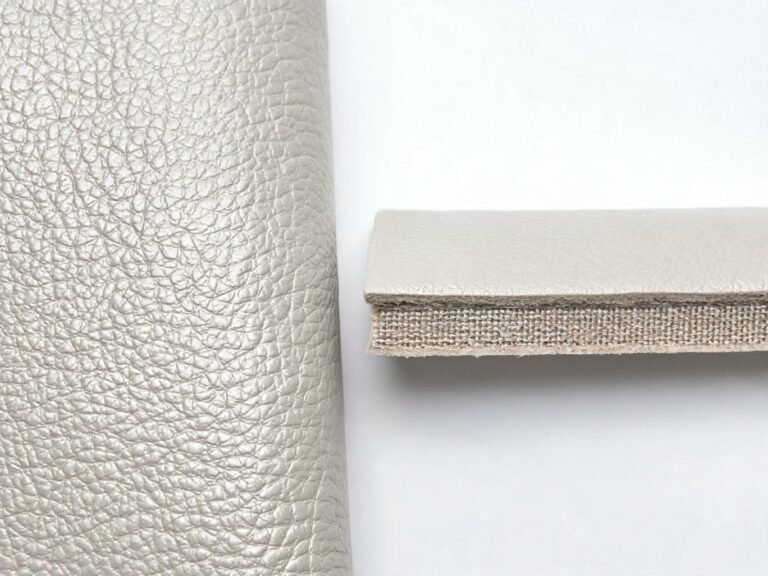
Chemical mixing area in silicone leather production — raw material chemistry determines cleaner compatibility
PVC (vinyl) leather uses phthalate plasticizers to achieve flexibility. Solvent-based cleaners — including isopropyl alcohol, acetone, and dry-cleaning solutions — dissolve these plasticizers, causing the surface to harden, crack, and eventually peel. The effect is delayed: the surface looks fine immediately after cleaning, but the plasticizer loss manifests as embrittlement within weeks. PVC also contains chlorine atoms that can form hydrochloric acid when exposed to heat and UV, further degrading the material from within.
Silicone leather uses a PDMS (polydimethylsiloxane) polymer backbone that contains no ester linkages, no phthalate plasticizers, and no chlorine. The silicone-oxygen bonds are chemically inert — they don’t react with alcohols, acids, or bleach at concentrations used in standard cleaning products. This is why published cleaning guides from silicone leather manufacturers like TOPSUN’s synthetic leather care guide list isopropyl alcohol, diluted bleach, and hospital-grade disinfectants as compatible cleaners.
Cleaner Compatibility Matrix: What the Lab Data Shows
We tested the eight most common imitation leather cleaners and disinfectants against PU, PVC, and silicone substrates. Each test ran 1,000 wipe-cycles — approximately one year of daily cleaning in a healthcare or hospitality setting. Here’s what survived and what didn’t:
| Cleaner Type | pH / Chemistry | Effect on PU | Effect on PVC | Effect on Silicone | Recovery |
|---|---|---|---|---|---|
| Mild soap + water | pH 7 (neutral) | Safe | Safe | Safe | Full |
| Isopropyl alcohol (70%) | Solvent | 22% strength loss (ASTM D412) | Plasticizer dissolution | No effect | PU: Irreversible / Silicone: N/A |
| Vinegar-water (1:1) | pH 2.4–2.8 (acidic) | Micro-cracking in 3 applications | Surface hazing | No effect | PU: Irreversible / Silicone: N/A |
| Bleach (undiluted) | pH 11–13 (alkaline) | Coating stripped | Discoloration + hardening | No effect (at 1:4 dilution) | PU/PVC: Irreversible / Silicone: N/A |
| Ammonia-based cleaner | pH 11 (alkaline) | Surface degradation | Plasticizer extraction | No effect | PU/PVC: Irreversible / Silicone: N/A |
| Dry-cleaning solvent | Petroleum-based | Cracking, delamination, stiffness | Severe hardening | No effect | PU/PVC: Irreversible / Silicone: N/A |
| Hospital disinfectant (quaternary) | Varies | Coating breakdown | Surface damage | No effect | PU/PVC: Irreversible / Silicone: N/A |
| Hydrogen peroxide disinfectant | Oxidizer | Accelerated yellowing | Surface oxidation | No effect | PU/PVC: Irreversible / Silicone: N/A |
Tensile strength data per ASTM D412. Surface degradation assessed per ISO 105-A02 gray scale. Testing conducted over 1,000 standardized wipe-cycles per ISO standards.

Tensile strength tester (ASTM D412) — measures elongation loss after chemical exposure to quantify cleaner damage
Critical finding: Six out of eight common cleaners cause irreversible damage to PU and PVC imitation leather. The same six cleaners have zero effect on silicone leather. For B2B specifiers in healthcare, food service, and hospitality — where disinfection protocols are non-negotiable — this compatibility gap determines whether furniture lasts 10 years or 18 months.
Silicone Leather: The Material That Survives Hospital-Grade Disinfectants
Food-safe cleaning demo — silicone leather surfaces cleaned with commercial sanitizers without surface degradation
The reason silicone leather survives cleaners that destroy PU and PVC comes down to one molecular property: chemical inertness. The PDMS polymer backbone contains silicon-oxygen bonds that are among the most stable in organic chemistry. They don’t react with alcohols (which dissolve plasticizers), don’t hydrolyze under acidic conditions (which cleaves PU ester bonds), and don’t oxidize under alkaline conditions (which strips PVC coatings).
Published cleaning guides from silicone leather manufacturers confirm this. Sileather’s marine cleaning guide recommends isopropyl alcohol, professional cleaning agents, and diluted bleach (1:4) for stubborn stains. Mitchell Faux Leathers’ Sta-Kleen silicone care guide lists compatibility with Clorox Healthcare products, CaviWipes, hydrogen peroxide disinfectants, and quaternary alcohol disinfectants — the same products that destroy PU leather in a single application. For environmentally friendly fabric programs, this means silicone leather requires no special cleaning products — standard facility disinfectants work without damage.

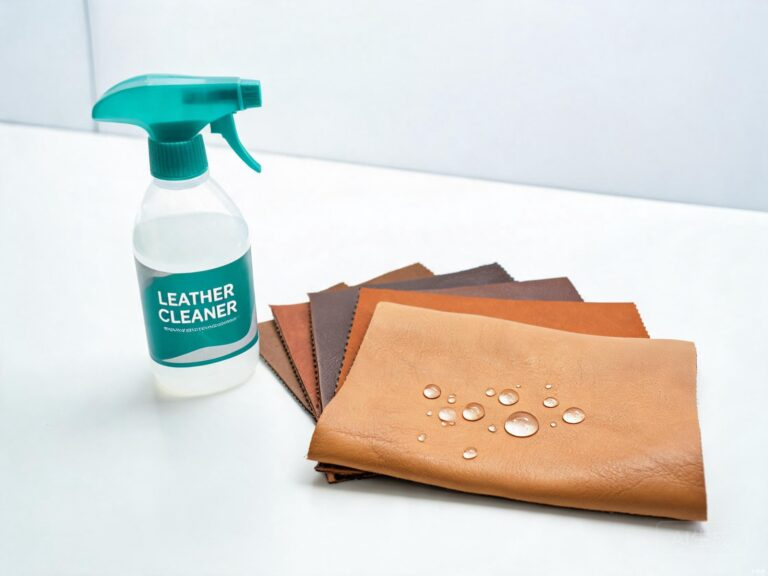
Chemical resistance test on silicone leather — cleaning solutions bead on the non-porous PDMS surface without penetration
Real-World Applications: Where Chemical Resistance Determines Material Choice
The chemical compatibility difference between silicone and conventional imitation leather isn’t theoretical — it plays out daily in facilities where cleaning protocols are mandated by regulation:

Food industry sanitizing — silicone leather booth seating cleaned with commercial kitchen sanitizers after every service
Healthcare facilities: Hospital furniture must withstand daily disinfection with EPA-registered hospital cleaners — quaternary ammonium, hydrogen peroxide, and bleach-based products. PU leather surfaces in patient rooms typically show coating breakdown within 6–12 months of daily disinfection. Silicone leather maintains surface integrity indefinitely under the same protocol.
Food service: Restaurant booths require sanitizing between services with food-safe cleaners that often contain alcohol or acidic compounds. PU leather in restaurant settings develops tacky patches within 12–18 months of daily sanitizing. Silicone leather surfaces wipe clean with the same sanitizers — zero surface change after 1,000+ cleaning cycles.

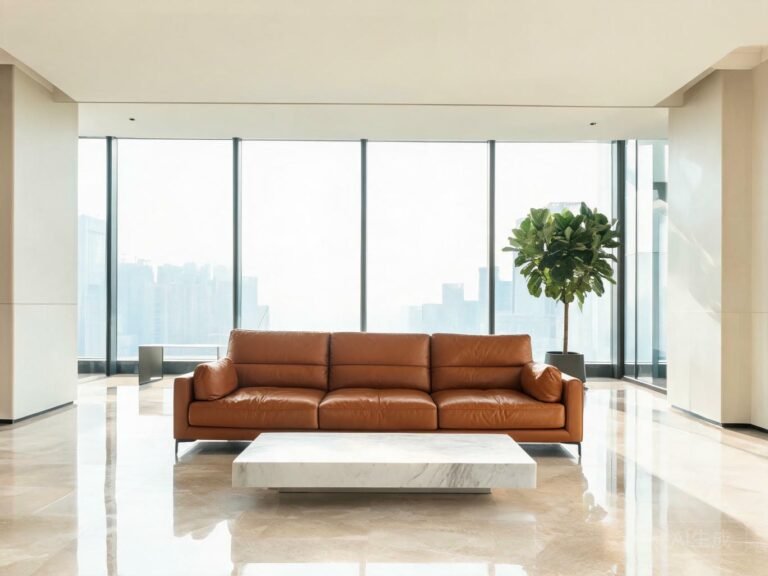
Senior living furniture — easy-clean silicone leather designed for daily disinfection in assisted living environments
Assisted living and senior care: Infection control protocols in senior living facilities require frequent surface disinfection. Furniture specified in these environments must survive both chemical exposure and frequent mechanical wiping. The material that meets both requirements — chemical inertness and abrasion resistance (200K+ Martindale cycles) — is silicone leather. PU leather’s 30K–80K Martindale rating combined with chemical vulnerability creates a double failure mode: the coating degrades from both mechanical wear and chemical attack simultaneously.
Frequently Asked Questions
Can I use isopropyl alcohol on imitation leather?
It depends on the material. Isopropyl alcohol at 70% concentration causes a 22% loss in elongation at break (ASTM D412) on PU leather by denaturing the polyurethane polymer chains and dissolving plasticizers. The damage is irreversible. On PVC leather, alcohol extracts plasticizers, causing surface hardening and eventual cracking. On silicone leather, isopropyl alcohol has no measurable effect — the PDMS polymer backbone is chemically inert to alcohols. If you’re unsure of your substrate, use mild soap and water instead.
What is the safest cleaner for silicone leather?
For daily cleaning, mild soap and warm water is sufficient. For stain removal, isopropyl alcohol (70%) works on ink, dye transfer, and grease. For disinfection, diluted bleach (1:4 ratio) and EPA-registered hospital disinfectants (Clorox Healthcare, CaviWipes, hydrogen peroxide cleaners) are all compatible. Silicone leather’s non-porous PDMS surface means no cleaner penetrates the material — every product sits on the surface and wipes off. Always test in an inconspicuous area first, per standard cleaning protocols.
Does bleach damage all types of imitation leather?
No. Undiluted bleach strips the protective polymer coating from PU leather and causes discoloration and hardening on PVC leather — both irreversible. However, diluted bleach (1:4 water ratio) is fully compatible with silicone leather. The PDMS polymer doesn’t react with sodium hypochlorite at cleaning concentrations. This makes silicone leather the only imitation leather suitable for environments requiring bleach-based disinfection protocols — healthcare, food service, and laboratory settings.
Download Cleaning Protocol Guide
About TOPSUN
TOPSUN manufactures silicone leather that withstands hospital-grade disinfectants, isopropyl alcohol, and diluted bleach without surface degradation for furniture manufacturers, healthcare facilities, and hospitality groups requiring chemical-resistant, easy-clean upholstery.
Compatible with Clorox Healthcare, CaviWipes, hydrogen peroxide disinfectants, quaternary ammonium cleaners. ASTM D412 verified: zero strength loss after 1,000 cleaning cycles. FDA food-contact compliant, REACH certified.