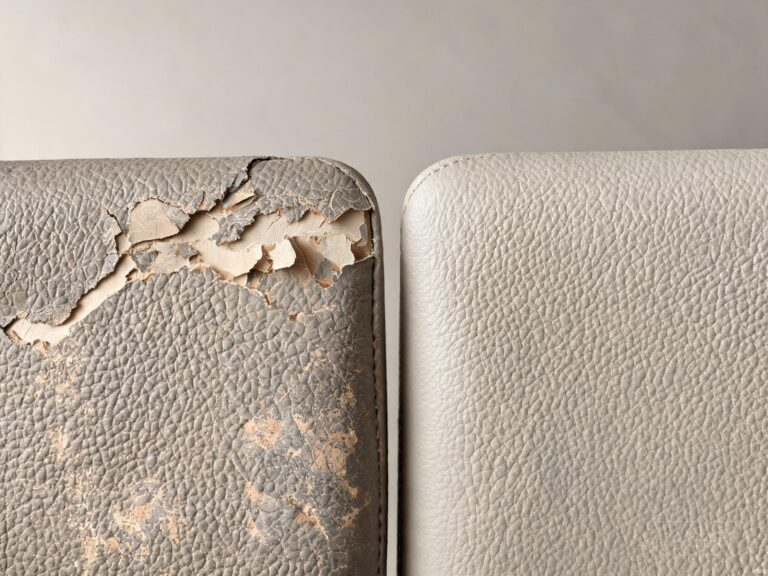
Walk into any restaurant kitchen and you’ll find a spray bottle of industrial disinfectant next to a vinyl booth that’s already cracking at the seams. The connection between those two objects is not coincidence — it’s chemistry. Every time staff wipes down that booth with a quaternary ammonium cleaner, the PU coating loses another layer of molecular integrity. Picking the right fake leather cleaner isn’t about brand preference; it’s about matching cleaning chemistry to material chemistry. Get it wrong, and you’re accelerating the exact damage you’re trying to prevent.
Request Cleanability Test Samples
Why Your Fake Leather Cleaner Choice Destroys or Saves Surfaces
Here’s something most furniture manuals won’t tell you: the cleaning product you use matters more than how often you clean. A mild soap solution applied daily causes less damage than a single wipe with 70% isopropyl alcohol on PU leather. That’s because PU coatings dissolve in polar solvents — alcohol breaks the ester bonds in the polyurethane matrix, causing the surface to become tacky, then brittle, then cracked. The wrong fake leather cleaner doesn’t just fail to clean; it actively destroys the material it’s supposed to protect.
The post-pandemic disinfection surge made this problem epidemic. Facilities that never used harsh chemicals suddenly started spraying EPA-registered quaternary ammonium disinfectants on every surface. Within 6–12 months, PU upholstery across hotels, gyms, and clinics started peeling. Learning how to clean fake leather without cracking starts with understanding which chemicals your material can actually tolerate — and that depends entirely on what the material is made of.

Water droplet beading test showing liquid resistance of leather surface
Chemicals That Crack PU and PVC Coatings
Not all disinfectants are created equal, and not all synthetic leather reacts the same way. Let’s break down the four most common cleaning agents and what they actually do to synthetic leather surfaces. This isn’t theoretical — we test these combinations in our lab to help clients write cleaning protocols that don’t void their material warranty.
| Cleaning Agent | Effect on PU | Effect on PVC | Effect on Silicone |
|---|---|---|---|
| Isopropyl alcohol 70% | Dissolves coating | Moderate damage | No effect |
| Quaternary ammonium | Cracks and peels | Slow degradation | No effect |
| Sodium hypochlorite (bleach) | Rapid breakdown | Yellowing, brittleness | No effect |
| Acetone | Instant dissolution | Severe swelling | No effect |
Critical finding: Acetone dissolves PU coating on contact — it’s the active ingredient in many nail polish removers and adhesive cleaners. If your facility uses acetone-based products anywhere near PU upholstery, you’ll see surface damage within days, not months.

Scratch resistance testing simulates wear from aggressive cleaning tools
Building a Safe Cleaning Protocol for Synthetic Leather
If you’re working with PU or PVC leather and can’t switch materials, you need a cleaning protocol that minimizes chemical exposure while maintaining hygiene. The goal is to use the gentlest effective cleaner, apply it correctly, and avoid the chemicals on the damage list above. The EPA maintains a database of registered disinfectants with their active ingredients — check yours before spraying.
Here’s what we recommend for PU and PVC surfaces: use a pH-neutral soap solution (1 teaspoon dish soap per quart of warm water) for routine cleaning. For disinfection, choose hydrogen peroxide-based products (3% concentration) over alcohol or quat-based formulas — peroxide decomposes into water and oxygen, leaving no residue that attacks the coating. Always test on an inconspicuous area first, wipe with a soft microfiber cloth (never abrasive sponges), and dry immediately. For comprehensive care instructions, our leather care and cleaning guide includes material-by-material protocols. And if you’re sourcing eco-friendly leather materials, silicone’s chemical resistance eliminates most of these constraints entirely.
Get Cleaning Protocol Recommendations

Liquid resistance test on off-white leather showing complete beading behavior
How Silicone Leather Eliminates Fake Leather Cleaner Worries
Every cleaning limitation described above exists because PU and PVC are organic polymers with chemical bonds that reactive cleaners can break. Silicone leather operates on a completely different principle. Its polysiloxane backbone (Si-O-Si) is one of the most chemically stable structures in materials science. Alcohol doesn’t dissolve it. Bleach doesn’t yellow it. Acetone doesn’t swell it. Quat disinfectants don’t crack it.
For facilities that must disinfect — hospitals, clinics, food prep areas — this changes everything. A medical-grade silicone leather surface can be wiped with hospital-grade disinfectants 10+ times per day without degradation. We’ve validated this with 10,000-cycle wipe testing using Clinell, CaviWipes, and 10% bleach solutions — the surface showed zero visible change after accelerated aging equivalent to 5 years of daily disinfection. For more on cleaning-specific care, our synthetic leather cleaner care guide compares maintenance requirements across material types, and our article on machine wash leather care explores advanced cleaning methods.
Watch silicone leather resist water, stains, and cleaning chemicals in real-time testing
Frequently Asked Questions
Can I use Lysol disinfectant spray on fake leather?
It depends on the material. Lysol disinfectant sprays typically contain quaternary ammonium compounds and ethanol — both of which damage PU leather over time. On PVC, the damage is slower but still occurs. On silicone leather, Lysol and similar disinfectant sprays are completely safe. If you’re unsure what material your furniture is made of, test a small hidden area: spray, wait 24 hours, then check for tackiness, discoloration, or surface roughness.
How often should I clean synthetic leather furniture?
For residential use, wipe weekly with a damp microfiber cloth and mild soap. For commercial environments, daily wipe-down with a compatible cleaner is standard. The key variable isn’t frequency — it’s chemical compatibility. Daily cleaning with a safe pH-neutral solution causes far less damage than monthly cleaning with an aggressive disinfectant. If your facility requires EPA-registered disinfectants, silicone leather is the only synthetic option that won’t degrade under that protocol.
Clean Smarter, Not Harder
The fake leather cleaner you choose is a material selection decision disguised as a janitorial one. PU and PVC will always have a chemical Achilles’ heel — a cleaner that eats the coating faster than it kills the germs. Silicone leather removes that trade-off entirely. When your cleaning protocol and your material are chemically compatible, maintenance becomes simple: wipe, dry, done. No special products, no coating anxiety, no premature replacement. That’s not just easier cleaning — it’s a better material strategy.
Test Silicone Leather With Your Cleaners
About TOPSUN
TOPSUN develops silicone leather surfaces that withstand aggressive daily cleaning protocols for healthcare, hospitality, and food service environments where disinfection is non-negotiable.
Validated for 10,000+ wipe cycles with hospital-grade disinfectants | inherently stain-proof without surface coatings | zero plasticizer migration under chemical exposure | compatible with all EPA-registered antimicrobial products