Walk into any high-end furniture showroom, open any luxury bag catalog, or step into any premium car interior, and you’ll see the same pattern: textile and leather used together, not in isolation. The soft texture of fabric against the rich surface of leather. The pattern of a weave against the smooth grain of hide. The warmth of one material balancing the coolness of the other.
Textile and leather combinations are everywhere in premium product design because they work — they create visual interest, tactile contrast, and functional advantages that neither material can deliver alone. But combining these two materials well is harder than it looks. Get the proportions wrong, and the product looks busy. Get the colors wrong, and it looks cheap. Get the performance mismatch wrong, and it fails in the field.
In this guide, we’ll explore the principles of combining textile and leather materials in B2B product design — for furniture, automotive interiors, fashion accessories, and contract applications. We’ll cover the five rules of successful material pairing, the most common application patterns, and practical advice for ensuring your combinations look great and perform well over time.
See Our Interior Design Combinations Guide
Why Textile and Leather Combinations Work (The Design Psychology)
Before we get into the “how,” let’s talk about the “why.” Textile and leather combinations are so effective because they activate multiple design principles simultaneously.
Tactile contrast
We experience products through touch as much as through sight — especially products we sit on, hold, or wear. Textile is soft, fuzzy, warm, and textured. Leather is smooth, cool, firm, and sleek. When you put them next to each other, each material’s tactile qualities are amplified by the contrast. A leather sofa arm feels more luxurious when it’s next to a fabric cushion. A fabric bag feels more premium when it has leather trim. The contrast makes both materials feel better.
Visual hierarchy
Mixed-material design creates natural visual hierarchy — the eye is drawn to the transition point between materials, which designers can use to highlight important features (armrests, seat edges, bag flaps, door handles). Leather is naturally more “premium” looking than most textiles, so using leather on the most visible or most touched parts of a product creates a perception of higher quality — without the cost of covering everything in leather.
Functional specialization
Beyond aesthetics, textile and leather have different functional strengths. Leather is durable, stain-resistant (especially coated and silicone leather), and easy to clean — perfect for high-wear, high-touch areas. Textile is breathable, soft, and comfortable — perfect for seating surfaces and areas that touch skin. Combining them lets you put the right material in the right place, rather than compromising with a single material that’s OK at everything but great at nothing.
Cost optimization
Let’s be practical: leather is expensive. Textile is less expensive. Using leather on the parts that people see and touch most — and textile on the rest — lets you achieve a premium look and feel at a lower total material cost. This is why so many “leather” car interiors are actually leather on the seating surfaces and vinyl or textile on the sides and back. Most customers never notice the difference, but the cost savings are significant.

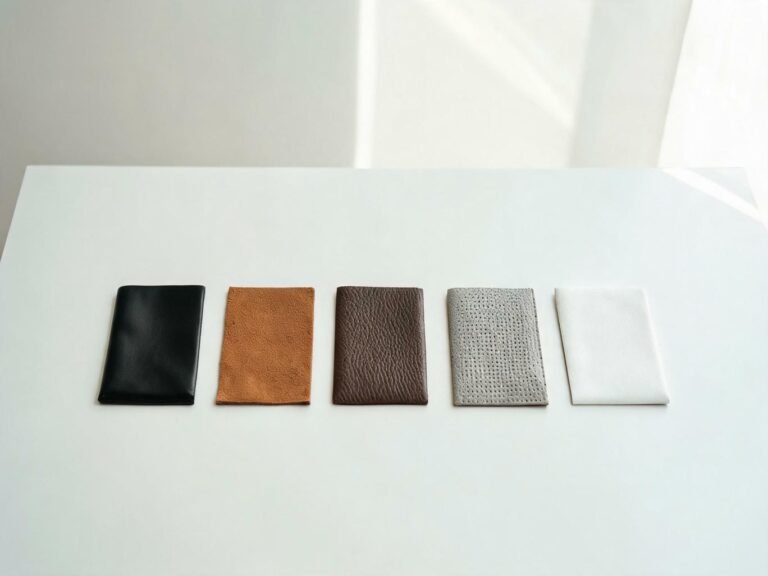
Material swatch selection — the key to successful textile and leather combinations is testing them together before specifying, not in isolation.
Designer’s rule of thumb: Use leather on the 20% of the product that gets 80% of the attention and use. Let textile handle the rest.
The 5 Rules of Successful Textile and Leather Pairing
Now let’s get practical. These are the five rules we follow when designing textile and leather combinations for B2B products. They apply across furniture, automotive, and fashion — any product where you’re combining these two materials.
Rule 1: Match the weight and quality level
A cheap textile next to expensive leather looks cheap. Expensive textile next to cheap leather looks cheap. The materials should be at roughly the same quality level — even if they’re different materials. A mid-grade woven fabric pairs well with mid-grade top-grain leather. A high-end velvet pairs well with premium full-grain leather. A budget canvas pairs well with budget PU leather. Mismatched quality levels are jarring — the cheaper material drags the more expensive one down.
Rule 2: One pattern, one solid (usually)
If the textile has a strong pattern (geometric, floral, stripe), the leather should be a solid color. If the leather has a strong texture or grain, the textile should be a simple solid or subtle pattern. Two strong patterns next to each other compete for attention and create visual chaos. The exception: if both patterns are in the same color family and very different scales (a small textile pattern with a large leather grain), you can sometimes make it work — but it’s risky and usually looks better in a photo than in person.
Rule 3: Use the 70/30 proportion
The most visually pleasing textile-and-leather combinations follow roughly the 70/30 rule: 70% one material, 30% the other. The dominant material sets the tone; the accent material provides contrast and interest. 50/50 splits tend to look indecisive — the eye doesn’t know where to focus. And more than 80/20 starts to look like the accent material was an afterthought. This isn’t a hard-and-fast rule, but it’s a good starting point that works for most product types.
Rule 4: Coordinate, don’t match
Trying to match the textile color and leather color exactly usually looks wrong — they’re different materials, so even if the colors are technically the same, they’ll look different because of texture, sheen, and how light interacts with them. Instead, coordinate. Use complementary colors, analogous colors, or different values of the same hue. A charcoal textile with black leather. A cream textile with tan leather. A navy textile with brown leather. These combinations are much more sophisticated than exact matches — and they’re much easier to execute consistently in production.
Rule 5: Consider the transition point
Where the two materials meet matters. A clean, precise transition (with stitching, piping, or a welt) looks premium and intentional. A messy or inconsistent transition looks cheap and careless. The transition is also where most field failures happen — if the two materials have different stretch characteristics, different thermal expansion rates, or different abrasion resistance, the seam or transition point will fail first. Always test the transition construction method under stress before going into production.
3 Common Application Patterns for Textile and Leather
There are three tried-and-true patterns for combining textile and leather in product design. Each one creates a different look and solves a different set of problems.
Pattern 1: High-wear zones in leather, comfort zones in textile
This is the most common pattern — especially in furniture and automotive. The parts that get the most wear (armrests, bolsters, headrests, edges) are leather. The parts where comfort and breathability matter most (seat cushion, back cushion) are textile. This is the pattern used in most “leather-trimmed” car seats. It’s practical, cost-effective, and visually appealing. For commercial and hospitality furniture, this pattern is increasingly popular with silicone leather on the high-wear zones because it has better stain resistance and durability than genuine leather. See our furniture sofa applications for examples.
Pattern 2: Leather accents and trim
In this pattern, the main body of the product is textile, and leather is used as trim, piping, handles, straps, or details. Think of a fabric tote bag with leather handles, a fabric sofa with leather arm caps, or a fabric chair with a leather base. This pattern adds a premium touch without using much leather — so it’s cost-effective. It also gives designers a lot of creative flexibility — the leather details can be changed seasonally or between product variants without reworking the whole product. This is the most common pattern in fashion accessories and is growing in furniture and interiors.
Pattern 3: Material blocking
Material blocking is the most design-forward pattern — large panels of textile and large panels of leather arranged in bold geometric compositions. Think of a sofa with leather on the outside arms and back and textile on the inside, or a chair with a leather frame and fabric seat and back. This pattern creates a strong visual statement and is popular in contemporary and modern design. It requires more precise engineering than the other patterns (the transitions are more prominent, so they need to be perfect), but when it’s done well, it looks absolutely stunning. For an example of this pattern with silicone leather, check out our interior design combinations guide.
Performance Considerations: Making Sure Your Combination Lasts
A textile and leather combination that looks great in the showroom but fails after a year in the field is a designer’s worst nightmare. Here are the performance issues to watch for and how to prevent them.
Differential wear
If one material wears much faster than the other, the product will look old and mismatched before its time. A textile seat cushion with a leather bolster looks great when both are new — but if the textile wears out in 3 years and the leather still looks good after 10, the product looks shabby. Make sure both materials have comparable expected lifespans for the application. For high-wear commercial applications, consider using silicone leather on the high-wear zones and a high-performance textile (like a solution-dyed acrylic or polyester) on the comfort zones — both will last 10+ years.
Color fastness mismatch
UV exposure fades different materials at different rates. If you have a textile and leather combination in a sunny location (a sunroom, a convertible car, a south-facing window), one material might fade faster than the other, creating a color mismatch. Always test both materials together under UV exposure (SAE J2527 or equivalent) and make sure their fade rates are similar. Silicone leather has inherently better UV stability than genuine leather or PU leather, so if you’re using silicone, make sure the textile you pair with it also has good UV resistance.
Cleaning compatibility
Textile and leather often require different cleaning products and methods. If you clean the whole product with a cleaner that’s safe for one material but not the other, you could damage the second material. Always specify a cleaning routine that’s safe for both materials — and include that information in the product’s care instructions. Silicone leather is forgiving here because it’s resistant to most cleaning chemicals, but genuine leather and delicate textiles can be damaged by harsh cleaners.
Sewing and construction compatibility
Different materials have different sewing requirements — different needle sizes, different thread types, different stitch lengths. If you’re sewing textile and leather together, you need a stitch that works for both. You also need to consider stretch: if the textile stretches but the leather doesn’t, the seam will pucker or the textile will pull away from the leather over time. Use a backing material or interface to stabilize the textile at the seam, and test the seam construction under real-world stress conditions before going into production.
Request Combined Material Sample Sets
Quality control check: Always test the finished assembly, not just the individual materials. The combination can fail in ways that neither material would fail on its own.
Frequently Asked Questions
Which textiles pair best with leather?
It depends on the look you’re going for, but there are some classic pairings that almost always work. Wool and leather are a timeless combination — wool’s soft texture and matte finish contrast beautifully with leather’s smooth surface and subtle sheen. Linen and leather give a relaxed, casual, natural look. Velvet and leather create a luxe, glamorous contrast (velvet’s plush softness against leather’s sleek firmness). Canvas and leather are a rugged, casual pairing, popular in bags and casual furniture. Silk and leather are elegant and formal, used in high-end fashion and luxury interiors. For commercial applications, performance fabrics like solution-dyed polyester or acrylic paired with silicone leather give you the best of both worlds — the comfort and pattern of textile with the durability and cleanability of silicone leather.
How do you mix textile and leather in interior design?
The key to mixing textile and leather in a room is to establish balance and repetition. Don’t have one leather piece in a room full of textile — it will look like an afterthought. Instead, repeat the leather in multiple pieces or details: a leather sofa with leather ottoman, or textile chairs with leather accent pillows, or textile drapery with leather tiebacks. The leather elements should “talk” to each other and create a visual rhythm in the room. Also, pay attention to scale: one large leather piece (like a sofa) can be balanced by several small textile pieces (chairs, pillows, throws), or vice versa. And don’t forget about other leather elements in the room — belts on pillows, leather picture frames, leather desk accessories, leather book covers. These small touches help tie the room together and make the material combination feel intentional rather than random.
Designing Better Products with Textile and Leather Combinations
Textile and leather combinations are one of the most powerful tools in a product designer’s toolkit. They create visual interest, tactile contrast, functional specialization, and cost optimization — all at the same time. But they need to be done thoughtfully.
The best combinations follow the five rules: matched quality levels, one pattern plus one solid, 70/30 proportion, coordinated colors, and carefully considered transition points. They use one of the three proven application patterns: high-wear zones in leather, leather accents and trim, or material blocking. And they’re tested as complete assemblies, not just as individual materials, to make sure they’ll perform in the real world.
As new materials like silicone leather enter the market, the possibilities for textile and leather combinations are expanding. Silicone leather’s performance advantages — better durability, stain resistance, UV stability, and cleanability — open up new applications where genuine leather wouldn’t have worked, and its wide range of colors and textures makes it easy to pair with any textile.
Talk to Our Design Team About Material Combinations
About TOPSUN
TOPSUN provides premium silicone leather materials that pair beautifully with textiles for furniture, automotive, fashion, and contract interior applications — with 100+ stock colors, custom color matching, and technical support for mixed-material product development.
Our design team can help you select the right silicone leather texture, finish, and color to complement your textile materials — with sample sets that include both materials side by side for evaluation.