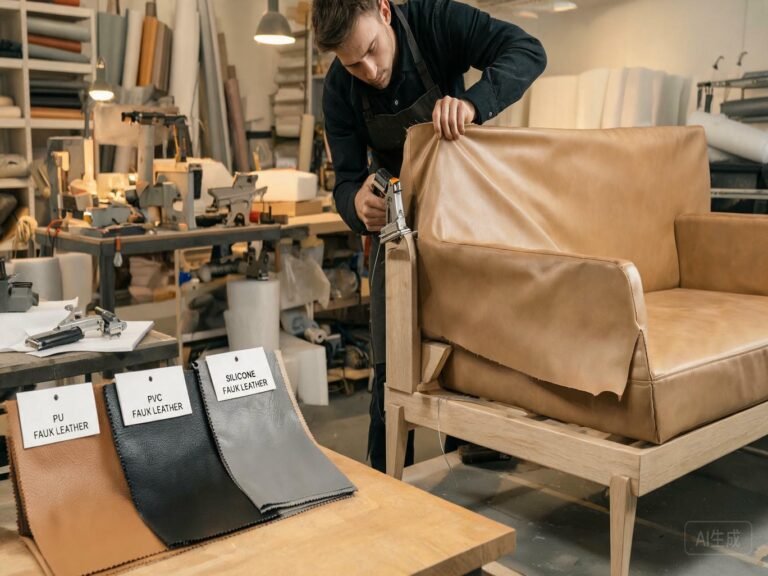
A designer specifies upholstery material faux leather for a 300-seat restaurant chain. The samples look stunning — supple, rich, perfect color match. Eighteen months later, the seats are peeling at the armrests where bodies rub thousands of times daily. The material passed visual inspection but failed on the one spec nobody verified: abrasion cycles. Commercial-grade contract furniture requires 120,000+ double rubs, yet most standard faux leather upholstery rates at 30,000 or less. Here are the seven specifications that separate material that lasts a decade from material that fails before the warranty expires.
Upholstery Material Faux Leather: The Commercial Durability Gap
The global faux leather market reached $37.59 billion in 2025, with PU leatherette holding 56.3% of that share. But market size doesn’t equal material adequacy. The gap between residential-grade and commercial-grade faux leather is enormous — and it’s measured in specific, testable metrics that most buyers never request.
In our experience working with furniture and sofa applications, the pattern repeats: a brand selects faux leather based on hand feel and color, skips the technical spec sheet, and faces warranty claims within 18-36 months. The seven specs below are what separates a material decision that holds up from one that doesn’t.

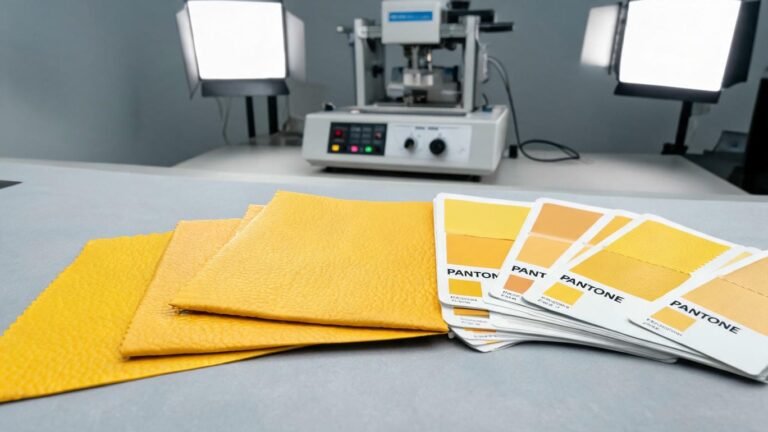
Color and texture options — but appearance is spec #0, not the only spec that matters
Abrasion and Hydrolysis: The Two Specs That Determine Lifespan
Spec 1 — Martindale abrasion cycles. This is the single most important number on a faux leather spec sheet. Commercial contract furniture requires 120,000+ double rubs. Standard PU faux leather rates 10,000-30,000 cycles. PVC reaches 15,000-30,000. Microfiber PU can exceed 100,000. Silicone faux leather delivers 200,000+ cycles. If your supplier can’t provide Martindale test data, the material isn’t rated for commercial use — period.
Spec 2 — Hydrolysis resistance class. PU-based faux leather contains ester bonds that react with moisture, causing the coating to break down from the inside. Standard polyester-PU shows hydrolysis damage in 2-4 years. Polyether-PU extends to 3-5 years. Silicone faux leather has zero ester bonds — it cannot hydrolyze. For hospitality, healthcare, or any environment with cleaning protocols involving liquids, this spec directly determines replacement frequency.
Spec 3 — Coating thickness and adhesion. The polyurethane coating on faux leather ranges from 0.2mm (budget) to 0.8mm (premium). Thicker coatings resist abrasion longer but add stiffness. More importantly, coating-to-substrate adhesion strength determines whether the surface peels or stays bonded. Request peel strength data — anything below 15N/25mm is a red flag for commercial applications.

Color fastness testing — UV stability matters as much as abrasion for commercial interiors
Flexing endurance test — how silicone faux leather performs under repeated stress cycles
VOC, Flame Retardancy, and Cleanability for Commercial Code
Spec 4 — VOC emissions data. Commercial interiors in the EU and US increasingly require VOC compliance documentation. PU faux leather manufactured with DMF solvents can off-gas for months. Request VDA 277 test results for automotive or EN 16516 for construction products. If the supplier can’t provide emission data, you’re carrying regulatory risk.
Spec 5 — Flame retardancy certification. Contract furniture in public spaces must meet specific fire codes — FAR 25.853 for aviation, EN 13773 for European commercial furniture, CA TB 117 for California. Standard PU faux leather requires chemical flame retardant additives that can leach over time. Silicone vs PU leather comparison shows silicone is inherently flame-resistant without additives, meeting FAR 25.853 and EN 13773 naturally.
Spec 6 — Chemical cleanability. Commercial furniture gets cleaned with aggressive disinfectants — alcohol, bleach, quaternary ammonium. PU faux leather coatings dissolve on contact with these agents. PVC is more resistant but stiffens and cracks over time. Silicone faux leather withstands alcohol, bleach, and standard disinfectants without surface degradation, making it the only faux leather type suitable for healthcare and hospitality settings with strict sanitization protocols.
Specs 1-3 determine how long the material looks good. Specs 4-6 determine whether it’s legal to install. Skip either group and you’re choosing between warranty claims and compliance violations.
Faux Leather Upholstery: The Silicone Alternative
Spec 7 — Material class. When all six specs above are verified, most faux leather types fail at least one. PU fails on hydrolysis and cleanability. PVC fails on cleanability and flexibility. Microfiber PU passes abrasion but fails on VOC. Only one faux leather material passes all seven specs simultaneously: silicone faux leather.
| Spec | PU Faux | PVC Faux | Microfiber | Silicone |
|---|---|---|---|---|
| Martindale (cycles) | 10K-30K | 15K-30K | 100K+ | 200K+ |
| Hydrolysis onset | 2-4 yrs | 3-5 yrs | 4-6 yrs | None |
| VOC emissions | DMF risk | Phthalate risk | Low | Zero |
| Flame retardancy | Additive only | Inherent (chlorine) | Additive only | Inherent |
| Disinfectant safe | No | Limited | Moderate | Yes |
| Commercial lifespan | 3-5 yrs | 5-8 yrs | 5-8 yrs | 10+ yrs |
For designers and specifiers, the table above is the spec sheet that matters. Everything else — color, texture, hand feel — is secondary to whether the material can survive its environment. For deeper comparisons, see our faux leather furniture durability analysis and leather upholstery fabric buyer guide for sourcing checklists.

Finished goods ready for shipment — verified specs before the material leaves the factory

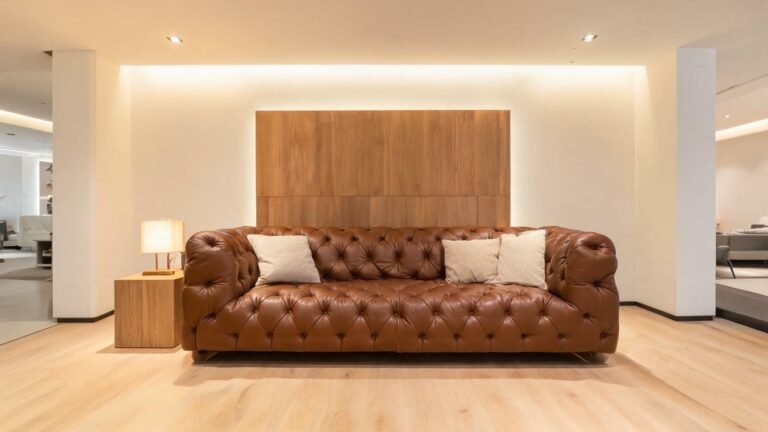
Commercial sofa upholstery — where spec failure becomes visible within 18 months
Frequently Asked Questions
What abrasion rating do I need for commercial furniture?
Commercial contract furniture requires a minimum of 120,000 double rubs (Martindale or Wyzenbeek). High-traffic environments like restaurants, airports, and public transit should specify 150,000+. Residential furniture can accept 30,000-50,000 cycles. Silicone faux leather’s 200,000+ cycle rating exceeds all commercial requirements, making it suitable for the most demanding contract applications without compromising on design flexibility.
Is silicone faux leather suitable for outdoor upholstery?
Yes. Silicone faux leather is inherently UV-stable (1,000+ hours with zero yellowing), waterproof (PDMS molecular structure), and temperature-resistant (-40°C to 250°C). It resists salt-spray for 1,000+ hours, making it suitable for marine and outdoor furniture. PU and PVC faux leather degrade rapidly outdoors — PU through hydrolysis and UV breakdown, PVC through plasticizer migration and stiffening.
Specify Beyond the Swatch
Faux leather upholstery fails in commercial settings not because the material is inherently bad, but because it’s specified against appearance rather than performance. The seven specs above — abrasion, hydrolysis, coating adhesion, VOC, flame retardancy, cleanability, and material class — are the difference between furniture that lasts a decade and furniture that generates warranty claims in year two. Silicone faux leather is the only material class that passes all seven simultaneously, which is why it’s becoming the default specification for commercial, healthcare, and hospitality projects where failure is not an option.
About TOPSUN
TOPSUN manufactures silicone faux leather for commercial upholstery projects where spec failure triggers warranty claims and brand damage. Our material passes all seven commercial durability specs — abrasion, hydrolysis, adhesion, VOC, flame retardancy, cleanability, and lifespan — in a single formulation.
200,000+ Martindale cycles · Zero VOC · Inherent flame retardancy (FAR 25.853, EN 13773) · Alcohol & bleach disinfectable · 10+ year commercial lifespan · 500,000m² monthly capacity