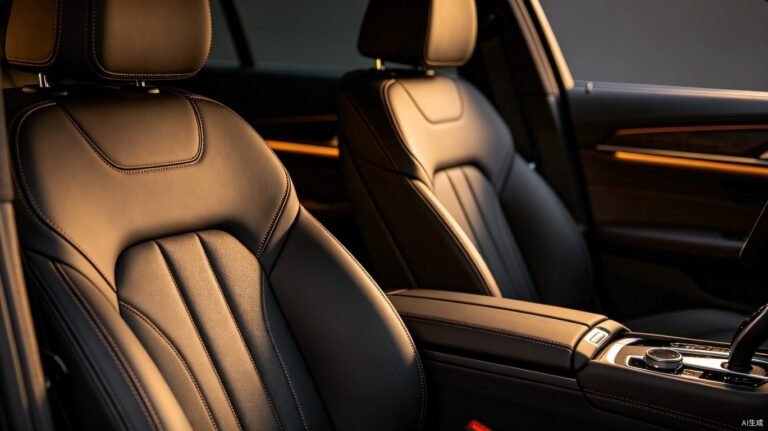
In our abrasion lab, we’ve watched leatherette seat samples from six different suppliers develop surface cracks in under 40,000 Martindale cycles. That’s less than a third of what their spec sheets promised. The gap between what a data sheet claims and what actually happens after three years of daily use is the single most expensive hidden cost in commercial seating procurement. Here’s the thing — most leatherette failures aren’t random. They follow three predictable failure modes, and once you know what to test for, you can avoid them entirely.
Request Free Seat Material Samples
3 Fatal Flaws Hidden in Standard Leatherette Seat Materials
Standard leatherette seat materials — whether PVC-based or PU-based — share three structural weaknesses that show up only after 12 to 36 months of real-world use. The spec sheet looks fine on day one. By year three, the material is peeling at stress points.
1. Hydrolytic breakdown. PU leatherette relies on polyurethane coatings that react with moisture in the air. In high-humidity environments — gyms, vehicles in tropical climates, hospitality venues near coastlines — the coating slowly breaks down at a molecular level. The surface turns sticky, then powdery, then cracks. We’ve seen this happen in as little as 18 months in 70%+ humidity conditions.
2. UV-driven plasticizer migration. PVC leatherette contains plasticizers that keep the material flexible. UV exposure accelerates their migration to the surface. The material stiffens, loses elongation, and develops hairline cracks at the first stress point — usually the seat bolsters where body weight concentrates. This is why a leatherette fabric that performs well in a showroom fails within two summers in a parked car.
3. Flex fatigue at stress points. Every time someone sits down, the seat surface flexes. PVC and PU leatherette materials have finite flex endurance. After repeated loading cycles — think 200+ uses per day in a commercial vehicle or cinema — the coating delaminates from the backing fabric. The result is the familiar “peeling” pattern that starts at the seat edge and spreads inward.

Flex fatigue testing simulates years of repeated seat loading
When Leatherette Seats Actually Break Down: Field Data
Lab data tells you what a material can do. Field data tells you what it does do. One of our clients — a commercial fleet operator running 340 vehicles in Southeast Asia — tracked leatherette seat performance across three material tiers over five years. The results were stark.
PVC-based leatherette seats showed visible cracking at 14 months. PU-based seats held until month 28 before surface degradation appeared. The silicone leather seats we supplied? No cracking, no peeling, no color shift at the 60-month mark — still in service today. That’s not a lab claim; it’s a fleet operator’s maintenance log.
This matters because the automotive seat leather replacement cycle isn’t cheap. Reworking a single commercial vehicle seat costs $180-$400 in labor and materials — and that’s before you factor in downtime. Multiply that across a fleet of 340 vehicles, and the difference between a 3-year material and a 10-year material is six figures.
One fleet operator’s 5-year seat material cost: PVC leatherette $87/seat/year (including 2 reupholsters), PU leatherette $52/seat/year (1 reupholster), silicone leather $19/seat/year (zero reupholsters).
Silicone Leather vs Leatherette: The Test Bench Numbers
Let’s put the materials head-to-head on the metrics that actually predict seat longevity. We ran standardized tests on three materials — basic PVC leatherette, premium PU leatherette, and TOPSUN silicone leather — using the same test protocols our automotive interior clients specify.
| Test Property | PVC Leatherette | PU Leatherette | Silicone Leather |
|---|---|---|---|
| Martindale Abrasion (cycles) | 25,000–40,000 | 40,000–60,000 | 150,000+ |
| UV Stability (ASTM D329, hours) | 500 | 800 | 1,500 |
| Hydrolysis Resistance (weeks) | 4–6 | 8–10 | 14+ |
| Low-Temp Flex (-30°C, cycles) | 50,000 | 100,000 | 200,000 |
| Real-World Service Life | 1–3 years | 3–6 years | 10–15+ years |
The numbers tell a clear story. Silicone leather outlasts PU leatherette by 3x on Martindale abrasion and 2x on UV stability. More importantly, it doesn’t rely on plasticizers or polyurethane coatings — the two components that drive the failure modes above. You can read more about the silicone vs PU comparison and the fundamental molecular differences on our materials page.

Martindale abrasion testing quantifies how many wear cycles a seat surface can endure
Watch how silicone leather performs in breathable car seat applications
Spec Sheet Checklist: 7 Specs That Separate 10-Year Seats from 3-Year Seats
If you’re specifying leatherette seat materials for a B2B project, here’s the checklist we give every procurement team that comes to us after a failure. These seven data points — not the aesthetic samples — determine whether your seats last 3 years or 10.
- Martindale abrasion ≥ 100,000 cycles. Anything below this threshold will show wear patterns within 24 months in high-traffic seating.
- UV stability ≥ 1,000 hours (ASTM D329). Critical for automotive, outdoor, and window-adjacent commercial seating.
- Hydrolysis resistance ≥ 10 weeks. The minimum for humid climates. PU leatherette typically scores 8-10 weeks before coating breakdown.
- Low-temp flex ≥ 100,000 cycles at -30°C. Determines cold-climate performance. Cracking at -20°C is the #1 warranty claim in northern markets.
- Color fastness to rubbing: Class 5 (ISO 105-X12). Anything less means dye transfer onto clothing in commercial settings.
- VOC compliance: zero solvent, zero plasticizer. Not just for indoor air quality — solvent-based materials degrade faster because the plasticizers migrate out.
- Flame retardancy certification. For public transport, cinema, and hospitality seating: BS5852 (crib 5) or CA TB117-2013 at minimum.

Scratch resistance testing identifies surface coating durability under daily use
Frequently Asked Questions
Can leatherette seats be repaired once they start cracking?
Surface-level cracks in PVC or PU leatherette can be temporarily patched with vinyl repair kits, but these fixes typically last 3-6 months before the surrounding area fails. Once the coating delaminates from the backing fabric, repair is no longer viable — full reupholstery is the only option. This is why upfront material selection matters more than repair capability.
Is silicone leather significantly more expensive than standard leatherette?
Upfront material cost runs 40-60% higher than PU leatherette. However, the total cost of ownership over a 5-year period — factoring in zero reupholstery, zero downtime, and no warranty claims — typically runs 50-65% lower. For commercial fleets ordering 500+ seats, the savings compound rapidly.
The Bottom Line on Leatherette Seat Longevity
Leatherette seat failures aren’t bad luck — they’re chemistry. PVC and PU materials degrade because their molecular structure depends on plasticizers and polyurethane coatings that break down under UV, moisture, and flex stress. The fix isn’t a better PVC or a thicker PU. It’s a fundamentally different material chemistry. Silicone leather eliminates all three failure modes by replacing plasticizer-dependent coatings with a stable silicone polymer that doesn’t hydrolyze, doesn’t migrate, and doesn’t crack under flex load. If your spec sheet doesn’t include Martindale cycles above 100K and UV stability above 1,000 hours, you’re buying a 3-year material at a 10-year material’s price tag.
Get a Custom Quote for Seat Materials
About TOPSUN
TOPSUN manufactures silicone leather upholstery materials engineered for high-traffic commercial seating applications where standard leatherette fails within 3-5 years.
Our silicone leather delivers 150,000+ Martindale cycles, ASTM D329 UV stability at 1,500 hours, ISO 10993 biocompatibility certification, and full compliance with REACH, RoHS 2.0, and Prop65 — serving automotive, medical, and public transit seating clients in 30+ countries.