Walk into any seat trim validation lab on a Tuesday morning and you will see the same scene: racks of cut swatches queued under the Martindale head, a Bally flexometer ticking off cycles on a folded coupon, and a xenon arc chamber baking the next batch under simulated desert sun. For procurement teams sourcing automotive seat leather, these numbers are not laboratory curiosities — they are the line between a clean field record and a warranty claim. Every automotive seat leather program eventually converges on three questions: will the trim survive the cabin, will the color match the OEM master, and can the supplier deliver at volume with full documentation?
This article walks through each gate — the test bench, the color booth, and the production line — and why silicone leather is the material that clears all three.
Why Automotive Seat Leather Durability Testing Matters in Real-World Cabin Conditions
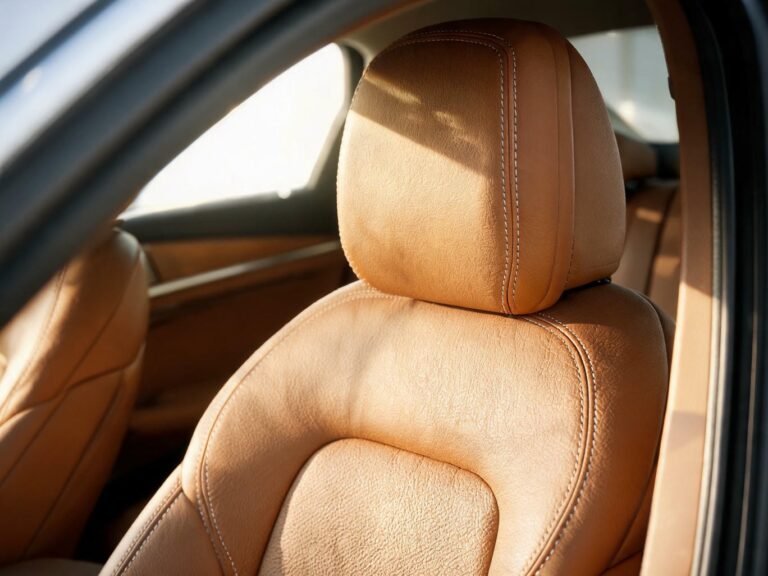
A seat in a daily-driven vehicle endures remarkable punishment over a five-year ownership cycle. The driver slides in and out tens of thousands of times, grinding dust and grit into the bolster. Summer sun pours through the windshield, pushing surface temperatures past 80 °C, while winter cabins run cold and dry. Any automotive seat leather that cannot hold up under this compound stress fails in the field — cracked bolsters, faded panels, and peeled coatings appear long before the warranty expires.
This is why OEMs lock durability testing into the material approval gate. A procurement buyer should treat the test report as non-negotiable evidence, not marketing copy. The three tests that most reliably predict in-cabin performance are Martindale abrasion, flexing resistance, and UV colorfastness. Together they model the sliding, folding, and light-exposure forces that age a seat. When a silicone leather composite clears all three with margin to spare, it signals trim built for the full vehicle life — not just the showroom.
Martindale, Flexing & UV: Decoding the Seat Trim Durability Test Matrix
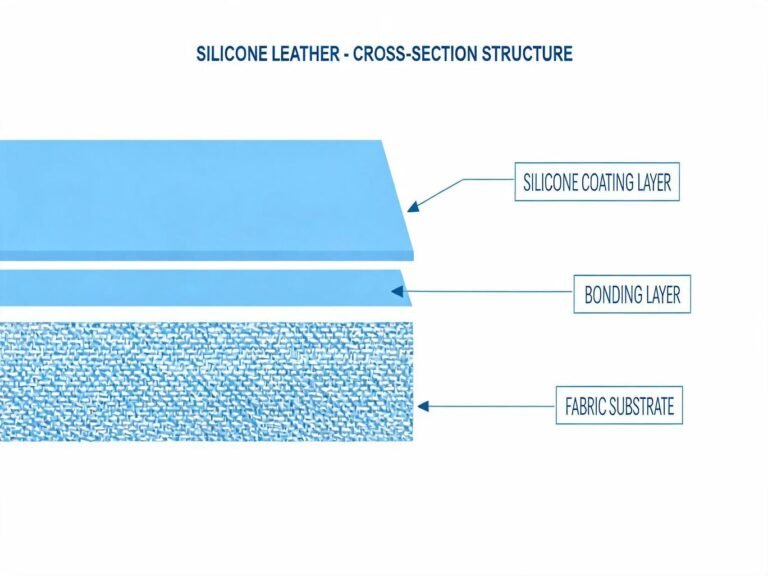
The Martindale abrasion test (ISO 5470-2) is the workhorse of seat trim evaluation. An abrasive head rubs the surface in a Lissajous pattern while a counter logs cycles. Genuine leather typically holds to roughly 25,000 cycles before the grain breaks down; PU leather often fails earlier as the topcoat wears through. Premium silicone leather routinely passes 50,000 cycles with no visible change, because the silicone elastomer is integral to the material rather than a surface coating.
Flexing resistance (ISO 5402, Bally flexometer) targets fold lines where seat contours crease. Each cycle folds the coupon 180 degrees, and micro-cracking predicts seam-edge failures. Silicone leather’s elastomeric backbone returns to shape cycle after cycle, where rigid PU coatings develop hairline cracks that propagate into visible splits.
UV colorfastness testing (VDA 75202 / ISO 105-B06) exposes swatches to xenon arc radiation replicating sunlight through glass. A grey-scale grade of 4 or higher means the color holds. Silicone pigments dispersed through a UV-stable matrix deliver grade 4-5 performance, where PU leather may drop to grade 2-3 and visibly fade on the top bolster within a single summer.

Bally flexometer in operation — the test that predicts seam-edge cracking before it reaches the field.
The table below compares performance across genuine leather, PU leather, and silicone leather on the five parameters that matter most:
| Test Parameter | Standard | Genuine Leather | PU Leather | Silicone Leather |
|---|---|---|---|---|
| Abrasion (Martindale) | ISO 5470-2 | ~25,000 cycles | 10,000-25,000 cycles | 50,000+ cycles |
| Flexing Resistance | ISO 5402 | Good | Moderate (early cracks) | Excellent |
| UV Colorfastness | VDA 75202 | Grade 3-4 | Grade 2-3 | Grade 4-5 |
| Fogging Value | DIN 75201 | < 3 mg | < 5 mg | < 2 mg |
| Flame Retardancy | FMVSS 302 | Pass | Pass | Pass (< 100 mm/min) |
Color Matching for OEM Programs: When Delta E Decides Program Approval
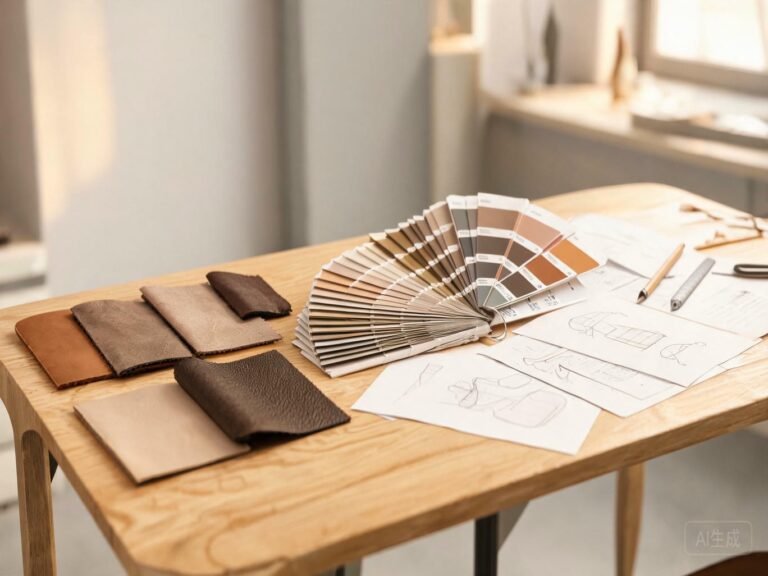
Color approval in an OEM program is governed by one number: Delta E (ΔE) in CIELAB color space. The OEM issues a master standard — a physical chip or digital L*a*b* target — and the supplier must keep batches within tolerance, typically ΔE ≤ 1.5 for seat trim. Anything wider triggers rejection and a re-submission cycle costing weeks.

Color fastness testing equipment — where every roll earns or loses its ΔE approval.
The challenge is hitting the target on every roll, across every shift, for the entire program life. Spectrophotometric measurement at the finishing line, coupled with tight pigment and calendering control, keeps batch-to-batch variation inside the window. Silicone leather offers an advantage: because color is dispersed through the full silicone layer rather than a thin surface print, there is more tolerance for minor process drift without a visible shift.
For procurement buyers, the question to ask any automotive seat leather supplier is simple: what is your documented ΔE capability and your batch rejection rate on color? A supplier who answers with data — rather than assurances — is one whose production process is actually under control. See how TOPSUN approaches car seat leather material selection and luxury car seat leather programs for related OEM requirements.
Automotive Seat Leather Mass Production Readiness: PPAP, Capacity & Lead Times
Passing lab tests proves the material is right. PPAP — the Production Part Approval Process — proves the supplier can make it right, repeatedly, at volume. This formal automotive gate requires dimensional results, material certifications, performance test data, capacity verification, and a controlled production run. For automotive seat leather, a Level 3 submission includes full dimensional and thickness reports, abrasion and flexing results from the production lot, and a capacity study showing the line can sustain weekly volume.
TOPSUN silicone leather for automotive interiors — from coating line to finished seat trim.
Capacity and lead time are where many candidates stall. A lab sample that tests beautifully means nothing if the supplier cannot deliver 50,000 linear meters per month with a four-week lead time. Procurement should verify effective capacity — what the line actually produces after changeovers and color transitions. Silicone leather’s continuous coating and curing process supports stable high-volume output with shorter color changeovers than batch-coated PU lines.
A reliable partner will commit to documented lead times, provide capacity verification as part of PPAP, and hold safety stock for approved programs. For stricter emission targets, the VDA 277 emission standard adds a documentation layer a production-ready supplier should handle without delay.

From PPAP-approved rolls to installed seat trim — the final step in mass production readiness.
Why Silicone Leather Outperforms in Automotive Seat Leather Applications
When all three gates — durability, color, and production readiness — are weighed together, silicone leather emerges as a premium alternative that reduces total program risk. It carries abrasion and flexing margins that genuine leather and PU struggle to match, holds color under UV without a separate topcoat, and runs on a continuous process supporting PPAP-level consistency at scale.
For procurement teams, that translates into fewer field complaints, lower warranty exposure, and a cleaner production ramp. Premium and EV programs increasingly specify silicone-based trim for exactly these reasons. If your next automotive seat leather program needs a material that is tested, color-stable, and production-ready, silicone leather deserves a seat at the shortlist — and TOPSUN can back every claim with the test data and PPAP documentation your engineers will ask for.
Get PPAP Documentation Request Color Match Samples
About TOPSUN
TOPSUN operates a solvent-free silicone leather line engineered for automotive seat trim programs, with an in-house lab covering Martindale, Bally flexing, UV colorfastness, and fogging. The company supports OEM and Tier-1 buyers with spectrophotometric color matching at ΔE ≤ 1.5, PPAP Level 3 documentation, and verified monthly capacity for high-volume delivery.
In-house Martindale & flexing test benches · Spectrophotometric color control · PPAP Level 3 ready · FMVSS 302 compliant
FAQ: Automotive Seat Leather Testing & Production
What Martindale cycle count does automotive seat leather need to pass?
Most OEM seat trim specs require a minimum of 25,000 Martindale cycles (ISO 5470-2) with no visible breakdown. Premium programs often push the threshold to 50,000 cycles. Silicone leather typically clears 50,000+ cycles because the wear-resistant silicone layer is integral to the material, not a surface coating.
How tight is the color matching tolerance for OEM seat trim?
OEM programs typically require a CIELAB Delta E (ΔE) of 1.5 or lower against the master standard for seat trim approval. Some luxury programs tighten this to ΔE ≤ 1.0. The supplier must demonstrate batch-to-batch consistency across the full program life, verified by spectrophotometric measurement at the finishing line.
What does PPAP mean for automotive seat leather suppliers?
PPAP (Production Part Approval Process) is the formal quality gate requiring the supplier to prove repeatable production capability. A Level 3 submission includes dimensional reports, material certifications, performance test data from the production lot, and capacity verification. It confirms the supplier can deliver automotive seat leather at agreed volume and quality, not just a one-off lab sample.
How does silicone leather compare to genuine leather for UV colorfastness?
Under VDA 75202 xenon arc exposure, silicone leather achieves grey-scale grade 4-5, while genuine leather lands at grade 3-4 and PU leather at grade 2-3. Silicone pigments dispersed through a UV-stable polymer matrix resist fading on sun-exposed bolsters far longer than surface-printed alternatives.