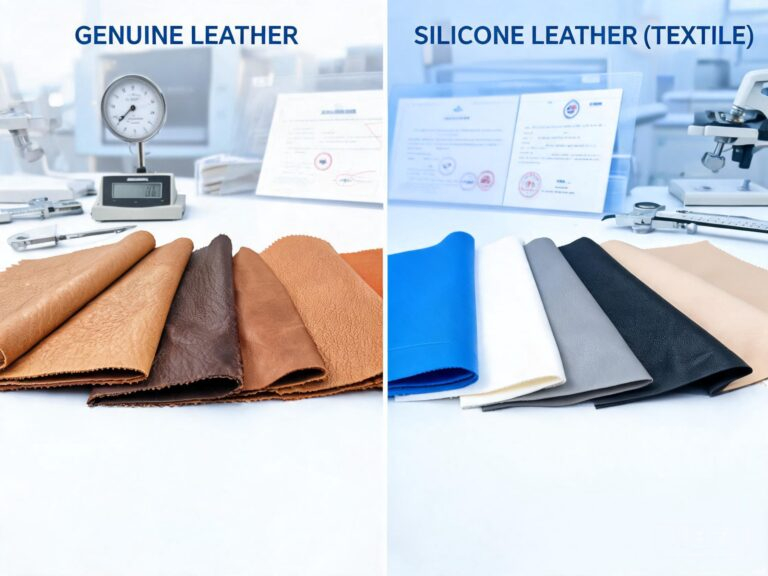
The global textile manufacturing market surpassed USD 1,027 billion in 2025. Yet for B2B buyers sourcing coated fabrics and synthetic leather, market size isn’t the bottleneck — compliance is. The ECHA’s REACH SVHC candidate list now exceeds 240 substances and updates twice yearly. Customs authorities in the EU and US are tightening enforcement, and shipments get held at the border for missing or expired documentation. This guide breaks down the 7 compliance gaps we see most often in factory audits — and the exact documents you need to close them.
How Textile Manufacturing Works for Synthetic Leather
Before diving into compliance, it helps to understand what happens on the production floor. Textile manufacturing for synthetic leather follows a seven-stage process: base fabric preparation, silicone compounding, coating, multi-zone thermal curing, substrate lamination, embossing, and automated inspection. Each stage introduces chemical inputs that fall under regulatory scrutiny.

Production process flow — seven stages from raw fabric to finished silicone-coated leather
The coating stage is where compliance risk concentrates. Two methods dominate: knife coating and roller coating. Knife coating uses a blade angle of 20-60 degrees with viscosity controlled at 5,000-10,000 mPa·s and solid content of 30-60%. Roller coating — including reverse roll application — deposits 0.15-0.50 mm per layer onto release paper. Both processes consume pigments, curing agents, crosslinkers, and release agents, all of which appear on REACH SVHC watchlists. Understanding your supplier’s coating process tells you which chemical categories to screen for. Our factory production overview walks through the full line configuration.
The Compliance Framework: REACH, RoHS, and OEKO-TEX
Three regulatory frameworks govern textile manufacturing for coated fabrics destined for Western markets. Each covers different chemical categories, and a factory must comply with all three simultaneously.

Quality and safety compliance signage on the production floor — visible commitment matters
REACH (EC No. 1907/2006): The European Chemicals Agency’s SVHC list now contains 240+ substances, updated every six months. Any substance exceeding 0.1% weight-by-weight must be disclosed to downstream users. Key restricted substances in textile manufacturing include DMFa (limit: ≤10 mg/kg in Annex XVII), hexavalent chromium (≤3 mg/kg), phthalates (≤1,000 mg/kg), and azo dyes (≤30 mg/kg). Non-compliance means customs rejection — no exceptions. The ECHA REACH regulation portal provides the current SVHC list and restriction details.
RoHS 2.0 (Directive 2011/65/EU): Restricts lead, cadmium, mercury, hexavalent chromium, and specific phthalates in electrical and electronic products — relevant when textile manufacturing serves 3C electronics accessories, automotive interiors, or wearable tech straps. RoHS testing protocols verify heavy metal content against threshold limits.
OEKO-TEX STANDARD 100: Tests over 1,000 harmful substances across four product classes. Class I (baby items) carries the strictest limits. Since January 2025, OEKO-TEX requires origin documentation for all LEATHER STANDARD-labeled products — aligning with the EU Deforestation Regulation’s traceability mandate. For a broader overview of certification requirements, see our guide to leather certification standards.
7 Compliance Gaps That Trigger Customs Holds
Based on factory audits we’ve conducted across China’s synthetic leather manufacturing sector, these are the seven most common compliance failures that result in shipment delays, customs holds, or rejected orders.
| Compliance Gap | Regulatory Reference | Consequence |
|---|---|---|
| Expired REACH report | ECHA SVHC biannual update | Shipment held at EU border |
| DMFa exceeds 10 mg/kg | REACH Annex XVII | Product recall + fines |
| Altered test report PDF | Third-party verification | Supplier blacklisted |
| Phthalates above 0.1% | RoHS 2.0 / REACH | Customs rejection |
| Missing VOC emission data | VDA 277 / VDA 278 | Automative OEM rejection |
| No PFAS screening | ECHA PFAS restriction (2027) | Future market exclusion |
| BOM mismatch with test sample | ISO 9001 traceability | Warranty invalidation |
The third gap — altered test reports — is more common than most buyers assume. Trading companies frequently modify PDF certificates, swap product names, or reuse reports across different material formulations. The fix is simple: verify every report number through the issuing lab’s official portal (SGS, TUV, Intertek all offer online verification). Cross-check that the material BOM on the report matches the actual product specification. If the report tests a 0.8mm silicone-coated polyester fabric but you’re ordering a 1.2mm silicone-coated microfiber, the report doesn’t apply.

Operator on the coating-calendering line — where chemical inputs enter the compliance chain
How to Verify Factory Compliance Before You Order
Compliance verification isn’t a single checkbox — it’s a layered process. Here’s the protocol we recommend B2B buyers follow before placing any first order with a textile manufacturing supplier.
Layer 1: ISO 9001 certification. Factories with ISO 9001 quality management systems report 40% fewer production defects and win 50% more international contracts than uncertified competitors. This is your baseline filter — if a factory lacks ISO 9001, the compliance documentation is likely unreliable regardless of what they claim.
Layer 2: Current third-party test reports. Request reports from SGS, TUV, or Intertek covering REACH SVHC screening, RoHS heavy metals, and VOC emissions (VDA 277/278). Reports must be dated within 6 months of your shipment date to align with the latest ECHA SVHC update. Verify each report number online. This is where most sourcing teams stop — and where most failures originate.
Layer 3: Factory audit. For orders exceeding USD 10,000, commission a third-party factory audit covering production capacity, quality control procedures, chemical management systems, and traceability protocols. The audit should confirm that the BOM used in testing matches the BOM used in production. Our eco-friendly silicone leather overview details the full compliance documentation we maintain for every production batch.
Textile Manufacturing Sustainability: Beyond Compliance
Compliance gets your shipment through customs. Sustainability gets your product through the next regulatory cycle. The ECHA is finalizing a comprehensive EU-wide PFAS restriction under REACH, with expected adoption in 2027. France has already moved ahead with national restrictions. If your supplier uses PFAS-based water or stain-repellent finishes, you’re sourcing material that may not be legal in your market within 24 months.
The shift toward waterborne polyurethane systems — replacing solvent-based DMF processes — is accelerating. Closed-loop recycling systems for end-of-life synthetic leather are becoming a compliance feature, not a marketing claim. Bio-based polyols are entering pilot production, with small-batch tests showing renewable content can match the mechanical integrity of petrochemical-derived alternatives while reducing carbon intensity by up to 25%. Meanwhile, automation is reshaping the production floor: 57% of new textile machinery now includes digital monitoring, 41% features predictive maintenance, and 35% is IoT-enabled — all of which improve consistency and reduce the batch-to-batch variation that triggers compliance failures.
Watch: Eco-certification overview — REACH, RoHS, OEKO-TEX and zero-VOC verification at TOPSUN
For B2B buyers sourcing from China, the landscape is shifting. China’s textile exports reached USD 293.77 billion in 2025, but supply chain transparency requirements under the EU Deforestation Regulation now demand full material traceability. Buyers need suppliers who maintain documented chemical management systems, not just end-product test reports. For a practical sourcing framework, our fabric sourcing guide for China covers supplier evaluation, MOQ negotiation, and compliance verification in detail.
Compliance Reality Check: A single expired REACH report can hold your shipment at customs for 3-6 weeks. The cost of one compliance failure — demurrage, lost retail windows, contract penalties — typically exceeds the cost of maintaining current certifications for an entire year.
Frequently Asked Questions
How often should REACH compliance reports be updated?
The ECHA updates the SVHC candidate list approximately every six months (January and July). Test reports older than 6 months may not reflect current restrictions. For shipments to the EU, request REACH SVHC screening reports dated within 6 months of your expected customs clearance date. If your supplier’s most recent report is from the previous SVHC update cycle, it’s already at risk of non-compliance for substances added in the latest revision.
What’s the difference between OEKO-TEX Standard 100 and ECO PASSPORT?
OEKO-TEX Standard 100 certifies the finished textile or leather product — testing the end material against 1,000+ harmful substances across four product classes. ECO PASSPORT certifies the chemical ingredients — pigments, auxiliaries, finishing agents — used during manufacturing. A factory can hold Standard 100 certification on its product while also holding ECO PASSPORT on its input chemicals. For B2B buyers, Standard 100 is the primary verification; ECO PASSPORT provides additional assurance that the production process itself uses safe chemistry.
Compliance Is Not Optional — It’s Operational
Textile manufacturing compliance isn’t a paperwork exercise. It’s the operational foundation that determines whether your product reaches the market or sits in a customs warehouse. The REACH SVHC list will keep growing. PFAS restrictions are coming. VOC emission limits are tightening. The factories that survive this regulatory cycle are the ones that treat compliance as a production-line discipline, not a last-minute documentation scramble. Verify your supplier’s documentation layer by layer — ISO 9001 baseline, current third-party reports, factory audit — before you place the order. The cost of verification is a fraction of the cost of failure.
Download Compliance Documentation
About TOPSUN
TOPSUN operates a silicone-coated textile manufacturing facility producing synthetic leather for automotive, furniture, medical, and consumer electronics B2B clients — with a solvent-free production process and full REACH SVHC, RoHS 2.0, and OEKO-TEX Standard 100 compliance documentation maintained for every production batch.
Zero-VOC formulation · REACH 240+ SVHC screened · RoHS 2.0 heavy-metal-free · OEKO-TEX Standard 100 certified · PFAS-free · ISO 9001 quality management system