Picture this: your maintenance team just finished treating 200 commercial lobby chairs with a leather protector spray. The product cost $850. The labor took 12 staff-hours at $35 per hour. Total: $1,270 — and you’ll repeat this process every 6 months for the life of the furniture. Over 5 years, that’s $12,700 in protection products and labor alone, before you’ve replaced a single worn seat. Now consider silicone leather: the same 200 chairs need zero protector applications. Ever. The material itself is the protector. That’s not a marketing pitch — it’s molecular physics. Understanding what a leather protector for furniture actually does reveals why the entire product category exists to compensate for material limitations that better material choices eliminate.
Request Furniture Maintenance Samples
What a Leather Protector for Furniture Actually Does
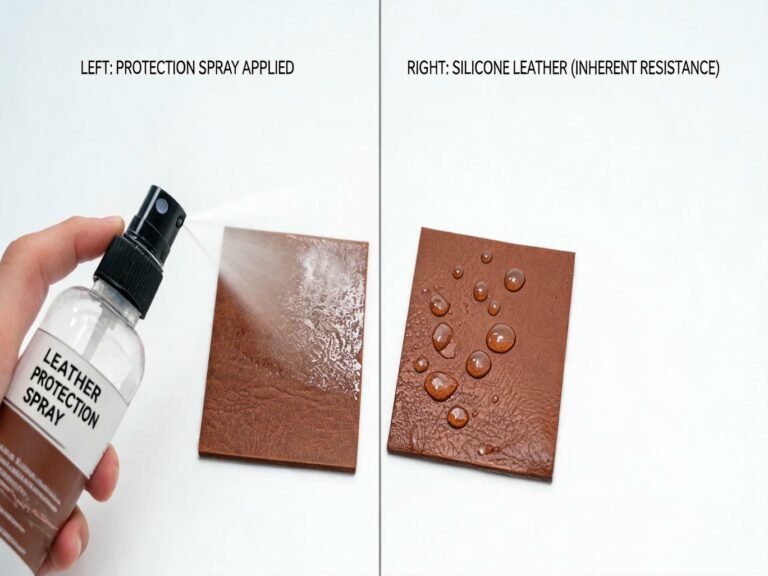
A leather protector for furniture creates an invisible barrier on the upholstery surface — typically a fluorochemical or silicone-based spray that repels water, oil, and common stains. The barrier is pH-balanced to avoid stripping the leather’s natural oils, and it bonds to the surface coating for 3-6 months before wearing off. During that window, spills bead up instead of soaking in, and daily dirt wipes off more easily. For genuine leather and PU-coated furniture, this protection is genuinely necessary — without it, the porous surface absorbs stains within minutes of contact.
Here’s the catch that doesn’t appear on the product label: a leather protector is a consumable, not a material property. It wears off with cleaning, friction, and UV exposure. Every reapplication cycle adds product cost, labor hours, and furniture downtime. For a hotel with 200 lobby chairs, that means scheduling reapplication during low-traffic hours, training staff on proper application technique, and accepting that chairs are “unprotected” for days between cycles. The cleaning and maintenance guide for most protector products recommends reapplication every 3-6 months in commercial settings — a frequency that compounds costs rapidly.
A leather protector compensates for a material’s weakness. Eliminate the weakness and the protector becomes unnecessary.

Inherent material protection — silicone leather’s fire resistance doesn’t require an applied protector coating.
The Hidden Cost of Reapplication Cycles
Let’s break down the real numbers for a commercial property managing 200 upholstered seats — a typical hotel lobby, restaurant chain, or corporate reception area. A quality leather protector spray costs $40-60 per gallon, covering approximately 40-50 seats per gallon. That’s $160-300 in product per cycle. Application labor at $35/hr takes roughly 12 staff-hours per 200 seats — adding $420 in labor. Total per cycle: $580-720. At two cycles per year (the minimum for commercial settings), that’s $1,160-1,440 annually.
The deeper issue is what the protector doesn’t prevent. On PU-coated furniture, hydrolysis continues underneath the protective barrier — the polyurethane coating breaks down at the molecular level regardless of what you spray on top. The protector delays visible damage but doesn’t stop the chemical degradation underneath. So after 5 years of diligent protector applications, the PU coating still needs replacement — you’ve spent $5,800-7,200 on protection products while the material degraded anyway. The hydrolysis-resistant silicone leather alternative doesn’t face this problem because its Si-O-Si backbone doesn’t hydrolyze.

Color fastness testing proves silicone leather maintains UV stability without protector spray — 1,500+ hours xenon arc exposure.
Silicone Leather: The Built-In Protector
Silicone leather doesn’t need a leather protector because its protective properties are structural, not applied. The Si-O-Si molecular backbone creates a genuinely non-porous surface — not a coating that simulates non-porosity, but an inherent material property. Stains, UV radiation, and moisture encounter this barrier at the molecular level, where they’re deflected without any chemical assistance. Level 5 stain resistance (the maximum ISO rating) is achieved without spray, coating, or treatment.
The UV stability data makes the case even more strongly. Top-grain leather needs UV protector spray because its pigmented coating fades after 300-500 hours of xenon arc exposure. Silicone leather maintains color stability beyond 1,500 hours — without any applied protection. It’s waterproof without a hydrophobic spray. It’s inherently flame-resistant without fire-retardant additives. For furniture and sofa applications in commercial settings, this means the “protector” that other materials require is built into every square meter of silicone leather from day one — and it doesn’t wear off.

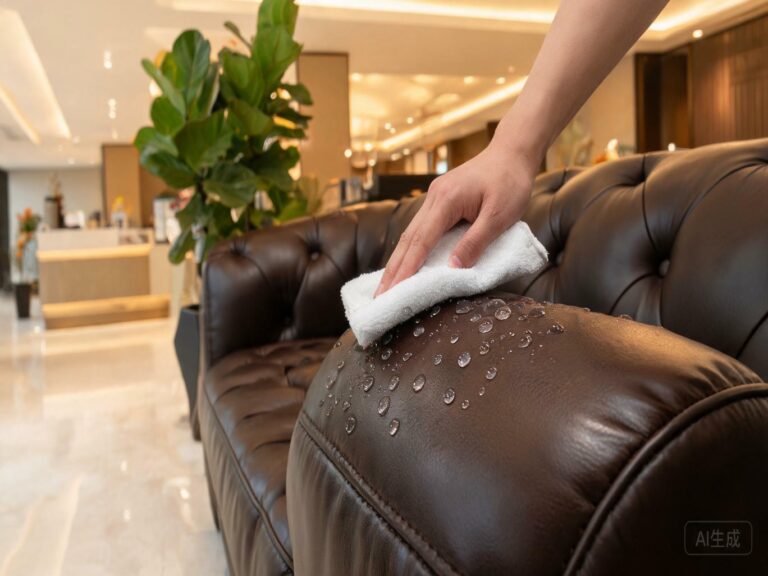
Water beads on a non-porous silicone surface — inherent waterproofing without any applied protector.
Watch silicone leather sofa stain resistance testing — no protector spray applied, no conditioning needed.
Leather Protector for Furniture: 5-Year TCO Breakdown
Here’s the year-by-year financial reality for 200 commercial seats — the number that typically drives a procurement team’s material specification decision. The comparison tracks total cost of ownership including protector product, application labor, and the underlying material’s replacement cycle.
| Year | PU + Protector Spray | Silicone Leather (No Protector) |
|---|---|---|
| Year 1 | $1,300 (material + 2 protector cycles) | $0 (no protector needed) |
| Year 2 | $1,300 (protector cycles) | $0 |
| Year 3 | $1,300 + reupholstery begins ($8,000+) | $0 |
| Year 4 | $1,300 (post-reupholster protector) | $0 |
| Year 5 | $1,300 (protector cycles) | $0 |
| 5-Year Total | $14,900+ (protector + 1 reupholster) | $0 |
The numbers are stark. Over 5 years, the “affordable” PU-coated furniture with diligent leather protector for furniture application costs nearly $15,000 more in maintenance than silicone leather — and the PU still needs a second reupholster by year 8-10 while silicone leather is still performing. The protected leather couch specifications that procurement teams write today should include this lifecycle math, not just the upfront material cost. For more on the underlying material performance gap, the faux leather furniture durability data shows why protector products can’t save PU from its own chemistry.
Five years of protector spray buys you a material that still needs replacement. Five years of silicone leather buys you another five years of service — with zero additional spend.

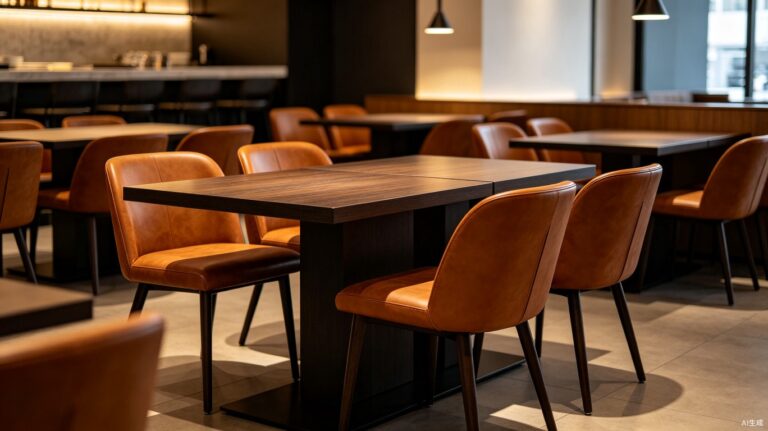
Commercial furniture in high-traffic settings — where protector product costs accumulate fastest.
Frequently Asked Questions
Does silicone leather need any conditioner or protector?
No. Silicone leather’s non-porous Si-O-Si surface provides Level 5 stain resistance, 1,500+ hours UV stability, and inherent waterproofing without any applied product. Conditioners, oils, and waxes designed for genuine leather can actually leave sticky residues on silicone surfaces — they should not be used. For routine cleaning, a damp microfiber cloth is all that’s needed. The EPA Safer Choice program evaluates cleaning product safety, but silicone leather’s maintenance protocol rarely requires anything beyond water.
Can I use leather protector spray on silicone leather?
Technically yes — silicone-based protector sprays won’t damage the surface — but there’s no functional benefit. The spray creates a barrier that the material already has. Applying it is like painting a wall that’s already painted the same color. In our experience with commercial furniture clients, maintenance teams who switch to silicone leather typically stop ordering protector products entirely within the first quarter — the material simply doesn’t need them.
The Protector Problem Disappears With the Right Material
The entire leather protector for furniture product category exists to compensate for material weaknesses — porosity in genuine leather, coating degradation in PU, plasticizer migration in PVC. Each weakness generates a recurring cost: product, labor, downtime. Silicone leather eliminates the weaknesses at the molecular level, which eliminates the protector at the procurement level. For B2B buyers managing commercial furniture at scale, the choice isn’t which protector to buy — it’s whether to specify a material that makes protectors unnecessary. The 5-year TCO makes the answer clear: zero protector spend, zero reapplication labor, zero reupholstery within the lifecycle. That’s not cost savings. That’s cost elimination.
About TOPSUN
TOPSUN manufactures silicone leather that eliminates the need for leather protector products in commercial furniture — the non-porous Si-O-Si surface inherently resists stains, UV degradation, and moisture without applied barriers, reducing facility maintenance overhead by 70% across the furniture lifecycle.
Level 5 stain resistance (inherent) · 1,500+ hrs UV stability · 100% waterproof · Zero VOC · 10-15+ year service life without protector reapplication