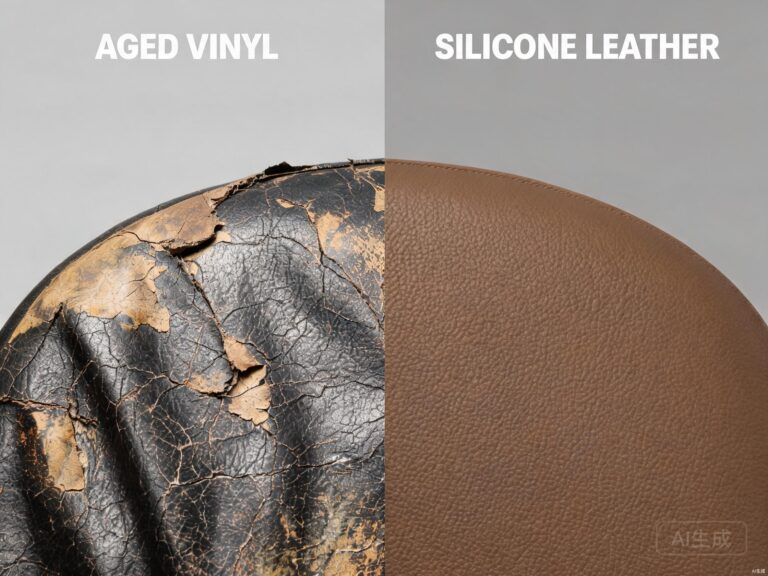
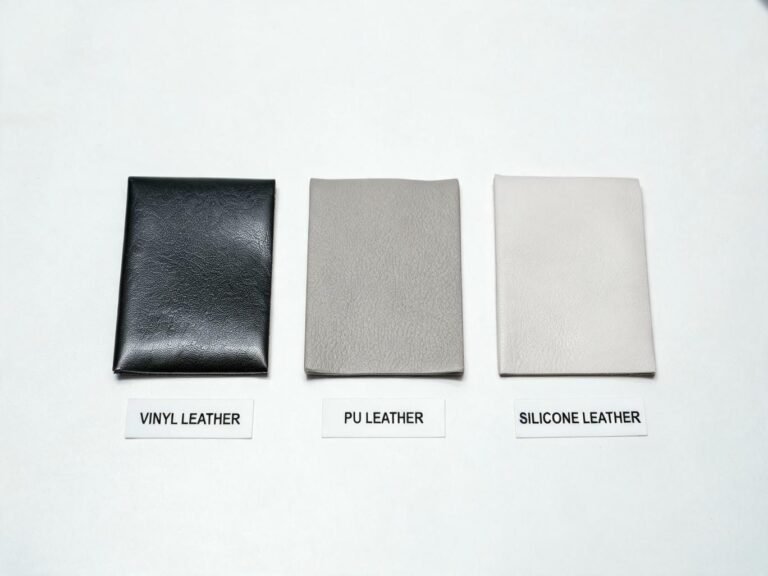
Upholstery vinyl is the cheapest leather-look material you can specify for commercial seating — and that is exactly the problem. At $2 to $6 per yard, PVC vinyl looks unbeatable on a procurement spreadsheet. It wipes clean, resists water, and passes basic fire codes. But the procurement spreadsheet does not account for phthalate plasticizer migration that turns vinyl brittle at 10 degrees Celsius, causing cold-crack failures in transit and storage. It does not account for REACH compliance audits that flag restricted phthalates in your furniture supply chain. And it does not account for the replacement cycle: commercial-grade vinyl lasts 3 to 5 years in high-traffic environments, while silicone leather — at a higher unit cost — lasts 10 to 15-plus years with zero maintenance. This article audits the six hidden costs that make cheap upholstery vinyl significantly more expensive than its sticker price suggests, and identifies the application scenarios where upgrading to silicone leather delivers measurable ROI.
What Is Upholstery Vinyl? The B2B Workhorse Explained
Upholstery vinyl is a PVC (polyvinyl chloride) coated fabric, laminated onto a woven polyester or cotton backing. The PVC layer — typically 0.5 to 1.0 millimeters thick — provides the leather-like surface, water resistance, and cleanability that make vinyl the default choice for high-traffic commercial seating in restaurants, airports, healthcare waiting rooms, and public transit. The backing provides tear strength and dimensional stability for sewing and upholstery construction. Commercial-grade vinyl is differentiated from consumer-grade by its abrasion rating (measured in double rubs via Wyzenbeek or Martindale tests), its fire retardancy certification (CAL 117, BS 5852 Crib 5, or EN 1021), and its antimicrobial treatment.
The material’s appeal is straightforward: it is waterproof, wipe-clean, available in hundreds of colors and embossed patterns, and costs a fraction of genuine leather. For a banquet hall furnishing 200 chairs, or a transit authority specifying 500 bus seats, the price difference between vinyl at $3 per yard and silicone leather at $15 per yard appears to be a budget-killer. But this price comparison ignores six cost factors that materialize after the purchase order is closed — and those factors are where the real money lives.

Abrasion testing — commercial vinyl must pass 50,000+ double rubs for high-traffic applications
6 Hidden Costs of Cheap Upholstery Vinyl
The procurement price of upholstery vinyl is the tip of the cost iceberg. Here are the six costs that emerge after installation — costs that a thorough total-cost-of-ownership analysis must include.
| Hidden Cost | What Happens | When It Hits | Cost Impact |
|---|---|---|---|
| Phthalate migration | Plasticizers leach to surface, material turns brittle | 18-36 months | Full reupholstery |
| Cold-crack failure | Material cracks below 10°C in transit/storage | First winter | Batch replacement |
| Seam splitting | Backing delaminates from PVC coating at stress points | 2-4 years | Repair or replace |
| Disinfectant damage | Alcohol/bleach degrades PVC surface, causes cracking | 500 clean cycles | Accelerated replacement |
| Compliance audit | REACH/Prop 65 flags restricted phthalates | Audit cycle | Retrofit or penalty |
| Replacement labor | 3-5 year vinyl cycle vs 10-15 year silicone | Each cycle | 2-3x material cost |
The replacement labor cost deserves special attention. Reupholstering 200 restaurant booths costs $15,000 to $25,000 in labor alone — before material costs. If vinyl requires replacement every 4 years and silicone leather every 12 years, the vinyl specification triggers two additional replacement cycles within the silicone leather’s lifespan. At that point, the “cheaper” material has cost 40 to 60 percent more in total ownership. For a comprehensive breakdown of these figures, our sofa upholstery material guide walks through the full lifecycle cost calculation.

Physical testing lab — every hidden cost is measurable with proper test protocols
Phthalates and REACH: The Compliance Time Bomb
The single most underestimated risk in upholstery vinyl specification is phthalate compliance. PVC vinyl requires plasticizer additives — typically phthalates like DEHP, BBP, and DBP — to achieve the flexibility needed for upholstery applications. These phthalates are not chemically bound to the PVC polymer; they migrate to the surface over time, where they can be absorbed through skin contact or inhaled as dust. California’s Proposition 65 lists DEHP as a known carcinogen and reproductive toxicant, and the EU REACH regulation restricts DEHP, BBP, and DBP in articles available to the public.
For B2B buyers, this creates a compliance time bomb. A vinyl specified today may pass REACH compliance on delivery — but as phthalates migrate to the surface over 18 to 36 months, the material can exceed restricted substance limits that were within spec at the time of purchase. A healthcare facility that specified vinyl seating in 2024 may face a 2026 compliance audit where the same seating fails Proposition 65 thresholds. Phthalate-free vinyl formulations exist, but they typically cost 40 to 70 percent more than standard PVC vinyl, narrowing the price gap with higher-performance alternatives. For environments where chemical resistance and compliance are non-negotiable, healthcare-grade material selection increasingly points away from PVC entirely.
Phthalates are not chemically bound to PVC. They migrate. A material that passes compliance on day one can fail on day 500. Specify phthalate-free formulations or choose a polymer that requires no plasticizers at all.
Upholstery Vinyl vs Silicone Leather: A Side-by-Side Audit
When the hidden costs are quantified, the comparison between PVC upholstery vinyl and silicone leather shifts dramatically. The table below presents a procurement-level audit across the dimensions that determine total cost of ownership in commercial seating applications.
| Audit Dimension | PVC Upholstery Vinyl | Silicone Leather |
|---|---|---|
| Unit cost per yard | $2-$6 | $12-$20 |
| Abrasion (Martindale) | 50,000-100,000 cycles | 200,000+ cycles |
| Service life (commercial) | 3-5 years | 10-15+ years |
| Cold-crack threshold | ~10°C (cracks) | -40°C (stable) |
| Disinfectant resistance | Cracks after ~500 cycles | 5,000+ cycles, no change |
| Phthalate-free | Requires premium grade | Inherently (no plasticizers) |
| Temperature range | -10°C to 60°C | -40°C to 250°C |
| VOC emissions | Moderate (plasticizer off-gas) | Zero (solvent-free process) |
The audit reveals that silicone leather outperforms PVC vinyl on every dimension except unit cost. The question for procurement teams is whether the 3 to 5 times higher unit cost is justified by the 3 to 4 times longer service life, the elimination of phthalate compliance risk, and the resistance to chemical cleaning. In applications where reupholstery labor is expensive or downtime is costly, the math consistently favors silicone. For those evaluating PU cloth material as a middle ground, the same audit framework applies — PU avoids phthalates but still suffers from hydrolysis and chemical sensitivity.

Restaurant booth seating — high-traffic commercial environment where replacement cycles drive total cost
When Vinyl Makes Sense (And When It Doesn’t)
Despite its limitations, upholstery vinyl remains the correct specification in specific scenarios. Short-term or temporary installations — event seating with a 6-month lifespan, trade show furniture, or seasonal outdoor venues — benefit from vinyl’s low unit cost and adequate performance over a short horizon. When the material will be replaced before phthalate migration or cold-crack failures materialize, the hidden costs never come due. Vinyl also remains viable for low-traffic applications where abrasion and chemical exposure are minimal: decorative panels, accent trim, or rarely-used conference room seating.
Commercial sofa applications — silicone leather in high-traffic hospitality environments
Vinyl is the wrong choice when the application involves long service life expectations, chemical cleaning protocols, cold-temperature exposure, or regulatory compliance audits. Healthcare facilities, restaurants with daily sanitization, transit vehicles exposed to winter temperatures, and hospitality spaces subject to fire code reviews all face the hidden costs outlined above. In these scenarios, the procurement savings on material cost are dwarfed by the operational costs of premature replacement, compliance remediation, and customer dissatisfaction. The silicone leather technical overview provides the full specification sheet for buyers considering the upgrade path from PVC vinyl.

Airport lounge seating — 24/7 traffic environment where material longevity determines ROI
Frequently Asked Questions
Is all upholstery vinyl the same quality?
No. Commercial-grade vinyl varies significantly by formulation, backing type, and topcoat quality. Key differentiators include abrasion rating (50,000 to 100,000-plus double rubs for commercial grade), cold-crack temperature (-10 to -20 degrees Celsius), phthalate content (standard vs phthalate-free formulations), and fire retardancy certification level. A $2 per yard vinyl and a $6 per yard vinyl may look identical in a swatch but deliver dramatically different service life and compliance profiles. Always request test certificates for abrasion, cold-crack, and restricted substances before specifying.
How long does commercial upholstery vinyl last?
In high-traffic commercial environments (restaurants, airports, transit), standard PVC vinyl typically lasts 3 to 5 years before showing significant wear — cracking at stress points, seam delamination, and surface hardening from plasticizer loss. Premium phthalate-free formulations can extend this to 5 to 8 years. Silicone leather, by comparison, lasts 10 to 15-plus years in the same environments, verified by 200,000-plus Martindale abrasion cycles and 5,000-plus disinfectant cleaning cycles with no material degradation.
Can upholstery vinyl be cleaned with bleach?
PVC vinyl can withstand mild soap and water cleaning, but concentrated bleach and alcohol-based disinfectants accelerate surface degradation. After approximately 500 cleaning cycles with hospital-grade disinfectants, PVC vinyl begins showing micro-cracking, discoloration, and hardening. Silicone leather withstands 5,000-plus cycles with the same disinfectants with no visible change, making it the preferred material for healthcare and food service environments where aggressive cleaning is mandatory.
Price Is What You Pay, Cost Is What You Get
Upholstery vinyl earns its place as the volume commercial seating material — but only when the application matches its limitations. For short-term installations, low-traffic environments, and budget-constrained projects where replacement is planned, vinyl delivers adequate performance at minimal cost. For long-life installations in high-traffic, chemically aggressive, or compliance-sensitive environments, the six hidden costs — phthalate migration, cold-crack failure, seam splitting, disinfectant damage, compliance audits, and replacement labor — transform the apparent bargain into a total cost that exceeds the premium alternative. The procurement decision is not between a $3 material and a $15 material. It is between a material that lasts 4 years and a material that lasts 15 years, between a material that requires plasticizers and one that does not, and between a material that fails compliance audits and one that passes them permanently. Calculate the total cost, not the unit price.
Discuss Your Upholstery Project
About TOPSUN
TOPSUN manufactures phthalate-free silicone leather for commercial upholstery applications where PVC vinyl’s hidden costs — replacement cycles, compliance failures, and chemical degradation — make it the wrong long-term specification. Our silicone leather is tested to 200,000-plus Martindale cycles, 5,000-plus disinfectant cleaning cycles, and certified to ISO 10993, REACH, and OEKO-TEX Standard 100 for healthcare, hospitality, and transit environments.
200,000+ Martindale cycles | 5,000+ disinfectant cycles | Phthalate-free | -40°C to 250°C range | ISO 10993 & REACH certified