Top grain leather is the most widely specified grade in commercial upholstery — used in mid-to-high-end furniture, automotive seating, handbags, and accessories. Suppliers market it as “real leather” with a uniform, defect-free surface. What they do not mention is that this uniformity comes from sanding away the hide’s strongest outer fibers and replacing them with a synthetic coating — and that coating, not the leather itself, is the component that fails first. A 2026 analysis of leather cracking complaints found that 67% of surface failures originate in the protective finish, not the hide beneath.
Request Material Comparison Samples
What Top Grain Leather Actually Is
To understand top grain leather, start with the hide’s anatomy. The outermost layer — the grain — contains the densest, tightest fiber structure in the animal hide. Full grain leather keeps this layer intact. Top grain leather takes that same outer layer but sands or buffs the surface to remove natural imperfections: scars, insect bites, branding marks, and wrinkling. The sanding creates visual uniformity but removes the strongest fibers.
After sanding, a protective finish coat is applied — typically a polyurethane or acrylic-based pigment system. This coating provides stain resistance, color consistency, and initial water repellency. It is the material’s primary defense against daily wear. And it is the component that procurement teams should scrutinize most carefully, because once it degrades, the sanded hide beneath is more vulnerable than an unsanded surface would be.

Top grain leather in automotive interiors: uniform appearance achieved through surface correction and coating
The Coating Dependency Problem
Here is the engineering reality that sourcing guides omit: top grain leather’s performance characteristics — stain resistance, color fastness, cleanability, water resistance — are properties of the coating, not the leather. The sanded hide underneath has reduced tensile strength compared to full grain, lower natural oil content, and a more open fiber structure that absorbs liquids and oils readily.
This creates a dependency chain: the product performs well only while the coating remains intact. Once the coating begins to break down — through UV exposure, chemical cleaners, flex fatigue, or thermal cycling — the underlying hide degrades faster than an uncoated surface would. The coating and the hide flex at different rates; this differential stress concentrates at flex zones like seat bolsters and armrest edges, accelerating coating fracture.
Key insight: Full grain leather ages by developing patina — the surface wears but remains structurally sound. Top grain leather ages by losing its coating — the surface wears and becomes structurally vulnerable. These are fundamentally different failure modes, and they determine product lifespan.
5 Ways the Coating Fails
In our materials testing laboratory, we have identified five primary coating failure modes that cause top grain leather products to require replacement long before the hide itself reaches end of life:
- UV degradation: The coating’s pigment system yellows and embrittles after 800–1,200 hours of xenon arc exposure (SAE J2412 equivalent to 3–4 years of indoor sunlight through windows). Once the coating cracks, UV reaches the sanded hide and accelerates fiber degradation.
- Chemical stripping: Alcohol-based cleaners (>15% isopropyl) and silicone-based “leather wipes” dissolve the protective anionic waxes in the finish. Ford’s Material Specification WSS-M4D75-B2 explicitly prohibits these products on leather seating. A single aggressive cleaning session can compromise months of coating integrity.
- Flex fatigue: Repeated bending at seat bolsters, armrest edges, and hinge points causes the coating to develop micro-cracks that propagate into visible fissures. The thicker the coating (heavily corrected grain), the faster this occurs — thick coatings flex differently than the fiber matrix beneath.
- Thermal cycling: Temperature swings between −20°C and +70°C cause differential expansion between the coating and hide. In automotive cabins reaching 80°C, plasticizers in the coating migrate and evaporate, leaving the finish brittle and prone to cracking.
- Maintenance neglect: Top grain leather requires conditioning every 6–12 months with pH-balanced, water-based conditioners. Without this, the hide’s natural moisture drops, causing shrinkage that stresses the coating from beneath — resulting in the familiar “crazing” pattern on neglected leather furniture.

Scratch resistance testing: quantifying when top grain leather’s protective coating begins to fail
Lifespan Reality vs. Marketing Claims
Suppliers typically quote 10–15 year lifespans for top grain leather products. This figure refers to the hide’s structural integrity — the leather itself does remain intact for a decade or more. But the functional lifespan — the period during which the product maintains acceptable appearance and performance — is significantly shorter:
| Property | Top Grain Leather | Full Grain Leather | Silicone Leather |
|---|---|---|---|
| Structural Lifespan | 10–15 years | 20–30+ years | 10–15+ years |
| Coating/Finish Lifespan | 3–5 years | No coating needed | No coating — intrinsic properties |
| Maintenance Frequency | Every 6–12 months | Annual conditioning | Wipe with damp cloth |
| Abrasion (Martindale) | 20,000–50,000 cycles | 30,000–60,000 cycles | 200,000+ cycles |
| UV Resistance | Coating fails at 800–1,200 hrs | Colorfast 4.2 grade at 800 hrs | ΔE ≤ 0.9 at 1,000 hrs |
| Water Resistance | Low — needs coating seal | Moderate — natural oils | 100% waterproof |
| Aging Characteristic | Coating cracks; hide exposed | Develops patina | Maintains appearance |
The critical distinction: top grain leather’s coating lifespan (3–5 years) is dramatically shorter than its structural lifespan (10–15 years). Products enter a degraded-appearance phase long before the hide itself fails. For more detail on leather grade comparisons, see our complete leather grades guide.

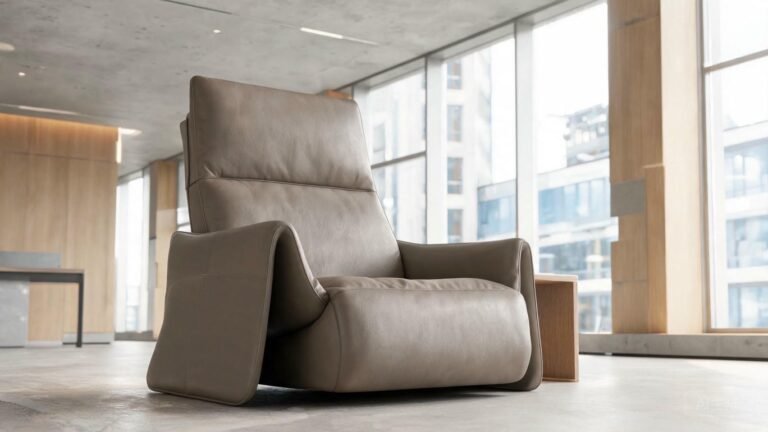
Top grain leather furniture: uniform surface appearance depends entirely on coating integrity
The Environmental Cost of a Coating-Dependent Material
Over 80% of the world’s leather is produced using chromium III tanning, which generates significant wastewater contaminated with chromium, sulfides, and organic compounds. Top grain leather carries this environmental burden and then adds a synthetic coating — meaning the product requires both chemical-intensive tanning and petroleum-based finishing.
When the coating fails after 3–5 years, the product often enters a replacement cycle despite the hide remaining structurally sound. This creates a wasteful paradox: the animal-derived core outlasts the synthetic surface that was applied to improve its appearance. For brands pursuing sustainable material strategies, this coating-replacement cycle undermines the sustainability narrative of “genuine leather.”
Why Silicone Leather Eliminates the Coating Dependency
Silicone leather does not rely on a surface coating for its performance properties. UV resistance, abrasion resistance, water resistance, stain resistance, and color stability are intrinsic to the silicone polymer structure — not applied as a finish that can degrade. This eliminates the fundamental failure mode of top grain leather.

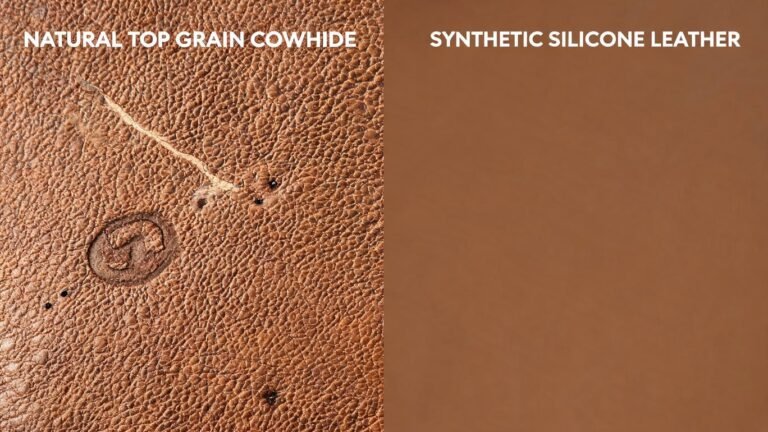
Color fastness testing: comparing coating-dependent materials with intrinsically stable silicone leather
The practical consequences are measurable. Silicone leather maintains 200,000+ Martindale abrasion cycles without surface degradation — four to ten times the coating-dependent performance of top grain leather. Its UV resistance holds at ΔE ≤ 0.9 after 1,000 hours, versus coating failure at 800–1,200 hours for top grain. It requires no conditioning, no special cleaners, and no maintenance schedule — because there is no coating to maintain.
Scratch resistance test: silicone leather’s intrinsic surface integrity vs coating-dependent material
About TOPSUN
TOPSUN manufactures silicone leather as a coating-independent alternative to top grain leather for furniture, automotive, and consumer product applications. Our material delivers the uniform appearance that top grain provides through sanding — but achieves it through precision calendering and embossing of the silicone surface layer, without compromising structural integrity or creating a coating that will fail.
Every production batch ships with ISO 10993, REACH, and FDA certifications from SGS and Intertek, plus per-shipment test reports covering abrasion, UV, color fastness, and flex resistance. For procurement teams comparing top grain leather specifications against silicone alternatives, our engineering team provides side-by-side material data sheets and application-specific samples.
Frequently Asked Questions
Is top grain leather real leather?
Yes. Top grain leather is the outer layer of a genuine animal hide. However, its surface has been sanded to remove natural imperfections and then coated with a synthetic finish. The hide is real; the uniform appearance you see is largely the coating.
Does top grain leather peel?
The hide itself does not peel. However, the protective coating applied during manufacturing can flake, crack, or delaminate — especially when exposed to alcohol-based cleaners, UV radiation, or thermal cycling. This coating failure is often mistaken for the leather “peeling,” but it is the finish failing, not the hide.
How long does top grain leather last?
The hide maintains structural integrity for 10–15 years. The protective coating that provides stain resistance, water resistance, and appearance typically lasts 3–5 years before requiring refinishing or showing visible degradation. Functional lifespan — the period of acceptable appearance — is shorter than structural lifespan.
What is the difference between top grain and full grain leather?
Full grain leather retains the original, unsanded hide surface — including natural marks and the densest fiber structure. It develops patina over time and has greater tensile strength. Top grain leather sands this surface for uniformity and applies a protective coating. Full grain ages gracefully; top grain ages by coating degradation.
Can silicone leather replicate the look of top grain leather?
Yes. Silicone leather can be embossed with grain patterns that replicate the visual texture of top grain leather — including corrected grain, pebble grain, and Nappa-style smooth finishes. The difference is structural: silicone leather’s appearance comes from the material itself, not a coating that will eventually fail.
Stop Specifying Materials That Fail by Coating
If your product’s appearance, stain resistance, and water resistance depend on a coating that lasts 3–5 years, you are not specifying a 10-year material — you are specifying a 3-year coating on a 10-year substrate. Request silicone leather samples and test the difference between coating-dependent performance and intrinsic material performance.