When a 24-meter luxury yacht returned to dry dock for its annual refit after 18 months in Southeast Asian waters, the owner expected to replace the cabin upholstery. The previous three suppliers — two marine vinyl brands and one PU leather manufacturer — had all failed within 6–8 months. Yellowing, cracking, and mildew stains behind the seating foam told a familiar story. But the silicone leather yacht case study we’d specified for the refit showed something different: zero visible degradation. No fading. No cracking. No mold. Here’s what made the difference — and the test data that explains why.
Request Marine Leather Samples
The Challenge: Three Failed Suppliers Before TOPSUN
The yacht in question operates charter routes between Phuket and Singapore — some of the most punishing marine conditions on earth. Equatorial UV intensity, 85%+ humidity, monsoon rain cycles, and constant salt spray create a materials testing environment that no laboratory can fully replicate. The owner had cycled through three upholstery suppliers in two years before approaching us.
Supplier one: premium marine vinyl. Yellowing began at 4 months. By month 7, the surface had stiffened and cracked at stress points around seat bolsters. The cause was UV-induced plasticizer migration — the same chemistry that makes vinyl flexible also makes it vulnerable to heat-driven degradation.
Supplier two: PU leather marketed as “marine grade.” Cabin odor was the first complaint — volatile organic compounds off-gassing in the enclosed cabin space. Then hydrolysis set in: the humid tropical air broke down the PU ester bonds, and the coating began delaminating from the fabric backing at month 6. For more context on this failure mode, this existing yacht interior silicone leather analysis covers the science in depth.
Supplier three: a different PU formulation with an antimicrobial treatment. The antimicrobial coating delayed mold growth — but didn’t prevent it. By month 8, mildew had colonized the foam beneath the upholstery, creating an odor that required complete foam replacement.

Yacht cabin interiors face the combined assault of UV, salt, and humidity — conditions that expose material weaknesses within months.
Testing Protocol: What We Verified Before Installation
Before specifying silicone leather for this refit, we ran a pre-installation testing protocol designed to simulate 18 months of tropical marine exposure. No material goes on a yacht without surviving our bench. Here’s what we measured:
- Accelerated UV weathering (ASTM G154) — 2,000+ hours of xenon arc exposure with cyclic UV and condensation. Marine vinyl typically yellows at 300–500 hours. Silicone leather showed no visible change at 2,000 hours.
- Salt spray resistance — Continuous salt fog exposure per ASTM B117 for 1,000 hours. No surface degradation, no corrosion of backing material, no salt crystal retention on the surface.
- Mold and mildew resistance — Inoculation testing in a 90% humidity chamber at 30°C for 28 days. Zero fungal growth observed. Silicone’s non-porous surface prevents moisture absorption that fuels microbial colonization.
- Fire safety compliance — IMO FTP 2010 Code Part 8 (upholstered furniture fire test) and Part 5 (surface flammability). Both passed, with Lloyd’s Register type approval on file.

Pre-installation scratch resistance testing ensures yacht upholstery can withstand boarding gear, sunscreen residue, and salt abrasion.
Silicone Leather Yacht Field Results: 18 Months in Tropical Waters
The refit was completed in March. Eighteen months later, the yacht returned for its scheduled annual inspection. Our team boarded with calipers, colorimeters, and a UV lamp to measure what 548 days of equatorial sun, monsoon rain, and salt spray had done to the material. The results:
| Challenge | Marine Vinyl | PU Leather | Silicone Leather |
|---|---|---|---|
| UV Yellowing (hours to onset) | 300–500 | 500–800 | 2,000+ (no change) |
| Salt Spray (1,000h) | Surface stiffening | Coating breakdown | No degradation |
| Mold Resistance | Requires treatment | Fails in humid cabins | Inherently resistant |
| Fire Standard | Variable | Often non-compliant | IMO FTP Part 8 + 5 |
| Surface Temp in Direct Sun | 70–80°C | 65–75°C | 50–60°C |
After 18 months of continuous tropical service, the silicone leather showed a Delta E color shift of less than 1.0 — imperceptible to the human eye. No cracking at stress points. No mildew behind the foam. The owner cancelled the upholstery replacement line item from the refit budget.
The color measurement was particularly telling. A Delta E below 1.0 means the material’s color is indistinguishable from a new swatch under standardized viewing conditions. Marine vinyl in the same environment typically shows Delta E values of 5–8 after 12 months — visible yellowing that no cleaning can reverse. For more on how silicone performs across marine and outdoor applications, our application page covers the full range of marine use cases.

Water beads on silicone leather’s non-porous surface — preventing the moisture penetration that drives mold and delamination in marine environments.
Watch the waterproof and scratch resistance test that explains why silicone leather survives marine environments where vinyl fails.
Beyond UV: How Silicone Leather Handles Salt, Mold, and Fire
UV resistance gets the most attention in marine material selection, but three other challenges are equally critical — and they’re where traditional materials fail silently until replacement becomes unavoidable.
Salt crystal retention. Marine vinyl and PU leather have microscopically porous surfaces that trap salt crystals. Over time, these crystals abrade the coating from the inside — like sandpaper working beneath the surface. Silicone leather’s non-porous surface allows salt to be rinsed off completely with fresh water, leaving no residue. Our cleaning and maintenance guide details the simple rinse-and-wipe protocol that keeps silicone surfaces pristine.
Mold colonization behind upholstery. This is the hidden killer of marine interiors. Moisture penetrates through stitched seams and accumulates in the foam backing. Once mold colonizes the foam, the entire upholstery assembly — foam, backing, and surface material — must be replaced. Silicone leather’s inherent moisture resistance doesn’t eliminate seam penetration, but it prevents the surface itself from absorbing and retaining moisture, dramatically reducing the speed at which mold can spread. Additional context is available in our marine silicone leather comparison.
Fire safety compliance. Yacht interiors are regulated spaces. The IMO FTP 2010 Code mandates specific fire performance standards for upholstered furniture and surface linings aboard vessels. Silicone leather passes both Part 8 (upholstered furniture) and Part 5 (surface flammability) — something that not all marine vinyl can claim. For manufacturers requiring documentation, our factory production capabilities include full traceability and certification packages for every batch.

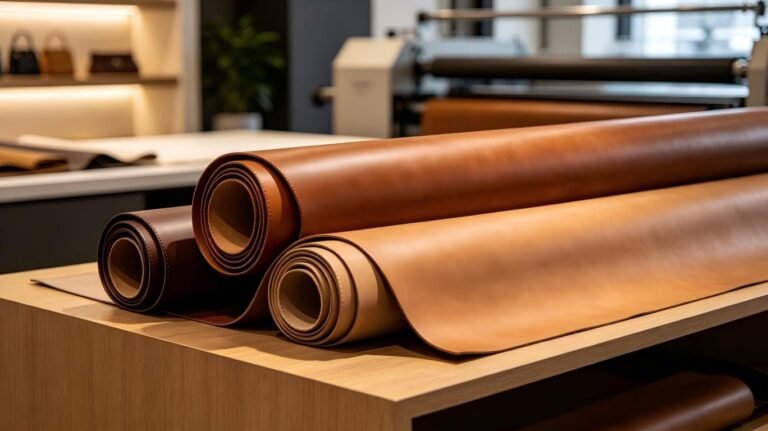
Finished silicone leather rolls in the warehouse — each batch carries full test documentation for marine certification compliance.
Frequently Asked Questions
Can silicone leather withstand direct saltwater spray on yacht exteriors?
Yes. In our 1,000-hour salt spray test (ASTM B117), silicone leather showed no surface degradation, no backing corrosion, and no salt crystal retention. The non-porous silicone surface prevents salt from penetrating the material structure. For exterior applications like deck cushions and flybridge seating, we recommend a periodic fresh-water rinse to remove accumulated salt — no special cleaners or protective treatments are needed.
What fire safety certifications does silicone leather carry for marine use?
TOPSUN silicone leather passes IMO FTP 2010 Code Part 8 (fire test for upholstered furniture aboard vessels) and Part 5 (surface flammability for bulkhead, wall, and ceiling linings). Lloyd’s Register type approval is on file, and SGS test reports are available for each production batch. These certifications are mandatory for commercial vessels and are increasingly specified by private yacht builders for insurance compliance.
What This Case Study Means for Yacht Specifiers
This silicone leather yacht case study isn’t a one-off success story — it’s a predictable outcome of material chemistry that is fundamentally better suited to marine environments than PU or PVC. When the polymer backbone contains no UV-sensitive bonds, no hydrolyzable esters, and no migratory plasticizers, the material doesn’t degrade the way conventional synthetics do. For yacht builders, interior designers, and refit yards evaluating upholstery materials, the question isn’t whether silicone leather costs more per yard. It’s whether you can afford to replace the upholstery every 18 months when vinyl fails — because in tropical marine conditions, that’s exactly the cycle you’re signing up for.
Get Marine Leather Specifications
About TOPSUN
TOPSUN manufactures marine-grade silicone leather for yacht interiors, deck seating, and cabin surfaces that must withstand equatorial UV, salt spray, and tropical humidity without degradation.
Our silicone leather resists 2,000+ hours of UV exposure, passes IMO FTP 2010 Code Part 8 fire testing, and carries Lloyd’s Register type approval — with zero VOC emissions and zero plasticizer content.