Art Deco is back. Not as a nostalgic throwback, but as a contemporary design language — what the industry now calls “Neo Deco.” The sunbursts, chevrons, and stepped geometries of the 1920s are reappearing in hotel lobbies, luxury retail, and high-end residential projects across Europe and North America. But here’s the problem most design teams discover too late: the art deco fabric that looks stunning on a mood board often fails within 18 months in a commercial space. Velvet stains. Jacquard frays. Printed PU leather loses its geometric precision after the first cleaning cycle. The material you choose matters more than the pattern you print on it.
What Defines Art Deco Fabric in 2026
The neo deco interior design fabric trends 2026 movement isn’t about copying the past. It’s about distilling Art Deco’s core principles — geometric clarity, metallic accents, bold contrast, and luxurious tactility — into materials that meet modern performance standards. Designers are moving away from literal reproductions and toward materials that capture the spirit: embossed geometric patterns, metallic-flecked surfaces, and rich jewel tones that hold their saturation under commercial lighting.
What separates 2026’s Neo Deco from the original movement is the emphasis on durability and cleanability. The Chrysler Building’s leather upholstery didn’t need to survive 100,000 Martindale cycles or resist hand sanitizer spills. Today’s commercial art deco fabric does. That shift has pushed specifiers toward silicone leather — the only material that can carry a precise geometric emboss while maintaining the performance profile a hospitality or retail project demands.

Custom embossed texture samples — geometric patterns pressed into silicone leather at production scale
Why Traditional Art Deco Fabric Fails in Commercial Spaces
Let’s be honest about what happens to traditional materials in real projects. Velvet — the tactile signature of Art Deco — absorbs spills instantly, shows compression marks within weeks, and requires professional cleaning that costs more per square meter than the fabric itself. When we compare art deco fabric vs traditional upholstery in a hospitality setting, velvet’s service life averages 18-24 months before it needs full replacement. Jacquard performs slightly better but loses pattern definition at seams and high-wear zones.
Printed PU leather seemed like a solution — until specifiers realized that the geometric patterns that define Art Deco require sharp, precise lines. After 20-30 cleaning cycles with commercial disinfectants, printed PU surfaces blur. The chevrons soften. The sunburst radii lose their edges. What started as an Art Deco statement devolves into a vague, faded pattern that signals “budget” rather than “luxury.” That’s the hidden cost of choosing a material that can’t maintain geometric precision under real-world maintenance.
Designer’s Takeaway: An Art Deco pattern is only as good as the material that carries it. If the substrate can’t hold a crisp geometric edge after cleaning, the design language collapses. Embossed silicone leather solves this because the pattern is pressed into the material — not printed on it.
Geometric Embossing: Bringing Art Deco Patterns to Silicone Leather
This is where the manufacturing process changes the design outcome. Traditional art deco fabric relies on surface printing — ink applied to the top layer. Art deco geometric pattern leather in silicone uses a different approach entirely: the pattern is embossed into the material during the calendering process, creating a three-dimensional texture that doesn’t wear off. The chevron ridges, sunburst rays, and stepped forms become physical features of the surface, not decorative coatings.

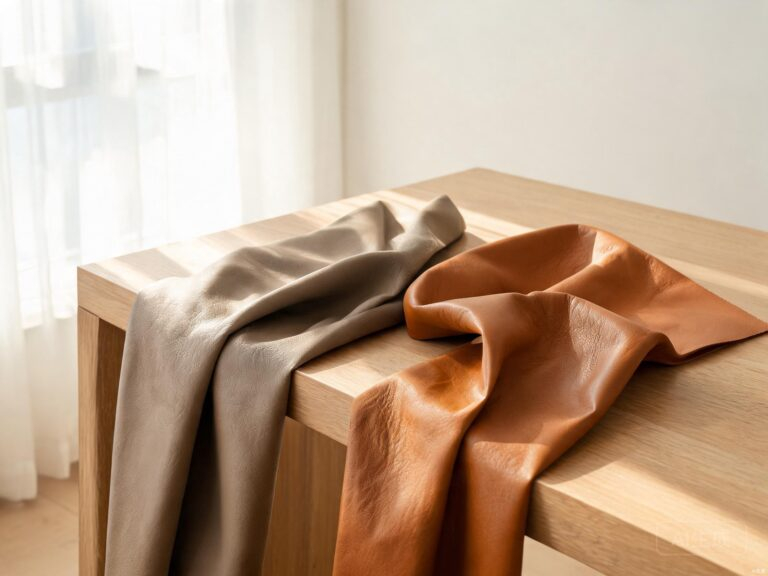
Warm-tone swatches — embossed patterns maintain their geometric definition across the full color range
In our experience working with hospitality specifiers, the difference is immediately visible. A hotel lobby banquette upholstered in embossed silicone leather with a stepped-fan pattern still shows crisp geometric lines after three years of daily guest traffic and nightly cleaning. The same pattern printed on PU leather was unreadable within 14 months. The embossed leather design guide covers the full range of available pattern geometries in more detail.
See how geometric embossing creates three-dimensional Art Deco patterns that printing can’t replicate
Color and Pattern Customization for Deco Interiors
Art Deco lives and dies by its color combinations. The classics — black and gold, navy and brass, emerald and cream — require precise color matching that generic swatch catalogs can’t deliver. When specifying art deco fabric color combinations gold black for a project, the ability to custom-match Pantone or RAL references directly into the silicone compound (not as a surface coating) means the color runs through the entire material thickness. Scratches don’t reveal a different underlying color.

Full-color swatch wall — custom Pantone and RAL matching for Art Deco palettes
This matters for Art Deco specifically because the style depends on high-contrast pairings. A gold-on-black geometric pattern needs both colors to stay saturated — if the gold yellows or the black grays after UV exposure, the entire design language breaks down. Silicone leather color customization compounds the pigment into the base material, giving you UV-stable color that holds its Art Deco contrast for the full service life of the installation.
| Material | Pattern Method | Edge Precision After Cleaning | Commercial Lifespan |
|---|---|---|---|
| Velvet | Woven jacquard | Flattens, loses sheen | 18-24 months |
| Jacquard | Woven pattern | Fraying at seams | 2-4 years |
| Printed PU Leather | Surface printing | Blurs after 20-30 cleanings | 14-36 months |
| Embossed Silicone Leather | 3D embossing | Crisp indefinitely | 10+ years |
Specifying Art Deco Fabric for Hospitality and Retail Projects
For specifiers wondering how to choose art deco fabric for commercial interiors, the decision framework is straightforward. First, identify the traffic level: boutique retail (moderate), hotel lobby (high), restaurant booth (very high). Second, determine the cleaning protocol: daily wipe-down, weekly deep clean, or periodic commercial disinfection. Third, evaluate whether the geometric pattern needs to remain crisp for the full warranty period or just look good at handover.
In high-traffic hospitality environments, embossed silicone leather is the only art deco fabric that checks all three boxes. It survives daily cleaning without pattern degradation, maintains geometric precision for 10+ years, and offers the commercial upholstery performance that hospitality procurement teams require.
The underlying material science — detailed in our silicone leather introduction — explains why embossed patterns hold their definition: the Si-O backbone resists the swelling and surface breakdown that blurs printed geometries on PU substrates.
For projects exploring the broader 2026 customization landscape, the leather customization trends 2026 analysis covers emerging pattern and texture directions beyond the classic Art Deco vocabulary.
Request Art Deco Pattern Samples
Frequently Asked Questions
Can silicone leather replicate authentic Art Deco geometric patterns?
Yes. Silicone leather supports custom embossing dies that can reproduce chevrons, sunbursts, stepped forms, and fan motifs at production scale. The pattern is pressed into the material during calendering, creating a three-dimensional texture that maintains its geometric definition far longer than surface-printed alternatives.
Is art deco fabric suitable for commercial hospitality environments?
It depends entirely on the substrate. Traditional art deco fabrics like velvet and jacquard struggle in hospitality settings due to staining, compression, and cleaning sensitivity. Embossed silicone leather brings Art Deco aesthetics to commercial-grade performance — 200,000+ Martindale cycles, stain resistance, and cleanability with standard commercial disinfectants.
The Pattern Is Only as Strong as the Material Beneath It
Art deco fabric in 2026 isn’t about choosing the right pattern — it’s about choosing the right material to carry that pattern. The geometric precision that defines Art Deco requires a substrate that can hold a crisp edge through years of cleaning, traffic, and UV exposure. Embossed silicone leather is the material that lets Art Deco survive in commercial spaces without becoming a maintenance liability. When your mood board shows a sunburst pattern, make sure the material underneath can actually deliver it — not just on day one, but in year five.
About TOPSUN
TOPSUN produces custom-embossed silicone leather that brings geometric Art Deco patterns to commercial-grade hospitality, retail, and residential interiors.
Custom embossing dies for chevrons, sunbursts, and stepped forms — with full Pantone/RAL color matching, 200,000+ Martindale cycle durability, and REACH/FDA/ISO 10993 certified materials.