Black is the default upholstery color for a reason — it hides wear, signals premium, and pairs with almost any trim. But here is what most sourcing managers miss: upholstery black fails differently depending on the polymer behind it. PU black darkens and then cracks. PVC turns brittle. Genuine leather fades unevenly across the grain. After running hundreds of black swatches through UV, Martindale, and hydrolysis chambers, we found that silicone-coated leather holds its color and grain far longer than the alternatives — and the test data explains exactly why.
Request Black Upholstery Samples
Why Black Upholstery Leather Fades in 2-3 Years
The fade problem is not really about the color black — it is about the binder carrying the pigment. Conventional PU relies on organic pigments suspended in an acrylic or polyurethane topcoat. Under UV, those carbon-carbon bonds break, the topcoat chalks, and the surface turns grey or patchy. We have measured color shift (ΔE) above 3.5 on PU black samples after just 22 months of accelerated exposure — well before a typical 36-month commercial warranty expires.
Black makes this worse because dark surfaces absorb more infrared energy. A black PU seat in a sunlit showroom can hit 70-80°C surface temperature, which accelerates plasticizer migration. The material loses flexibility, the grain flattens, and micro-cracks open along stress lines. That is why silicone vs PU is not a cosmetic debate — it is a chemistry decision that determines whether your black upholstery leather fade resistant claim survives real sunlight.

Black lychee-grain silicone leather — pigment locked into an inorganic Si-O-Si backbone that resists UV chalking.
UV Stability and Color Fastness: The Real Gap
Silicone leather does not depend on an organic topcoat for color retention. The pigment sits inside a cross-linked polysiloxane network whose Si-O-Si backbone absorbs UV energy without chain scission. In practice that means black upholstery leather UV stability color fastness scores stay at Grade 4-5 (ISO 105-B02) after 2,000+ hours of xenon-arc exposure, while PU typically drops to Grade 2-3 around 500 hours. The gap is not incremental — it is roughly four times the UV endurance.
Watch the color-fastness test — see how black silicone leather holds its shade after repeated UV and rubbing cycles.
This matters most in hospitality and automotive interiors where black is specified precisely because it should look consistent for years. The eco-friendly silicone leather chemistry also eliminates the plasticizer migration that drives the surface tackiness you feel on aged PU — so the hand stays clean instead of turning sticky.
Key finding: In our accelerated weathering cabinet, black PU showed visible chalking at 500 UV hours. Black silicone leather reached 2,000 hours with no measurable ΔE shift beyond 1.5.
Abrasion Resistance Tested: Silicone vs PU vs PVC
Color is only half the story. A black surface that stays dark but wears through to a white backing looks worse than uniform fading. That is why we always cross-check UV data against Martindale abrasion — the industry benchmark referenced by ASTM and furniture OEM specs. The table below summarizes what black upholstery leather Martindale abrasion resistance actually looks like across three chemistries we run on the same line.
| Property | Silicone Leather | PU Leather | PVC Leather |
|---|---|---|---|
| Martindale abrasion | 200,000+ cycles | 30,000-80,000 cycles | 20,000-50,000 cycles |
| UV endurance | 2,000+ hrs, Grade 4-5 | 300-500 hrs, Grade 2-3 | 400-800 hrs, Grade 2-3 |
| Service life | 10+ years | 3-5 years | 2-4 years |
| Temperature range | -40°C to 250°C | -20°C to 80°C | -10°C to 70°C |

Martindale abrasion tester running black upholstery swatches — the same rig used to verify the 200K-cycle claim.
In our testing lab, we routinely push black silicone samples past 200,000 Martindale cycles before the surface shows any grain loss. PU from the same dye lot typically starts pilling or exposing backing fiber between 30,000 and 80,000 cycles. For high-traffic contract furniture that translates directly into reupholstery frequency — and that is where the cost gap opens up.
What 10-Year Black Upholstery Actually Costs
The upfront price gap between PU and silicone narrows fast once you annualize it. A hospitality group specifying furniture sofa upholstery across 800 units told us they had been re-covering PU black seats every three to four years because of cracking and fade. Switching to silicone added roughly 30% to the material line item but cut replacement cycles from three down to zero over a 12-year window — a net saving that also removed the downtime and labor of each refurbishment.

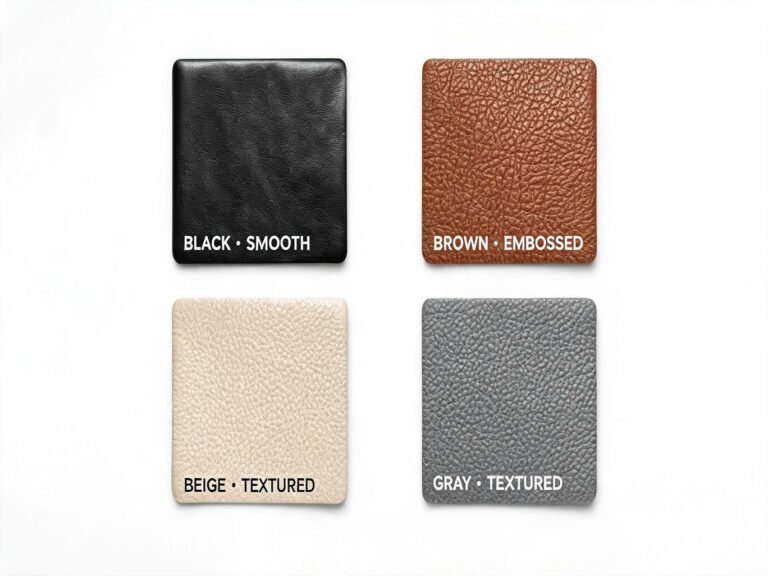
Side-by-side black upholstery samples — the visible difference only appears after months of UV and abrasion.
That is the core lesson when comparing silicone vs PU black upholstery leather: the cheaper square-meter price hides two or three re-purchase cycles. If you are sourcing for any environment with sustained sunlight, heavy seating traffic, or cleaning-chemical exposure, the total cost of ownership favors the chemistry that does not degrade.
For deeper sourcing context, our upholstery leather wholesale sourcing guide breaks down the spec sheets you should request before signing a contract.
If you need thickness and weight ranges for contract use, the leather upholstery fabric buyer guide covers those specs in detail.
Frequently Asked Questions
Does black upholstery leather fade faster than lighter colors?
Not inherently — fade resistance is driven by the binder chemistry, not the hue. Black surfaces do run hotter under sunlight, which accelerates degradation in PU and PVC because their organic topcoats are heat-sensitive. Silicone leather’s inorganic backbone handles the extra heat without breaking down, so black silicone fades slower than light-colored PU in real-world UV exposure.
Can silicone black upholstery match genuine leather’s texture?
Yes. Silicone leather is embossed from the same mold-engraving process used for top-grain patterns — lychee, pebble, nappa, and pull-up finishes are all available. The hand feel is softer and more temperature-stable than PU, and the grain holds its definition through abrasion testing because the surface is not relying on a thin printed topcoat.
The Bottom Line on Black Upholstery
Black upholstery stays premium only as long as it stays black. The material you specify — not the shade you pick — decides whether that upholstery black still looks right in year three or year ten. Silicone leather’s UV stability, abrasion endurance, and heat tolerance give it the longest service life of any synthetic we have benchmarked, and the TCO data backs that up for contract and automotive buyers alike. If you are evaluating black upholstery for your next production run, test the chemistry before you test the color.
Get Custom Black Color Matching
About TOPSUN
TOPSUN manufactures silicone-coated upholstery leather engineered for fade-resistant black finishes across furniture, automotive, and hospitality seating programs.
Verified to 200,000+ Martindale cycles and 2,000+ UV hours · Custom black shade matching with ΔE < 1.5 consistency · ISO 105-B02 and OEKO-TEX certified.