Most sofa specification sheets I review list “genuine leather” as the upholstery material. That phrase tells you nothing useful. Genuine leather spans everything from a $2,000 full-grain sectional that lasts 25 years to a $400 bonded-leather loveseat that starts peeling at month 18. When B2B specifiers write “genuine leather” into a furniture procurement document, they’re creating a liability — not a specification. This article ranks five leather for sofa upholstery grades by real-world performance, 10-year cost, and compliance readiness, so your specification sheet actually protects your project.
Leather for Sofa Upholstery: Understanding the Grade Hierarchy
The types of leather for furniture follow a strict hierarchy determined by how much of the original hide surface remains intact. Each step down the hierarchy involves more processing — sanding, coating, bonding — that trades natural durability for uniform appearance and lower cost.
| Grade | Construction | Martindale Cycles | Lifespan | 10-Yr Cost/Seat/Yr |
|---|---|---|---|---|
| Full-grain aniline | Untouched hide, aniline dye | 100,000+ | 15–25 yrs | $53 |
| Top-grain semi-aniline | Light sanding + pigment coat | 25,000–40,000 | 10–15 yrs | $75 |
| Corrected grain | Heavy sand + emboss + PU coat | 8,000–15,000 | 3–6 yrs | $95 |
| Bonded leather | Scrap + polyurethane binder | 3,000–8,000 | 18–24 months | $125 |
| Silicone leather (TOPSUN) | Silicone coating on fabric base | 100,000+ | 10+ yrs | $45 |
The price inversion is striking. Bonded leather — the cheapest upfront option — costs 136% more per seat per year than full-grain over a decade, because it requires complete replacement every 18–24 months. That’s not a theoretical projection; it’s documented across hospitality furniture programs where bonded leather shows a 35–40% peeling failure rate within 24 months of hotel use.

Leather swatch samples showing grade and texture variations
Performance Specs That Separate Commercial from Residential Leather
Residential and commercial commercial grade leather for sofa upholstery live in different specification universes. A material that passes residential standards can catastrophically fail in a hotel lobby. Here’s where the thresholds diverge:
- Martindale abrasion (ISO 12947): Residential accepts 15,000–20,000 cycles. Commercial hospitality requires 40,000+ minimum. Heavy-traffic lobbies demand 80,000+. Full-grain leather and silicone leather both exceed 100,000.
- Thickness: High-end sofa leather measures 1.8–2.2 mm. Lower-end sofas run 1.4–1.8 mm. Commercial PU coatings need minimum 0.5 mm to survive contract use. Thinner materials tear at stress points within the first year.
- Color fastness to light (ISO 105-B02:2014): Grade 5 minimum for commercial. Lower grades cause visible fading within 6 months near windows or under display lighting.
- Rub fastness (ISO 11640:2018): Dry 500 cycles, wet 200 cycles, perspiration 80 cycles. Hotel towels, cleaning chemicals, and body oils stress all three parameters simultaneously.
- Cold crack resistance (EN ISO 17233): -15°C with no finish cracking. Critical for furniture shipped to or stored in cold climates — a specification most residential suppliers skip entirely.

Color fastness testing — ISO 105-B02 verification for upholstery leather
10-Year TCO: Why Leather for Sofa Upholstery Grade Matters More Than Price
When evaluating best leather for sofas full grain vs top grain, the upfront price conversation ends quickly — full-grain costs more. The 10-year conversation is where procurement decisions should actually happen.
Consider a 50-seat commercial lounge deployment. Full-grain leather at $800 per seat requires no replacement over 10 years, with $15/seat annual conditioning. That’s $53 per seat per year. Bonded leather at $250 per seat needs full replacement at year 2 and again at year 6 — total spend of $1,250 per seat, or $125 per seat per year. The “cheaper” material costs 136% more over the project lifecycle.
From a recent hotel project: We specified silicone leather for 80 lobby sofas in a tropical resort. After 24 months of continuous commercial use — sun exposure, humidity, daily cleaning — zero panels required replacement. The previous bonded leather specification had a 40% failure rate within the same period.
The full-grain leather market is projected to reach $22.19 billion in 2026, growing at 8.23% CAGR through 2032, according to Research and Markets. That growth reflects a market correction — buyers are moving up the grade hierarchy as TCO data becomes more widely available.

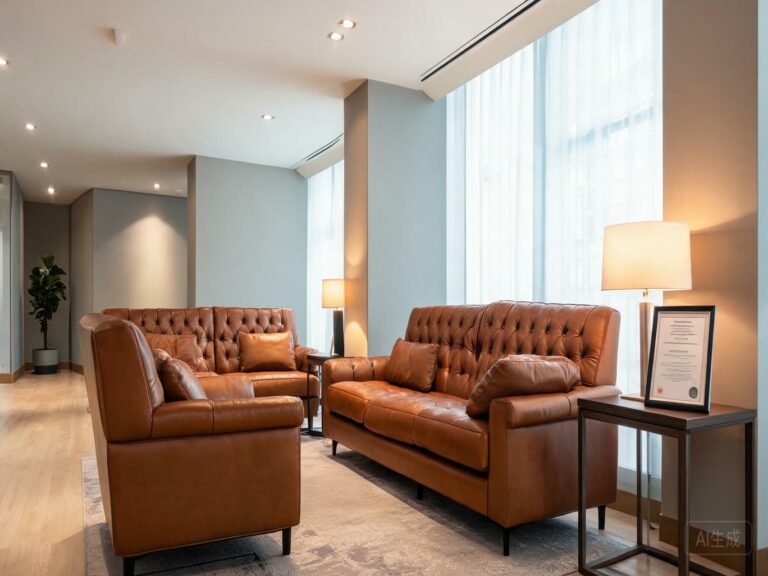
Full-grain leather sofa — the benchmark for 15+ year upholstery performance
Fire Retardancy and Compliance for B2B Sofa Programs
Fire safety compliance is where many sofa upholstery leather specifications thickness documents fall apart. Suppliers present certificates for the fabric alone, but fire testing must cover the finished composite assembly — fabric, foam, and frame together.
The three standards B2B specifiers must verify:
- California TB117-2013: US baseline — smolder-only test. Non-compliant product faces customs seizure. Request test reports from accredited labs, not supplier in-house data.
- UK BS5852 Crib 5 (Source 5): Mandatory for UK hospitality. Significantly more demanding than TB117 — tests ignition resistance with a wooden crib flame source.
- IMO Resolution MSC.61(67): Required for marine and cruise ship furniture. The most stringent standard — if your material passes IMO, it passes everything else.
Beyond fire safety, the EU Deforestation Regulation (EUDR) takes effect in 2026, requiring full chain-of-custody traceability for timber components in furniture — including sofa frames. This shifts FSC/PEFC certification from a marketing advantage to a legal requirement for European-bound orders. Specifiers who don’t verify frame timber sourcing now will face shipment holds later.

Hand-feel and flexibility assessment — critical for upholstery comfort specifications
Stain resistance demonstration — why silicone leather matches full-grain performance for commercial sofa programs
Frequently Asked Questions
Is “genuine leather” a quality grade I can specify in procurement documents?
No. “Genuine leather” only indicates that real leather exists somewhere in the product — it tells you nothing about grade, thickness, or processing. B2B specification documents should never use this term. Instead, specify the exact grade: full-grain, top-grain, corrected grain, or bonded — along with Martindale cycle minimum, thickness range, and required certifications. For silicone leather alternatives, specify full silicone vs semi-silicone construction.
Why does bonded leather peel so quickly in commercial settings?
Bonded leather is approximately 10–20% actual leather fibers bonded with polyurethane adhesive. Under commercial use — repeated seating pressure, cleaning chemical exposure, humidity cycling — the adhesive degrades and the leather fibers separate from the backing. This peeling is irreversible and typically begins at stress points (seat edges, armrests) within 18–24 months. The upholstery buyer’s guide for B2B programs should explicitly exclude bonded leather from commercial specifications.
Writing Specifications That Actually Protect Your Project
Leather for sofa upholstery procurement fails most often not at the factory, but at the specification stage. When a procurement document says “genuine leather, brown, per attached sample,” it leaves every critical variable — grade, thickness, Martindale minimum, fire certification, cold crack resistance — undefined. The supplier fills those gaps with whatever costs least. The result is a sofa that looks right on day one and fails on day 540.
The fix is straightforward. Specify grade by name, Martindale cycle minimum by application type, thickness range, fire certification by jurisdiction, and color fastness grade. Then verify with independent testing before the full order ships. Materials like silicone leather that match full-grain performance at lower TCO should be evaluated alongside traditional grades — the specification framework applies equally to both.
About TOPSUN
TOPSUN produces specification-grade silicone leather for sofa upholstery programs, delivering full-grain-equivalent hand-feel with verified 100K+ Martindale abrasion cycles across residential, hospitality, and contract furniture applications.
Our material achieves zero-VOC certification per SGS testing, passes CA TB117-2013 and BS5852 Crib 5 fire safety standards, and offers 500+ OEM color options with lychee, smooth, and embossed textures — all from 500-meter MOQs with 500,000+ meters monthly production capacity.