Leather textures are not cosmetic afterthoughts. The pattern embossed onto a leather surface determines how it wears over time, how it hides scratches, how it feels under fingertips, and how it responds to cleaning protocols. Yet many B2B buyers treat texture selection as a design-only decision, only to discover—18 months into a product lifecycle—that the chosen grain has flattened, collected grime in its valleys, or failed to meet abrasion thresholds after repeated cleaning.
The global synthetic leather market, valued at $50.6 billion in 2026, offers hundreds of embossed patterns across PU, PVC, and silicone leather substrates. Understanding how texture geometry interacts with material chemistry is the difference between specifying a surface that lasts 10 years and one that degrades in 18 months. This guide breaks down eight dominant texture types, maps them to end-use applications, and provides inspection criteria for verifying pattern durability before you commit to a volume order.
Request Texture Sample Swatches
What Are Leather Textures? Types and Manufacturing Methods
Leather textures are surface patterns created either by the natural grain structure of animal hide or by mechanical embossing during synthetic leather production. In genuine leather, the texture comes from the animal’s pore structure—each species produces a distinct grain. In synthetic and silicone leather, textures are engineered by pressing heated embossing rollers onto the coated surface, transferring a negative pattern into the polymer layer.
Eight texture types dominate the B2B procurement landscape:
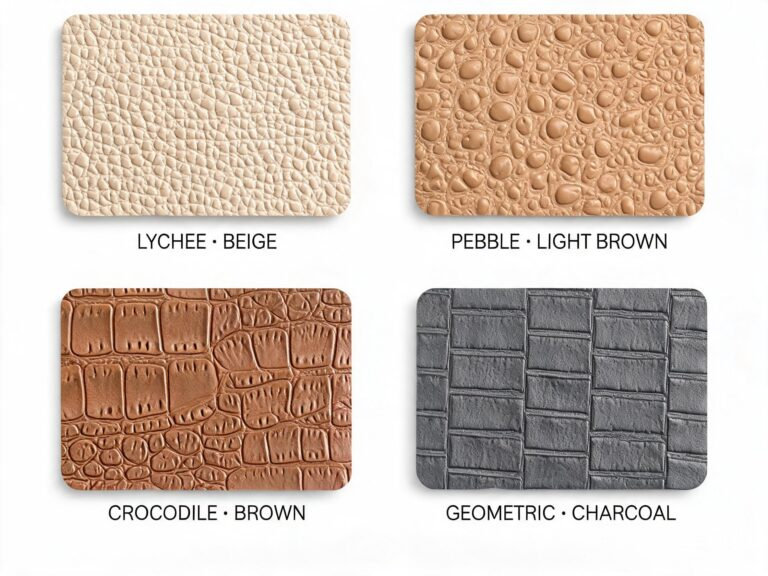
- Lychee grain — Irregular bumpy pattern resembling lychee fruit skin. The most common synthetic texture; balances scratch-hiding ability with tactile grip. Embossing depth: 0.3–0.6mm.
- Pebbled grain — Small, uniform rounded pebbles across the surface. Hides minor abrasions well; popular in furniture and automotive seating. Depth: 0.2–0.4mm.
- Full-grain (smooth) — Minimal embossing; preserves the natural-looking flat surface. Premium aesthetic but shows scratches and wear marks more readily. Depth: 0.05–0.15mm.
- Saffiano (cross-hatch) — Diagonal cross-hatch pattern originally from Prada handbags. Extremely scratch-resistant due to pattern geometry. Depth: 0.15–0.3mm.
- Nubuck-style — Fine velvet-like surface created by micro-sanding. Soft touch but high maintenance; impractical for high-traffic commercial applications. Depth: N/A (surface treatment).
- Ostrich/quill — Distinctive raised dot pattern simulating ostrich skin. Used in fashion accessories and premium automotive accents. Depth: 0.4–0.8mm.
- Geometric/custom — Non-natural patterns: hexagons, stripes, abstract designs. Growing in consumer electronics and branded merchandise. Depth varies by design.
- Top-grain cowhide replica — Engineered to replicate the irregular pore structure of premium bovine leather. Used in luxury automotive and high-end furniture where authenticity matters. Depth: 0.1–0.25mm.

Macro closeup of lychee grain leather texture showing embossed pattern depth and uniformity
The embossing process itself matters as much as the pattern choice. Silicone leather uses solvent-free coating applied to fabric substrate, followed by thermal embossing at 150–180°C. The silicone polymer’s inherent elasticity allows deeper pattern penetration without cracking—unlike PU, where deep embossing can embrittle the coating and accelerate hydrolysis failure. TOPSUN maintains 100+ standard texture patterns across three series: Basic (lychee, plain), Premium (cowhide, sheepskin replicas), and Special (geometric, abstract).
How Leather Texture Depth Affects Durability and Cleanability
Texture depth is the single most underestimated specification parameter in B2B leather sourcing. Deeper textures hide scratches and wear marks better but create valleys where dirt, oils, and cleaning residues accumulate. Shallow textures are easier to clean and maintain but show every abrasion. This trade-off directly impacts total cost of ownership.
In our QC lab, we tested three texture depths across identical silicone leather substrate material using ISO 5470-2 Martindale abrasion testing and a standardized soiling protocol (ASTM D4212 soil retention). Results after 50,000 abrasion cycles:
| Texture Depth | Pattern Retention | Soil Retention Score | Cleaning Cycles to Restore |
|---|---|---|---|
| Shallow (0.05–0.15mm) | 92% retained | Low (1.2/5) | 2–3 wipes |
| Medium (0.2–0.4mm) | 88% retained | Moderate (2.4/5) | 4–6 wipes |
| Deep (0.5–0.8mm) | 79% retained | High (3.8/5) | 8–12 wipes |
The data tells a clear story: deep textures lose 21% of their pattern definition under heavy abrasion, while shallow textures retain 92%. But deep textures still outperform shallow ones in scratch concealment—a single 5N scratch is invisible on a 0.6mm lychee grain but clearly visible on a 0.1mm smooth surface. The specification question becomes: what is the primary failure mode for your application—abrasion wear or visible scratching?

Warm-tone lychee grain leather texture swatches showing color and pattern consistency across production batches
Matching Leather Textures to End-Use Applications
No single texture type works across all applications. The correct specification balances tactile expectations, cleanability requirements, regulatory constraints, and aesthetic positioning. Here is the application-to-texture matching matrix we build for B2B clients during specification review:
| Application | Recommended Texture | Depth Range | Primary Rationale |
|---|---|---|---|
| Automotive seating | Pebbled / lychee | 0.3–0.5mm | Hides wear from daily ingress/egress; grip prevents sliding |
| Furniture upholstery | Lychee / pebbled | 0.2–0.4mm | Balance of comfort and cleanability for residential use |
| Medical / healthcare | Smooth / shallow pebbled | 0.05–0.2mm | Must withstand hospital-grade disinfection without soil traps |
| Marine / outdoor | Medium lychee | 0.3–0.4mm | Salt spray and UV exposure; texture must resist flattening |
| Fashion / bags | Saffiano / ostrich | 0.15–0.8mm | Brand differentiation; scratch resistance for daily-carry items |
| 3C electronics | Fine geometric / smooth | 0.1–0.2mm | Precision die-cutting requires shallow, uniform patterns |
| Public transit seating | Deep pebbled | 0.4–0.6mm | High-traffic wear; vandalism scratch concealment |
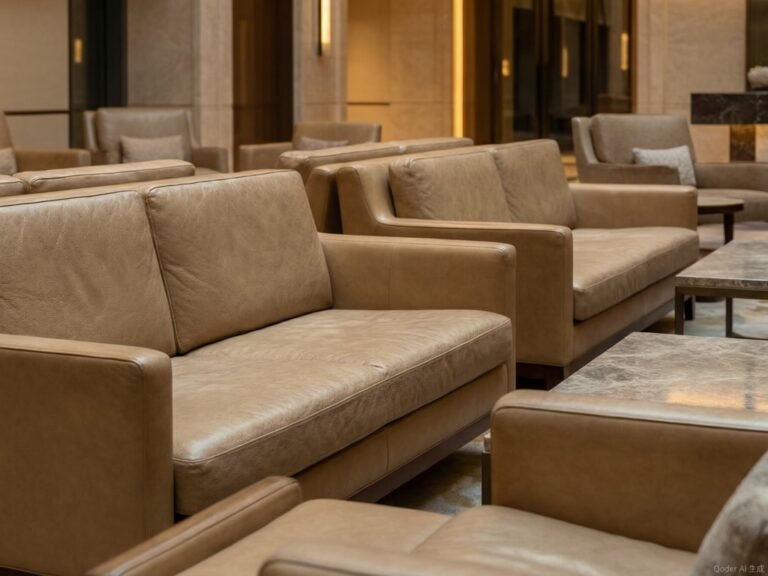
A furniture manufacturer sourcing for the hospitality sector—a client we supplied in Q3 2025—initially specified a smooth full-grain texture for 500 hotel lobby sofas. After reviewing the soiling protocol data, they switched to a 0.3mm pebbled grain. Six months post-installation, the hotel reported 40% fewer cleaning service calls compared to smooth-surface seating in their previous property. Texture specification is a maintenance cost decision, not just an aesthetic one.

Custom leather texture sample swatches reviewed during B2B specification consultation
Custom Leather Texture Development for Brand Differentiation
When off-the-shelf textures do not meet your brand positioning, custom pattern development creates exclusive surface designs unavailable to competitors. This is increasingly common in automotive OEM programs, premium consumer electronics, and branded hospitality projects where tactile identity is part of the IP.
The custom texture development process involves four stages:
- Pattern design — 2D artwork or 3D scan of a reference surface. Files are converted to embossing roller specifications with defined groove angles and depth profiles.
- Prototype embossing — A test roller is engraved and used to emboss 2–5 meters of sample material. This sample is evaluated for pattern definition, tactile feel, and visual consistency.
- Performance validation — The textured sample undergoes Martindale abrasion (ISO 5470-2), flexing endurance (ISO 7854), and cleanability testing. Pattern retention must exceed 85% after 25,000 cycles for approval.
- Production roller manufacturing — Once the prototype is approved, a production-grade embossing roller is manufactured. Typical lead time: 15–25 days from approval to first production run.
Custom texture development costs vary widely. Engraving a standard-sized embossing roller (1,400mm width) ranges from $2,800 to $6,500 depending on pattern complexity. This is a one-time tooling cost—the roller is reusable across production runs for the life of the pattern. For brands evaluating whether silicone vs PU substrates better preserve custom patterns, silicone’s elasticity maintains pattern depth 15–20% longer under equivalent abrasion conditions.

Multi-color lychee grain leather rolls showing texture consistency across different color batches
Silicone leather texture variety showcase: lychee, pebbled, smooth, and custom patterns
Quality Inspection Standards for Leather Textures
Verifying texture quality on incoming rolls requires both visual and dimensional inspection. The following four checks should appear on every incoming QC checklist when textured leather is specified:
1. Pattern depth uniformity. Use a digital depth gauge to measure embossing depth at 10 points across the roll width and every 5 meters along the length. Acceptable variation is ±0.05mm from the specified depth. Greater variation causes visible pattern inconsistency in finished products, particularly under directional lighting.
2. Pattern retention after flexing. Per ISO 7854, flex the material through 50,000 cycles and re-measure depth. Retention above 85% is acceptable for commercial applications; automotive requires 90%+. PU materials often drop below 80% at this threshold due to coating rigidity—silicone leather typically retains 92–95% because the polymer recovers elastically.

Closeup detail of silicone leather fabric texture showing pattern precision and surface uniformity
3. Seam matching consistency. When textured leather is sewn into panels, the pattern must align across seams. Inspect the pattern repeat distance (typically 50–150mm depending on design) and verify that adjacent rolls share the same phase alignment. Misaligned patterns are immediately visible in upholstered furniture and automotive interiors.
4. Abrasion-induced pattern loss. Run Martindale testing (ISO 5470-2) to 25,000 cycles and visually inspect for pattern flattening at wear peaks. The ISO 5470-2 standard provides the test methodology. Deep textures are particularly vulnerable—valley-to-peak height reduction exceeding 20% indicates the embossing was insufficiently bonded to the substrate.
About TOPSUN: Texture Engineering Expertise
TOPSUN has developed and manufactured silicone leather textures for B2B clients across 30+ countries since 2016. Our texture vault contains 100+ standard patterns, and our engineering team has delivered 200+ custom exclusive designs for automotive OEMs, furniture brands, and consumer electronics manufacturers. Every textured roll ships with documented Martindale, flexing, and color fastness test data from our in-house QC lab—because texture specification without test data is guesswork.
Whether you need a standard lychee grain for furniture production or an exclusive geometric pattern for a new product launch, our team provides pattern design consultation, prototype embossing, and performance validation under one roof. For existing leather texture customization options, explore our full pattern library or request physical swatches through our samples center.
Get Texture Design Consultation
Frequently Asked Questions
How deep should embossed leather textures be for automotive seating?
Automotive seating typically specifies 0.3–0.5mm embossing depth. This range balances scratch concealment (critical for daily ingress/egress wear) with cleanability (dealership detailing protocols). Depths above 0.6mm trap dirt in valley structures and require aggressive cleaning that accelerates pattern flattening. Depths below 0.2mm show visible wear marks within 6–12 months of daily use.
Can leather textures affect color fastness test results?
Yes. Deep texture valleys can trap rubbing felt during ISO 11640 color fastness testing, creating localized pressure concentration that accelerates dye transfer. In our lab, deep textures (0.6mm+) test 0.5–1.0 grade lower than the same material in smooth finish under identical conditions. Always specify the texture depth when communicating color fastness requirements to your supplier, and request test data on the actual textured surface rather than a smooth reference sample.