A Tier-1 seat supplier we work with spent 14 months qualifying a woven polyester fabric for a mid-size SUV program. By year three of production, warranty claims for seat fading and odor retention hit 4.2% — triple the OEM threshold. The fabric looked great in the showroom. It failed in real life. Fabric car upholstery remains the default for cost-driven programs, but procurement teams who have lived through a warranty spike know the hidden costs. This article breaks down where fabric seat trim falls short of OEM specifications, and what to specify instead.
Request Automotive Seat Trim Samples
Types of Fabric Car Upholstery in Production Today
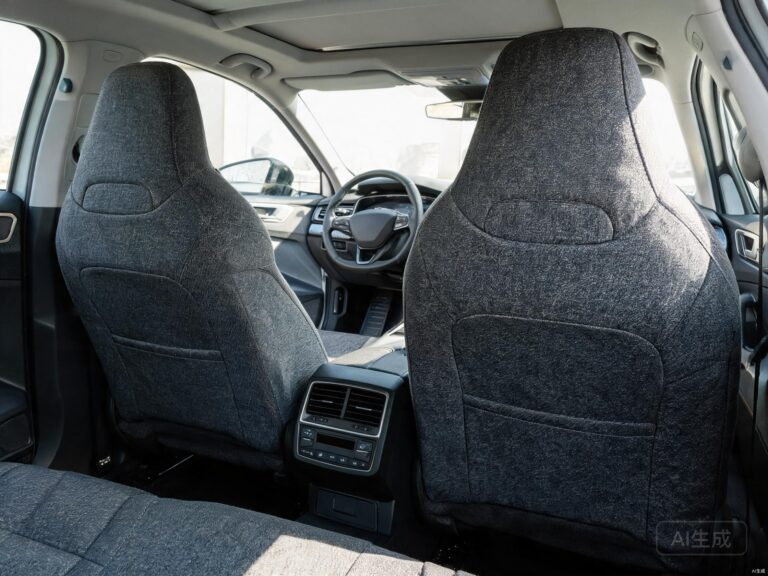
Walk through any auto show and you’ll see three dominant fabric types on seat trim: woven polyester, tricot knit, and velvet-style microfiber. Woven polyester is the workhorse — it accounts for roughly 60% of non-leather seat surfaces in mass-market vehicles because it costs $2 to $5 per square meter and passes basic automotive interior material requirements.
Tricot knit offers better stretch for contoured seat shells but sacrifices abrasion resistance — typically 15,000 to 25,000 Martindale cycles versus woven polyester’s 25,000 to 40,000. Velvet microfiber delivers a premium look but acts like a sponge for spills, body oils, and odor molecules. None of these fabric types were engineered to survive 10 years of daily driver exposure without significant degradation.

Flexibility and bending test equipment evaluating automotive seat trim material performance
In our procurement reviews, the pattern is consistent. OEMs specify fabric for entry-level trims to hit a price point, then switch to leather or synthetic leather for mid-tier and above. The assumption is that fabric is “good enough” for budget buyers. The warranty data tells a different story.
Where Fabric Car Upholstery Falls Short in OEM Testing
OEM material specifications for seat trim go beyond basic abrasion. They include colorfastness to light (xenon arc), stain resistance, odor emission, fogging value, and flammability per FMVSS 302. Fabric car upholstery passes the initial qualification. The problem is what happens after 30,000 miles of real-world use.

Tensile strength testing equipment measuring seat trim material failure thresholds
UV colorfastness is the first failure point. Standard automotive polyester fabric loses 1.5 to 2 Grey Scale ratings after 400 hours of xenon arc exposure — visible fading on seat bolsters within 18 to 24 months in sunbelt markets. Stain resistance is the second. Fabric absorbs coffee, sunscreen, and body oils into the fiber matrix. Once absorbed, stains require professional extraction cleaning. Repeated cleaning degrades the fabric’s surface treatment, accelerating further soiling.
One OEM’s internal study found that fabric seats in fleet vehicles required professional cleaning every 4 months, costing $45 per vehicle per cycle — $1,800 over a 10-year fleet lifecycle.
Odor retention is the third — and least discussed — failure mode. Fabric fibers trap volatile organic compounds from food, smoke, and cleaning chemicals. Unlike leather or silicone surfaces that can be wiped clean, fabric requires deep extraction to remove embedded odor molecules. For ride-share and rental fleets, this translates to higher vehicle depreciation and faster interior refurbishment cycles. Read more about how car upholstery product standards address these gaps.
Color Matching and Batch Consistency Challenges
Automotive OEMs demand Delta E color matching of 1.5 or tighter across all interior trim components — seats, door panels, steering wheel, and dashboard must look identical under showroom lighting. Woven fabric makes this exceptionally difficult. Dye lot variation between production runs can push Delta E to 2.5 or higher, especially for saturated colors like deep blue, burgundy, and forest green.
The procurement reality: fabric suppliers typically require minimum order quantities of 5,000 to 10,000 linear meters to guarantee a single dye lot. For low-volume programs or late-design color changes, this forces buyers to either accept visible color mismatch or pay premium pricing for smaller batch dye runs. Neither option is acceptable to OEM quality teams.

Automotive interior seat trim must maintain color consistency across all visible surfaces
Silicone leather solves this through pigmented coating chemistry rather than fiber dyeing. Color is applied as a surface layer using Pantone-matched pigment dispersions, achieving Delta E below 1.0 consistently across production batches — even for complex metallic and pearl finishes. For context on how silicone leather manufacturing achieves this precision, the key is that the coating is applied post-substrate, allowing independent color control.
Fabric vs Silicone Leather for Automotive Seat Trim
The comparison comes down to five procurement-critical dimensions: breathability, stain and odor behavior, color fastness, flame retardancy, and OEM color matching lead time. Here is how the materials stack up when evaluated against actual OEM specification sheets.

Scratch resistance testing validates seat trim material durability under daily use conditions
| Metric | Woven Polyester Fabric | PU Synthetic Leather | Silicone Leather |
|---|---|---|---|
| Breathability | High (air permeable) | Low (traps heat) | Moderate (cool-touch surface) |
| Stain & Odor Behavior | Absorbs liquids and odors | Surface stains, moderate odor | Level 5 stain resistance, zero odor absorption |
| Color Fastness (Xenon Arc) | Grade 2-3 (400 hrs) | Grade 3-4 (500 hrs) | Grade 4-5 (1500+ hrs) |
| FMVSS 302 Flame Rating | Pass (with treatment) | Pass | Pass + EN 13773 Class 4 |
| OEM Color Match Lead Time | 6-8 weeks (dye lot) | 4-6 weeks | 2-3 weeks (pigment coating) |
The data reveals a paradox procurement teams must navigate. Fabric wins on breathability — no synthetic material matches the air permeability of woven textile. But fabric loses on every other dimension that drives warranty cost and customer satisfaction. The question is whether breathability alone justifies the downstream costs of staining, fading, and odor remediation. For most OEM programs, the answer is no — which is why automotive seat leather adoption continues to climb even in mid-tier trims.
Mass Production Readiness with Silicone Leather
For OEM procurement teams evaluating silicone leather as a fabric replacement, three production criteria matter most: supply consistency, conversion compatibility, and compliance documentation. Silicone leather addresses all three.
Breathable silicone leather for car seats — demonstrating airflow, comfort, and easy-clean surface properties
Supply consistency comes from roll-to-roll coating production — the same equipment used for PU leather, meaning existing Tier-1 cutting and sewing lines require no retooling. Color matching runs 2 to 3 weeks versus fabric’s 6 to 8 week dye lot cycle. Compliance is pre-certified: FMVSS 302, EN 13773 Class 4, REACH, and near-zero VOC emissions meet OEM cabin air quality targets without additional testing rounds.
One of our automotive clients replaced woven polyester on a 50,000-unit EV program. The switch to silicone leather added $3.20 per seat in material cost but eliminated the $45-per-vehicle professional cleaning cycle from the fleet maintenance schedule. The silicone vs PU comparison data shows similar advantages over synthetic leather alternatives — with 200,000+ Martindale cycles, 1,500+ hour UV resistance, and Level 5 stain resistance verified on factory testing equipment.
Frequently Asked Questions
Can fabric car upholstery be treated to match OEM stain resistance requirements?
Fluorocarbon and nano-silica surface treatments can improve fabric stain resistance to Grade 3-4 initially. However, these treatments degrade with cleaning — each wash cycle removes 10-15% of the protective coating. After 8-12 professional cleanings, the fabric reverts to its untreated state. OEMs that specify treated fabric typically see warranty claims spike in year three, coinciding with treatment depletion. Silicone leather achieves Level 5 stain resistance through its molecular structure, not a surface treatment, so performance does not degrade over time.
How does fabric car upholstery affect cabin VOC and fogging values?
Fabric itself emits low VOC compared to PU or PVC. The problem is what fabric absorbs. Volatile compounds from food, cleaning products, and body oils become trapped in the fiber matrix and re-emit slowly over time — a phenomenon called secondary emission. Fogging values on fabric seats can exceed 3 mg after two years of use, compared to silicone leather’s consistent sub-1 mg rating. For OEMs targeting VDA 270 or ISO 12219 compliance, this secondary emission behavior makes fabric a liability in long-term cabin air quality testing.
The Procurement Case for Upgrading Seat Trim
Fabric car upholstery has served the industry well as a low-cost seat trim option. But the procurement landscape has shifted. OEM warranty thresholds are tighter, fleet buyers demand longer service intervals, and cabin air quality regulations are expanding. A material that absorbs stains, fades under UV, and traps odors is no longer just a comfort issue — it is a cost center that shows up in warranty data, residual values, and customer satisfaction scores. Silicone leather eliminates every one of fabric’s failure modes while maintaining OEM-grade flammancy compliance and cutting color matching lead time in half. For procurement teams planning their next seat trim program, the question is not whether to upgrade — it is whether they can afford not to. Explore more about silicone leather in automotive applications for your next program.
About TOPSUN
TOPSUN supplies silicone leather to automotive OEMs and Tier-1 seat manufacturers, with FMVSS 302 and EN 13773 Class 4 flame retardant certifications, Pantone-precise color matching within 3-week lead times, and 200,000+ Martindale cycle durability verified through in-house testing equipment.
Near-zero VOC · REACH / PAHs compliant · Low fogging · No plasticizers · -40°C to 250°C thermal stability · Custom OEM color matching