The Material That’s Everywhere — and Misunderstood
Walk through any product development studio and you’ll find it: a swatch board covered in artificial leather PU samples. Phone case mockups. Handbag prototypes. Automotive trim concepts. Medical device housings. PU leather is the default synthetic leather for product designers worldwide — it’s affordable, versatile, and available in thousands of colors and textures. But here’s what most specifiers learn the hard way: not all PU leather is created equal, and the wrong formulation can sink a product launch faster than a supply chain disruption.
In our application engineering work, we’ve seen PU leather specified for outdoor furniture that cracked within one summer, for medical devices that failed biocompatibility screening, and for automotive interiors that emitted VOCs above OEM thresholds. The problem wasn’t PU leather itself — it was a mismatch between the material grade and the application requirements. This guide walks through how to match artificial leather PU to the right application, plan specifications for bulk procurement, and recognize when a silicone leather upgrade is the smarter specification.
What Is Artificial Leather PU and Where Does It Fit?
Artificial leather PU (polyurethane) is a synthetic leather made by coating a fabric substrate — typically polyester, cotton, or a blend — with a polyurethane polymer layer. The PU coating provides the leather-like appearance, hand-feel, and surface performance, while the fabric backing provides structural strength and tear resistance. Unlike PVC leather, which uses plasticizers to achieve flexibility, PU leather achieves softness through the polymer chemistry itself — which makes it generally safer and more pleasant to handle than PVC.
From a designer’s perspective, PU leather fills a specific niche in the material spectrum:
- Cost-sensitive applications — products where unit price drives the BOM and material lifespan requirements are 2-3 years or less
- Aesthetic-driven products — fashion accessories, seasonal goods, and trend-driven items where visual variety matters more than long-term durability
- Indoor, low-stress environments — products that won’t face sustained UV exposure, chemical cleaning, or extreme temperatures
- Rapid prototyping — PU leather’s wide availability and short lead times make it ideal for development phases and short production runs
Where PU leather struggles is in applications that demand longevity, chemical resistance, or environmental compliance beyond basic standards. That’s not a flaw of the material — it’s a limitation of the chemistry. Understanding where PU fits and where it doesn’t is the first step in specification planning.

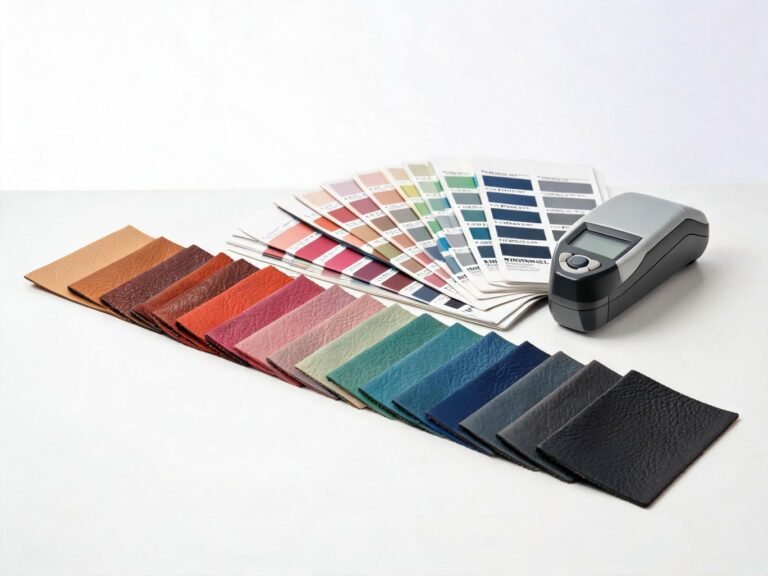
PU leather color and texture library — the breadth of aesthetic options makes PU the default for trend-driven product development.
PU Leather Manufacturing: Solvent-Based vs Water-Based vs Silicone
The manufacturing process determines everything about a PU leather’s environmental profile, performance characteristics, and cost. Three production methods dominate the market today, and they produce fundamentally different materials — even though all three may carry the “PU leather” label.
Solvent-based PU is the traditional method, using DMF (dimethylformamide) as the primary solvent. It produces the widest range of textures and finishes at the lowest cost, but the process releases significant VOC emissions during manufacturing. The finished material may retain residual solvents that off-gas over time — a critical issue for automotive interiors and enclosed-product applications where air quality standards apply.
Water-based PU replaces organic solvents with water as the carrier medium, reducing VOC emissions during manufacturing by 70-90%. The finished material has lower residual solvent content, making it suitable for applications with stricter indoor air quality requirements. However, water-based PU typically costs 20-30% more than solvent-based and offers slightly narrower texture options due to processing limitations.
Silicone-coated leather takes a different approach entirely — replacing the PU polymer with a silicone (polysiloxane) coating on the same fabric substrate. This isn’t PU leather anymore; it’s a different material class. But it’s the natural upgrade path when PU’s limitations become deal-breakers. Silicone leather offers zero VOC emissions, UV stability, chemical inertness, and a 10+ year lifespan — at roughly 1.5-2x the cost of standard PU. For a full silicone vs PU comparison, our technical reference page covers every parameter.

Cross-section comparison — PU polymer coating (left) vs silicone polymer coating (right) on identical fabric substrates.
Specification Planning for Bulk PU Leather Orders
When you’re ordering artificial leather PU in volume — 500 meters, 5,000 meters, or container loads — the specification sheet becomes the single most important document in the procurement process. A vague spec leads to quality drift between batches, unexpected lead times, and material that doesn’t match the approved sample. Here’s what a complete PU leather specification should include:
- Substrate specification — fabric type (polyester, cotton, blend), weight (g/m²), weave structure, and tear strength. The substrate determines the leather’s structural performance more than the coating does.
- Coating specification — PU type (solvent-based, water-based), total coating weight, number of layers, and whether a topcoat or finish treatment is applied
- Physical dimensions — thickness (with tolerance, e.g., 0.8mm ±0.05mm), width (typically 1370-1500mm for standard rolls), and roll length
- Color specification — Pantone or RAL reference, with acceptable Delta E tolerance (typically ≤2.0 for commercial grade)
- Performance requirements — Martindale cycles, tensile strength, tear strength, color fastness grades, and any application-specific tests (flammability, biocompatibility, etc.)
- Regulatory compliance — REACH, RoHS, Prop 65, or application-specific certifications (FDA for food contact, ISO 10993 for medical)
The most common specification failure in bulk PU procurement is omitting the substrate details. Two batches of “0.8mm black PU leather” with identical coating specifications but different substrate weights will perform dramatically differently in production. One tears cleanly during die-cutting; the other delaminates. Always specify the full material stack, not just the surface.

Bulk production floor — color-matched rolls staged for quality inspection before container shipment.
Download Technical Data Sheets
Artificial Leather PU vs Silicone: Application Fit Comparison
The decision between PU and silicone leather isn’t about which material is “better” — it’s about which material fits the application. Here’s how the two compare across the product categories where specifiers most often face this choice:
| Application | Recommended Material | Key Spec Requirement | PU Limitation | Silicone Advantage |
|---|---|---|---|---|
| Fashion accessories | PU (seasonal) / Silicone (premium) | Color variety, hand-feel | 2-3 year lifespan | 10+ year color stability |
| Automotive interiors | Silicone | VOC (VDA 277), UV, -40~250°C | VOC emissions exceed OEM limits | Zero VOC, UV Grade 4+ |
| Medical devices | Silicone | ISO 10993 biocompatibility | Fails biocompatibility, plasticizer leaching | ISO 10993 certified, chemical inert |
| Budget furniture | PU | Cost, Martindale 25K+ | Acceptable for 2-3 year lifecycle | Over-specification for budget tier |
Table: Application fit matrix based on TOPSUN’s material engineering experience across product categories.
The pattern is clear: PU leather fits short-lifecycle, indoor, cost-sensitive applications. Silicone leather fits long-lifecycle, harsh-environment, compliance-driven applications. When a product sits at the boundary — like a premium furniture line that needs both aesthetics and 10-year durability — the decision should be driven by lifecycle cost analysis, not upfront material price.

Sample strips for specification matching — each strip carries a unique formulation code traceable to the production batch.
Bulk Procurement: MOQ, Lead Times, and Quality Consistency
Once the specification is locked, bulk procurement introduces a new set of variables. The MOQ, lead time, and quality consistency practices vary significantly between PU leather suppliers — and understanding these factors prevents the most costly procurement mistakes.
MOQ considerations: Standard PU leather typically carries a 300-500 meter MOQ per color, while silicone leather starts at 500 meters. For custom colors or textures, expect MOQs of 1,000+ meters regardless of material type. If your production run is below MOQ, consider stock colors from existing inventory rather than commissioning a custom batch.
Lead time planning: Standard PU leather from stock colors ships in 7-15 days. Custom colors add 5-7 days for color matching and approval. Silicone leather follows similar timelines for stock colors but may require 15-20 days for custom formulations due to the more complex curing process. Always build a 20% buffer into your lead time for quality inspection and potential re-runs.
Quality consistency: The single biggest risk in bulk PU procurement is color and texture drift between batches. Require the supplier to provide a master sample (sealed and signed) that serves as the reference for every subsequent batch. Implement an AQL (Acceptable Quality Limit) inspection protocol — typically AQL 2.5 for major defects and AQL 4.0 for minor defects — and inspect every roll, not just random samples. For applications where consistency is critical (automotive, branded furniture), specify application requirements that include batch-to-batch Delta E limits.

Quality reference rack — each sample serves as the batch-to-batch consistency standard for bulk orders.
FAQ: Artificial Leather PU Procurement
What MOQ should I expect for custom artificial leather PU?
For custom colors and textures in PU leather, expect a minimum order quantity of 500-1,000 meters per color, depending on the formulation complexity. Standard stock colors are often available from 100-300 meters. Silicone leather custom formulations typically require 500+ meters. If your production volume is below these thresholds, consider using stock colors or consolidating multiple product lines under a single color specification to meet MOQ efficiently.
Is water-based PU leather a viable alternative to silicone leather?
Water-based PU leather reduces VOC emissions during manufacturing by 70-90% compared to solvent-based PU, making it a meaningful improvement for environmental compliance. However, it doesn’t address PU’s fundamental limitations in UV stability, hydrolysis resistance, or chemical inertness — those are inherent to the polyurethane chemistry. For applications requiring 5+ year durability, UV exposure, or frequent chemical cleaning, silicone leather remains the superior specification. Water-based PU is ideal for indoor applications where VOC reduction is the primary sustainability goal but extreme durability isn’t required. For more on eco-friendly leather options, our sustainability page provides full certification details.
About TOPSUN
TOPSUN develops and manufactures both PU and silicone leather formulations, giving us unique insight into where each material fits — and where it doesn’t. Our application engineering team helps specifiers match material chemistry to product requirements across automotive, furniture, fashion, and medical industries. We provide full specification documentation, third-party test reports, and batch-to-batch quality consistency programs for every bulk order. Learn more about TOPSUN.
Specify Once. Specify Right.
Artificial leather PU is a workhorse material that fits thousands of applications — but only when the specification matches the requirement. Whether you’re sourcing PU for a seasonal product line or evaluating a silicone leather upgrade for a long-lifecycle application, the right specification prevents costly rework. Request our application guide, compare material samples side by side, and build your specification with confidence.
Talk to Our Application Engineers
Related reading: what is PU leather and polyurethane leather manufacturing process.