A healthcare furniture buyer recently rejected a 40,000-meter vinyl upholstery order because the supplier couldn’t produce a phthalate-free declaration. That single rejection cost the manufacturer six weeks of production time — and it’s becoming routine. Compliance teams now treat vinyl for chair upholstery not as a material choice but as a regulatory risk calculation, and suppliers who can’t speak the language of REACH, Proposition 65, and CPSIA are losing orders they used to win on price alone. Understanding what’s inside vinyl — and what regulators are doing about it — determines whether your chair specification survives the next audit.
What Makes Vinyl for Chair Upholstery So Common — and So Contested?
Vinyl dominates commercial chair upholstery for one reason: it’s cheap, wipeable, and available in virtually any color. A standard 54-inch-wide commercial grade vinyl upholstery fabric runs $3–8 per linear yard — a fraction of genuine leather’s $15–40 range. For high-traffic seating in restaurants, clinics, offices, and transit systems, that price advantage has made PVC-coated fabric the default specification for decades.
But the same chemistry that makes vinyl affordable also makes it a compliance target. Polyvinyl chloride requires plasticizers — primarily phthalates — to achieve the flexibility needed for upholstery applications. Without plasticizers, PVC is rigid pipe material. With them, it becomes the soft, foldable upholstery fabric covering millions of chairs worldwide. The problem is that those plasticizers don’t stay locked inside the material. They migrate, off-gas, and leach — and regulators have taken notice.

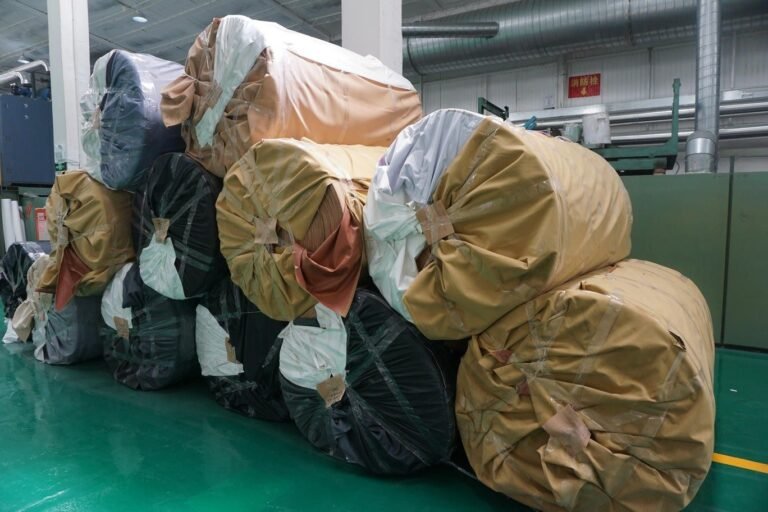
Chemical mixing area in a leather production facility — where raw polymer chemistry determines compliance outcomes
Vinyl Upholstery Specifications: Reading Beyond the Data Sheet
Most chair specification sheets list four parameters: weight (ounces per linear yard), thickness, abrasion resistance, and width. These are necessary but insufficient. A vinyl upholstery abrasion resistance rating of 100,000 double rubs (Wyzenbeek) tells you the surface won’t wear through quickly — but it says nothing about what happens to the plasticizers inside that surface over time.
Here’s what data sheets routinely omit:
- Plasticizer type and content (%) — DEHP, DINP, or non-phthalate alternatives. This single line item determines whether your product triggers Prop 65 warnings or REACH restrictions. Many suppliers won’t disclose it without a contractual push.
- Cold-crack temperature — vinyl stiffens and cracks below a threshold temperature (typically -10°C to -20°C for standard grades). Chairs shipped or stored in unheated environments fail at seams and fold points.
- Plasticizer migration rate — over 3–5 years, plasticizers migrate to the surface, causing stickiness, staining of clothing, and eventual embrittlement of the remaining material. No standard spec sheet tracks this.
- VOC emission profile — vinyl releases volatile organic compounds throughout its lifecycle, particularly in the first 6 months after manufacturing. Healthcare and automotive interior specifications increasingly demand VOC test data that vinyl suppliers struggle to provide.
In our testing facility, we’ve evaluated vinyl upholstery samples that passed Wyzenbeek abrasion at 80,000 double rubs but showed measurable phthalate migration after just 500 hours of ISO 4892 accelerated UV exposure. The surface was intact; the chemistry was failing. That’s the gap between a data sheet and real-world compliance.

PVC vinyl upholstery surface close-up — the plasticized coating that provides flexibility but creates compliance exposure
The Regulatory Net Tightening Around PVC Chair Materials
Three regulatory frameworks are converging to make phthalate-plasticized vinyl increasingly difficult to specify — particularly in healthcare, education, and children’s product applications where chair upholstery contacts skin for extended periods.
- EU REACH Regulation — restricts DEHP, DBP, and BBP in articles available to the public. DINP and DIDP face restrictions in toys and childcare articles. Chair upholstery in EU markets requires SVHC (Substance of Very High Concern) declarations that many vinyl suppliers cannot provide without reformulation.
- California Proposition 65 — DEHP, DINP, and DBP are listed chemicals. Products containing them require clear and reasonable warnings. Major furniture retailers are demanding Prop 65-compliant upholstery to avoid litigation — and that demand cascades up the supply chain to material suppliers.
- US CPSIA — permanently bans DEHP, DBP, and BBP in children’s products at levels above 0.1%. Children’s furniture — including school chairs and daycare seating — cannot use standard phthalate-plasticized vinyl without violating federal law. The CDC has documented widespread phthalate exposure in the general population, adding public health pressure to regulatory action.
Compliance tip: The regulatory trend is unidirectional — more phthalates are being added to restricted lists, not removed. Specifying a material that’s compliant by chemistry (not by exemption) eliminates the need to re-qualify materials every time a regulation updates.

Fire retardancy testing — commercial chair upholstery must meet flame spread standards alongside chemical compliance
Vinyl vs Silicone Leather for Chair Upholstery: Compliance Comparison
When compliance teams compare vinyl for chair upholstery against silicone leather, the question isn’t just “which performs better?” — it’s “which one eliminates audit risk?” The table below maps the compliance parameters that matter most to procurement teams in regulated industries:
| Compliance Parameter | Standard Vinyl (PVC) | Silicone Leather | Audit Impact |
|---|---|---|---|
| Phthalate content | 10–40% by weight | Zero | Vinyl triggers Prop 65 / REACH |
| VOC emissions | Moderate–high (first 6 months) | Zero-VOC certified | Vinyl fails indoor air quality specs |
| Cold-crack resistance | -10°C to -20°C | -40°C | Vinyl fails cold-chain transit tests |
| Biocompatibility (ISO 10993) | Not rated | Certified | Silicone passes healthcare audits |
One medical equipment manufacturer we worked with switched from vinyl to silicone leather on their examination chair line after a California hospital network required Prop 65-compliant upholstery across all new equipment purchases. The switch added 35% to material cost per unit — but eliminated the warning label requirement, passed healthcare-grade material audits on the first attempt, and opened access to EU hospital procurement that had been closed due to REACH compliance gaps.

Healthcare seating application — where upholstery compliance with phthalate and biocompatibility standards is mandatory
Alcohol resistance testing — critical for healthcare chair upholstery that undergoes frequent disinfection cycles
How to Specify Chair Upholstery That Passes Every Audit
The difference between a specification that passes audit and one that fails usually comes down to five documentation requirements. Buyers who embed these into their purchase orders eliminate 90% of compliance surprises:
- Phthalate declaration (per batch) — require the supplier to declare phthalate type and content for each production batch, not just the initial sample. Batch variability in vinyl is significant.
- SVHC compliance statement — for EU-bound products, a signed declaration that the material complies with REACH Article 33 disclosure obligations for all SVHCs above 0.1% w/w.
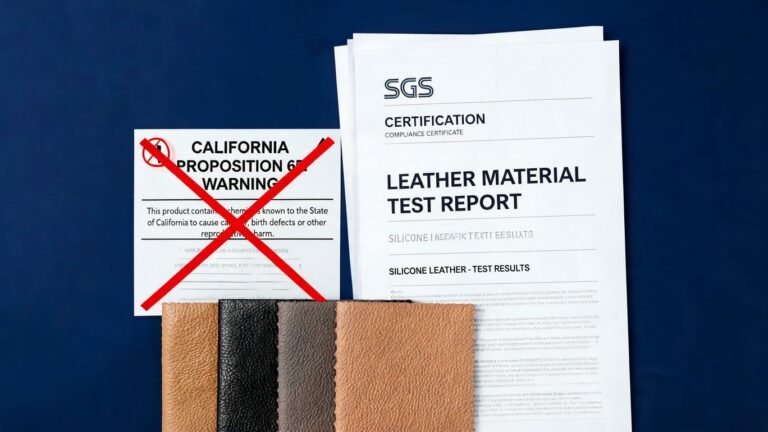
- Prop 65 warning assessment — a written assessment of whether the material triggers California Proposition 65 warning requirements, including specific chemical listings and exposure pathways.
- VOC emission test report — ISO 16000 or equivalent indoor air quality test data, particularly for healthcare, education, and enclosed office environments.
- Cold-crack test certificate — verification that the material withstands the minimum transit and storage temperature your logistics chain will encounter.
For procurement teams sourcing office chair upholstery materials or PVC leather alternatives, these five documents form the minimum compliance package. Suppliers who can’t provide them on the first request are signaling a capability gap — not a documentation delay.

Material swatch rack — compliance documentation should accompany every color and texture variant, not just the primary sample
Frequently Asked Questions
Is all vinyl upholstery fabric phthalate-free?
No. The vast majority of standard commercial vinyl upholstery contains phthalate plasticizers — typically DEHP or DINP at 10–40% by weight. “Phthalate-free” vinyl exists (using alternatives like DOTP or DINCH), but it costs 20–30% more and represents a small fraction of market volume. Always request a written phthalate declaration specifying which plasticizer system is used. A supplier who responds with “it’s compliant” without naming the specific chemistry is not providing a declaration — they’re deflecting the question.
Can vinyl upholstery pass California Proposition 65 without a warning label?
Only if it uses non-listed plasticizers and the manufacturer can demonstrate that exposure to any listed chemicals falls below the safe harbor level. Standard phthalate-plasticized vinyl almost always requires a Prop 65 warning. Phthalate-free vinyl formulations can avoid the warning, but the burden of proof — including exposure pathway analysis — falls on the product manufacturer, not the material supplier. Many furniture brands find it simpler to specify materials that are inherently Prop 65-exempt rather than manage the documentation burden of borderline-compliant vinyl.
The Compliance-First Future of Chair Upholstery
Vinyl for chair upholstery isn’t disappearing — its low cost and cleanability guarantee continued use in budget-conscious applications. But the compliance landscape around it is tightening every year, and the cost of non-compliance — rejected orders, litigation risk, product recalls — is rising faster than the material cost savings. Procurement teams who continue specifying standard vinyl without phthalate declarations, VOC test data, and Prop 65 assessments are building audit risk into their supply chain. The alternative isn’t more expensive vinyl — it’s a material whose chemistry is compliant by design. Whether that means phthalate-free vinyl for budget applications or silicone leather for regulated environments, the specification decision should start with compliance, not end with it.
Request Compliance-Verified Upholstery Samples
About TOPSUN
TOPSUN manufactures silicone leather upholstery materials for chair and seating producers who need vinyl-level cleanability without the phthalate compliance risk. Our materials serve healthcare seating, office furniture, hospitality, and public transit applications where regulatory audits are part of routine procurement.
Our materials carry REACH-compliant zero-VOC certification, ISO 10993 biocompatibility for healthcare seating applications, 50,000+ Martindale abrasion cycles, alcohol resistance for disinfection protocols, and full OEM color matching with Delta E ≤2.0 consistency across production batches.