When a German OEM rejected a 40,000-meter seat leather shipment because fogging values exceeded the VDA 270 limit by 12%, the buyer learned a costly lesson about car interior leather wholesale: specifications outrank price. As a technical engineer who has audited over thirty automotive leather production lines across Asia, I have seen how overlooking a single test parameter can void an entire contract. European and American B2B buyers increasingly source silicone and synthetic leather for steering wheels, door panels, and seating. Yet many procurement teams still evaluate suppliers on catalog aesthetics alone. This guide reframes supplier selection around the standards that actually govern OEM approval.
Why Car Interior Leather Wholesale Demands Standard-Driven Evaluation
Most procurement teams begin with a color swatch and a unit price. That approach fails fast in automotive. Cabin materials must survive a decade of UV exposure, repeated body contact, and thermal cycling from -40°C to 85°C, so a standard-driven evaluation protocol is non-negotiable for any car interior leather wholesale program. Among car interior leather wholesale suppliers, the gap between catalog claims and certified performance is exactly where most warranty disputes originate.

Tensile strength testing confirms whether wholesale automotive leather meets PV 3906 load requirements before bulk commitment.
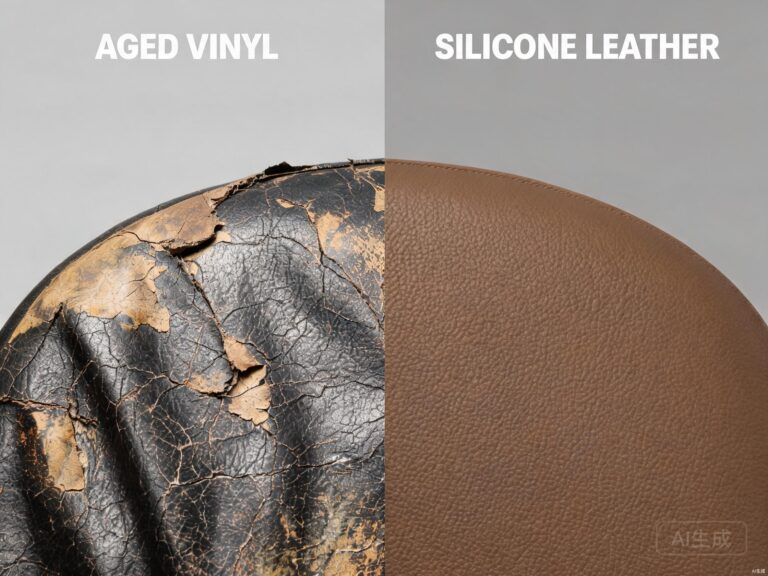
The relevant benchmarks are not optional. OEMs reference VDA 270 for odor characterization, VDA 277 for total VOC emissions, and PV 3341 for Martindale abrasion. A material that looks flawless on the showroom floor can still fail a Taber abrasion test at 1,000 revolutions. In our lab, we compared a standard PVC substrate against silicone leather under ISO 12947 Martindale abrasion. The PVC coating broke down at 8,200 cycles. The silicone leather exceeded 25,000 cycles with no visible coating loss. That threefold delta directly determines warranty exposure and lifecycle cost.
Decoding VDA and OEM Test Specifications
Automotive leather is governed by a dense matrix of OEM-specific and industry-wide standards. Buyers who work with automotive leather wholesale standards must verify that a supplier’s test reports map to the exact specification called out in the OEM drawing, not a generic equivalent. Understanding how silicone compares to PU is only the first step. The second is confirming that every performance claim carries a traceable test method.

Color fastness testing to ISO 105-B02 verifies the lightfastness ratings required by European OEM interior specifications.
The core tests fall into four families. FMVSS 302 governs horizontal flammability for all US-market vehicle interiors. DIN 75201 measures fogging condensation on glass surfaces. VDA 270 characterizes odor on a six-point scale. PV 3341 sets the Martindale abrasion threshold that most Tier-1 seat suppliers reference. When a supplier submits a datasheet, check that each line item cites the correct standard number, test method, and pass criterion. A common red flag is a report that lists “pass” without the underlying numeric value. Fogging behavior, for example, must report a reflectance percentage or gravimetric mass, not a binary result. The ASTM standards library publishes the full test method definitions for cross-referencing.
MOQ Planning and Cost Engineering for Car Interior Leather Wholesale
Minimum order quantities are not arbitrary numbers. They reflect the coating line’s economic batch width, color-change downtime, and substrate minimums. For car interior leather wholesale programs, understanding these drivers helps buyers plan MOQ around actual vehicle program volumes rather than absorbing inflated supplier minimums. A qualified car interior leather supplier evaluation should always include a frank conversation about what physically drives the order threshold.

Production process flow showing where quality checkpoints gate each batch during car interior leather wholesale manufacturing.
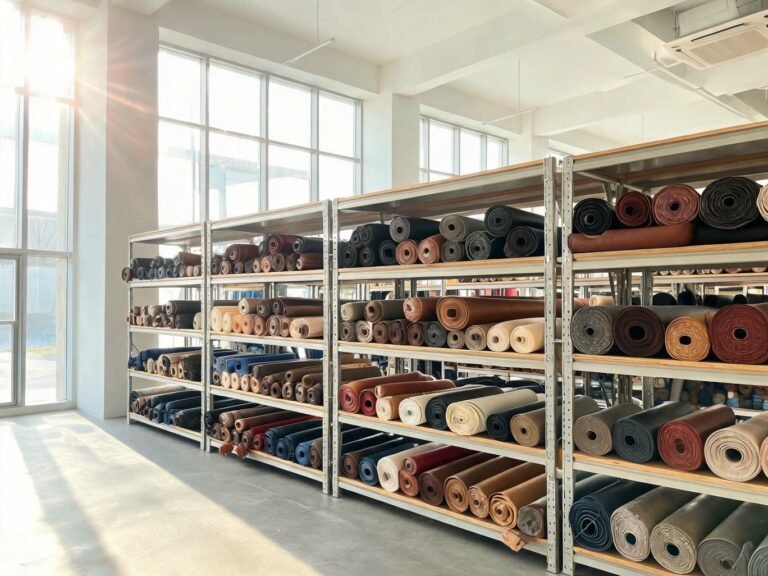
A typical silicone leather coating line runs 1,500 mm wide. If an OEM program needs only 800 mm slit width, the buyer either pays for yield loss or consolidates multiple programs into a single master roll. We worked with a Tier-1 seat supplier who needed a custom wine-red shade for a low-volume EV program. By aligning three model variants on a shared color standard, the buyer reduced MOQ from 5,000 meters to 1,800 meters and cut unit cost by 18 percent. The key was matching the factory production capacity to real program demand instead of accepting a flat minimum. For a deeper look at how pricing and thresholds interlock, see our leather MOQ and pricing breakdown.
Building a Quality Audit Checklist Before You Commit
A pre-production quality audit prevents the most expensive failure mode: discovering nonconformance after goods arrive at your assembly plant. Use an automotive interior leather quality audit checklist that covers documentation, sample testing, and factory process control in equal measure.

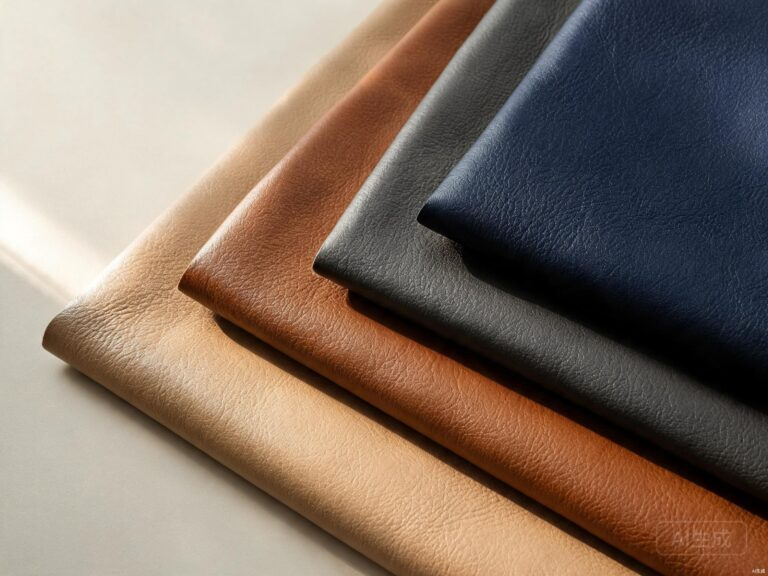
OEM-grade automotive interior leather applied to seating and door trim, validated against VDA and PV test suites.
Documentation audit: valid third-party test reports (SGS, TÜV, or Intertek) issued within the last 12 months; IATF 16949 certification for automotive quality management; REACH SVHC and RoHS declarations with full substance disclosure.
Physical sample audit: send a 1 m × 1 m swatch to your own lab for independent cross-verification; run abrasion, color fastness, and fogging tests in-house; compare the results against the supplier’s submitted datasheet line by line.
Factory process control: verify in-line QC stations for coating weight, web tension, and cure temperature; confirm batch traceability from raw silicone to finished roll; review the hydrolysis resistance data that governs long-term cabin durability.
From Sample Approval to Production Consistency
Sample approval is only the beginning. The real risk in volume sourcing is drift between the golden sample and bulk production. Color deviation of Delta E greater than 1.5 is visible to the human eye and will trigger OEM rejection at incoming inspection.
A German Tier-1 we supplied required Delta E below 1.0 across a 20,000-meter run. We implemented in-line spectrophotometer checks every 500 meters and held the entire batch within Delta E 0.6. Specify a tolerance band, a sampling frequency, and an AQL level directly in the purchase contract. Insist on a pre-shipment inspection that pulls samples from the beginning, middle, and end of each roll. Our leather quality inspection protocol documents the full sampling methodology. Consistency is what separates a qualified wholesale partner from a one-time vendor.
Silicone leather engineered for automotive interiors — performance overview and testing highlights.
Whether you are sourcing for a new EV platform or replacing a legacy material across multiple programs, car interior leather wholesale success comes down to one principle: let standards drive the decision, not the other way around. Build the audit checklist, verify the test data firsthand, and partner with a supplier whose process control can hold tolerances across volume.
About TOPSUN
TOPSUN supplies solvent-free silicone leather engineered for car interior leather wholesale programs that must clear VDA 270, PV 3341, and FMVSS 302 without compromise. Our automotive-grade lines deliver IATF 16949 process control, in-line spectrophotometer color management held to Delta E 0.6, Martindale abrasion performance above 25,000 cycles, and flexible MOQ planning that consolidates multi-variant programs onto shared master rolls — every shipment ships with third-party test reports and full batch traceability.