Polyester fake leather is the workhorse of the synthetic leather world — it shows up in everything from budget furniture to fast-fashion handbags, and most designers never think twice about what’s actually in the material they’re specifying. But here’s the catch: polyester is just the backing substrate. The coating applied on top determines whether that material lasts five years or five months, whether it feels like premium leather or plastic sheeting, and whether it passes the compliance audits your brand cares about. Understanding the substrate-coating system changes how you evaluate polyester fake leather suppliers — and it’s the difference between specifying a material that performs and one that merely looks the part on the day of delivery.
What Is Polyester Fake Leather and How Is It Made
If you’re asking what is polyester fake leather, the answer starts with structure. Every synthetic leather has two layers: a fabric backing (the substrate) and a polymer coating (the surface). Polyester is the most common backing material because it offers excellent tensile strength, dimensional stability, and cost efficiency. The polyester fabric — typically woven or knitted in weights from 200 to 600 gsm — provides the structural foundation. The coating, applied through knife-over-roll, transfer, or calendering processes, creates the leather-like surface that consumers see and touch.
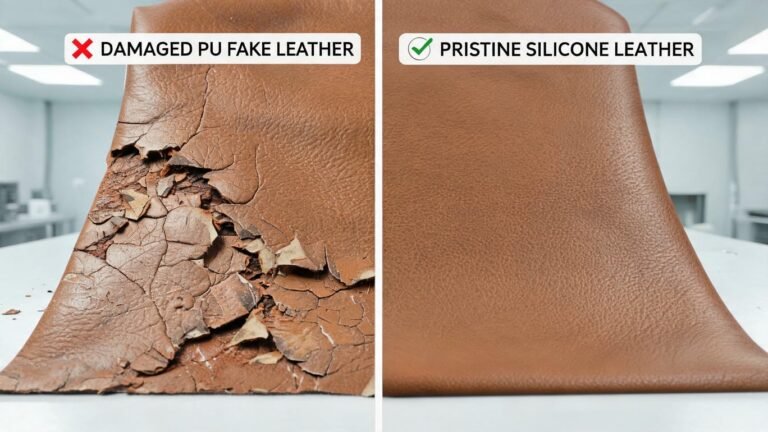
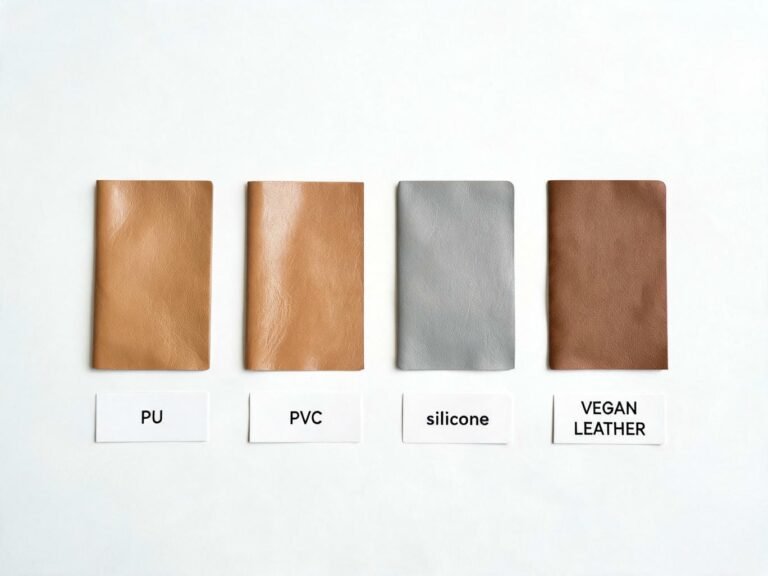
Four coating chemistries dominate the market. PVC (polyvinyl chloride) coatings are the cheapest, using plasticizers to achieve flexibility — but those plasticizers migrate and off-gas over time. PU (polyurethane) coatings offer softer hand feel and better breathability but degrade through hydrolysis. Water-based PU reduces VOC emissions during production but doesn’t solve the hydrolysis problem. Silicone coatings represent the newest category, using a solvent-free process to deposit a silicon-oxygen polymer that is inherently stable against water, UV, and thermal stress. The substrate matters, but the coating chemistry is what determines 80% of the material’s real-world behavior. For a deeper dive into silicone leather composition and manufacturing, our technical introduction covers the full process.

Polyester base fabric feeding into the coating line — the substrate determines structural strength
Performance Criteria for Polyester-Based Synthetic Leather
When evaluating polyester fake leather durability, five properties predict how the material will behave in real applications. Design teams often focus on hand feel and color — both important — but the properties below determine whether the product still looks good after two years of use.
- Coating adhesion — measures how tightly the surface layer bonds to the polyester substrate. Poor adhesion leads to delamination, the most common failure mode in budget synthetic leather. Test method: peel strength per ASTM D903.
- Hydrolysis resistance — critical for PU-coated polyester. Accelerated aging at 70°C/95% RH reveals whether the coating will peel in humid climates. PVC and silicone coatings are inherently resistant; PU is not.
- Color fastness — ISO 105-B02 xenon arc testing predicts UV fading. Polyester substrates hold dye well, but coating pigments can shift under prolonged UV exposure, especially in automotive and outdoor applications.
- Flex cracking — Bally flexometer testing (ISO 5402) reveals whether the coating will crack at stress points. Soft PU coatings generally pass; rigid PVC coatings fail at lower cycle counts.
- Chemical resistance — determines how the surface responds to cleaning agents, hand sanitizers, and food stains. Silicone coatings are chemically inert; PU and PVC are vulnerable to solvent-based cleaners.
In our experience working with fashion and furniture brands, the most overlooked property is coating adhesion. A supplier can deliver beautiful samples with perfect hand feel, but if the coating-to-substrate bond is weak, the material will start peeling at seams and edges within months of production. One of our clients switched from a budget PU-coated polyester to our silicone-coated variant after their handbag line generated a 12% return rate from coating separation at stress points. The switch eliminated that failure mode entirely. Learn more about silicone vs PU performance differences in our comparison guide.

Precision coating application — the coating chemistry defines the material’s surface properties
Cost Factors in Polyester Fake Leather Production
Understanding polyester synthetic leather cost factors requires looking at three variables that drive 90% of price variation between suppliers. First, substrate weight — heavier polyester fabric (500+ gsm) costs more but provides better drape and durability for furniture applications. Lighter substrates (200-300 gsm) suit fashion accessories and consumer electronics where weight matters more than structural strength. Second, coating chemistry — PVC is cheapest at $2-4 per meter, PU ranges from $4-8, water-based PU adds a 20-30% premium, and silicone commands $8-15+ per meter. Third, finishing complexity — embossing patterns, multi-color printing, and special effects like metallic sheen or perforation all add cost.
The table below compares coating types across the criteria that matter most to design and procurement teams. Price ranges are indicative for B2B orders and vary by volume, thickness, and finishing requirements.
| Coating Type | Hand Feel | Durability | VOC Risk | Cost Level |
|---|---|---|---|---|
| PVC | Plasticky | 3-5 years | High | Low ($2-4/m) |
| PU (solvent) | Soft, leather-like | 2-5 years | Moderate-High | Medium ($4-8/m) |
| Water-based PU | Soft | 2-5 years | Low | Medium-High |
| Silicone | Premium, skin-like | 10-15+ years | Zero | High ($8-15/m) |

Color fastness testing — UV stability varies dramatically by coating chemistry
B2B Sourcing Recommendations for Polyester Leather
When sourcing the best polyester faux leather for furniture, bags, or automotive trim, the single most important step is specifying by coating type — not just by substrate. “Polyester synthetic leather” is a category, not a specification. A PO that says “polyester PU leather, 0.8mm, black” tells the supplier almost nothing about hydrolysis resistance, VOC limits, or coating adhesion requirements. Write specifications that include minimum test thresholds: Martindale abrasion ≥ 50,000 cycles, hydrolysis ≥ 7 days at 70°C/95% RH (for PU), coating adhesion ≥ 3.0 N/cm, and VOC compliance per REACH Annex XVII.
Second, request substrate specification sheets. The polyester fabric’s weight, weave type, and yarn count affect drape, tear strength, and dimensional stability. A supplier who can’t provide this data is buying substrate on the spot market with no quality control. Third, evaluate the coating line’s capability — solvent-based PU lines, water-based PU lines, and silicone coating lines are fundamentally different equipment. A factory running a 15-year-old solvent PU line cannot produce water-based or silicone products regardless of what their sales team claims. You can learn more about artificial leather types and their differences in our classification guide.

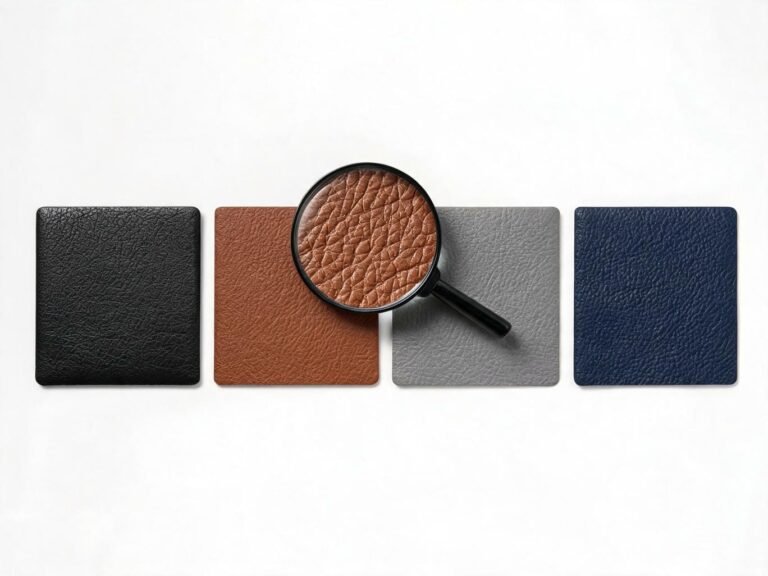
Color palette options — coating chemistry determines how vividly pigments render and how long they last
Material comparison — see how different coating chemistries perform under identical test conditions
For brands pursuing sustainability targets, the coating choice has environmental implications as significant as the substrate. PVC coatings release dioxins during incineration and cannot be effectively recycled. PU coatings are difficult to separate from polyester substrates at end-of-life. Silicone coatings, by contrast, can be processed and repurposed — and the solvent-free production process generates zero VOC emissions. This is why leading brands are shifting toward eco-friendly leather alternatives that maintain polyester’s structural advantages while eliminating the environmental liabilities of conventional coatings. Our faux leather types overview provides additional context on material classification.
Frequently Asked Questions
Is polyester fake leather the same as PU leather?
Not exactly. Polyester refers to the backing substrate, while PU (polyurethane) refers to the coating chemistry applied on top. Most PU leather does use a polyester backing, but PU leather can also use cotton, nylon, or blended substrates. Conversely, polyester-backed fake leather can have PVC, PU, water-based PU, or silicone coatings. When a supplier says “polyester PU leather,” they mean polyester substrate with PU coating. Always clarify both components — the substrate determines structural properties, and the coating determines surface performance.
Can polyester fake leather be recycled?
It depends on the coating. PVC-coated polyester is extremely difficult to recycle because separating the PVC from the fabric requires chemical processes that are rarely economical. PU-coated polyester faces similar separation challenges. Silicone-coated polyester offers better recyclability because the silicone layer can be processed separately from the polyester substrate. For brands with circular economy commitments, the coating chemistry should be a primary selection criterion — not an afterthought.
Choose Your Coating Wisely
Polyester fake leather is not a single material — it’s a family of products united by a common substrate but differentiated by coating chemistry. The substrate provides the skeleton; the coating determines the personality. When you specify polyester synthetic leather for your next project, specify the coating type, define minimum performance thresholds, and demand test data that proves the supplier can meet them. The brands that win in 2026 and beyond will be the ones who understand this distinction and source accordingly.
About TOPSUN
TOPSUN produces silicone-coated polyester leather for brands that need the structural strength of polyester backing combined with the surface performance of medical-grade silicone — manufactured through a solvent-free process that generates zero VOC emissions.
100+ embossing textures · Pantone-matched color system · 0.3mm-3.0mm thickness range · FDA / REACH / ISO 10993 certified · OEM/ODM custom development