When a furniture brand’s upholstery starts peeling after 14 months, the warranty claims pile up fast. We’ve seen procurement teams spend weeks auditing new leather suppliers only to discover that the samples passed lab tests but the bulk shipment told a different story. The gap between a polished supplier presentation and a production-ready leather roll is where most sourcing decisions fail.
Choosing the right furniture leather supplier goes beyond finding a vendor with competitive pricing. It demands a structured evaluation of production capacity, quality control systems, compliance documentation, and material performance data. Whether you source for residential sofas, commercial seating, or hospitality furniture, the supplier you partner with directly determines your product’s longevity and your brand’s reputation. This guide breaks down the criteria that matter most.
What Makes a Dependable Furniture Leather Supplier
A dependable furniture leather supplier does more than ship material on time. The best suppliers operate as an extension of your procurement team, sharing production schedules, flagging material inconsistencies before they leave the factory, and maintaining transparent communication throughout the order lifecycle.
Here is what separates reliable suppliers from the rest:
- Integrated production: Suppliers who control the full process, from base fabric to coating to finishing, can guarantee consistency across batches. Trading companies that source from multiple unnamed factories cannot.
- Documented quality systems: Look for ISO 9001-certified facilities with in-house testing labs. If a supplier claims to test every batch but cannot show you the testing equipment or results logs, that is a red flag.
- Scalable capacity: Your supplier should handle both your current order volume and projected growth. Ask for their monthly production capacity and typical utilization rate.
- Communication responsiveness: A supplier that takes 72 hours to answer a technical question during the evaluation phase will be slower when a production issue arises mid-run.
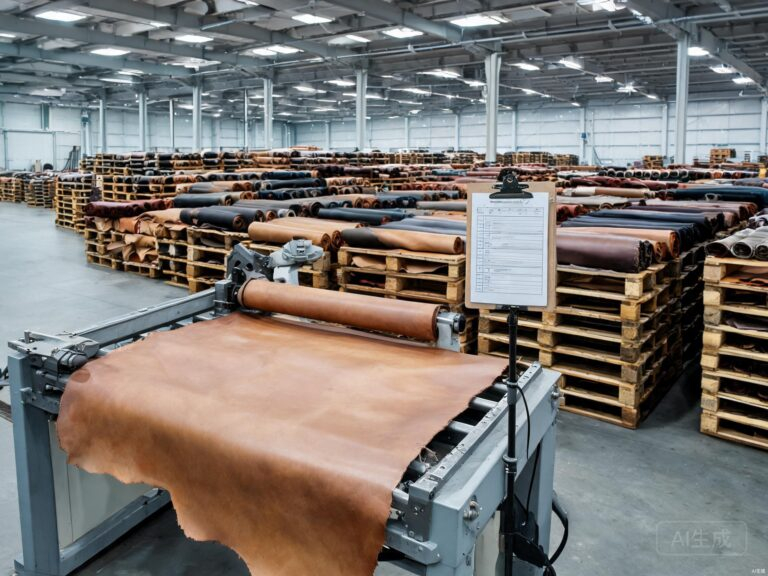
In our experience working with furniture manufacturers, the suppliers who proactively share their factory production line photos, testing protocols, and defect rates during the initial qualification phase tend to be the ones who deliver consistently in production.
Quality Benchmarks Your Furniture Leather Supplier Should Meet

Martindale abrasion tester used for furniture leather quality verification
Quality claims mean nothing without standardized testing. When evaluating a furniture leather supplier, request test reports for the following performance metrics and make sure they reference recognized international standards, not in-house methods.
Abrasion resistance: The Martindale abrasion test (ISO 5470) measures how well the leather surface withstands repeated rubbing. For furniture upholstery, look for results exceeding 25,000 cycles for residential use and 50,000 cycles for commercial applications.
Color fastness: ISO 11640 evaluates color fastness to cycles of to-and-fro rubbing. A rating of 4 or higher on a 1 to 5 scale indicates the leather will not transfer color onto clothing or adjacent materials under normal use.
Tear and tensile strength: These determine how well the leather holds up under stress, particularly important for stretched upholstery applications like tight-back sofas. Request ISO 3377 (tear load) and ISO 3376 (tensile strength) results.
Flexibility and crack resistance: The Bally flexing test (ISO 5402) simulates repeated bending. Furniture leather should withstand at least 50,000 flex cycles without visible cracking.

In-house fabric inspection station for batch-level quality verification
If a supplier cannot provide these test reports or cites vague standards like “meets industry requirements,” walk away. The cost of a failed upholstery warranty claim far exceeds the time spent verifying credentials upfront. For more on how we approach supplier evaluation, see our article on choosing the right silicone leather supplier.
Certifications and Compliance: Non-Negotiable for Global Markets

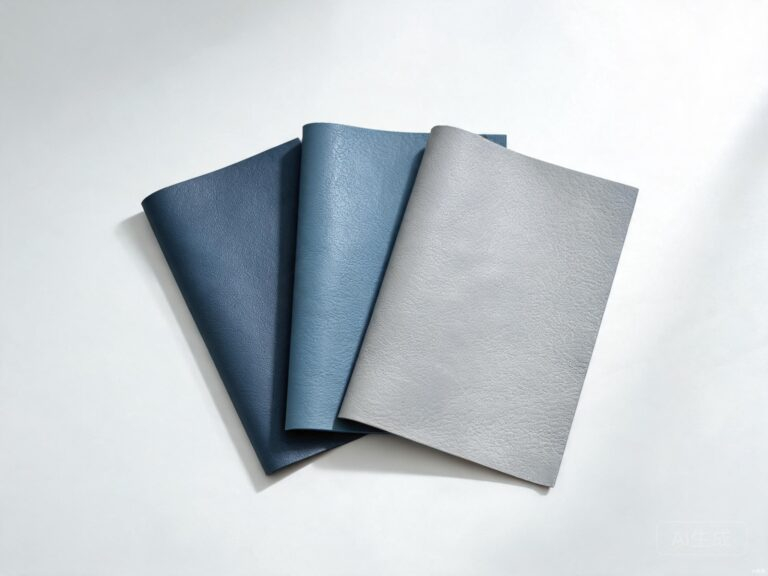
Full color swatch range from a qualified furniture leather supplier
Furniture leather destined for international markets must meet a web of regulatory requirements. Your supplier should provide current, verifiable documentation for each of the following:
- REACH compliance: The EU chemical regulation restricts harmful substances including specific phthalates, heavy metals, and SVHCs. Request a REACH SVHC declaration with each shipment.
- RoHS compliance: While primarily an electronics directive, many furniture buyers now require RoHS compliance for upholstered products with integrated electronics such as heated seats or massage functions.
- Fire safety standards: Furniture flammability requirements vary by market. In the US, California TB 117-2013 is the benchmark. In the UK, furniture must meet the Furniture and Furnishings Fire Safety Regulations. For public spaces, EN 1021-1 and EN 1021-2 apply.
- VOC emissions: Low-VOC certification such as GREENGUARD Gold or OEKO-TEX Standard 100 signals that the leather will not off-gas harmful chemicals in indoor environments, a growing requirement for hospitality and healthcare furniture buyers.
Pro tip: Always cross-check certification claims against the issuing body’s database. We have encountered suppliers presenting expired or altered certificates during audits. A five-minute online verification can save months of compliance headaches downstream.
MOQ, Lead Time, and Customization: What to Negotiate

Direct factory access is critical for verifying supplier capabilities
The commercial terms of your supplier relationship often determine whether the partnership is viable long-term. Here is how to approach the key negotiation points.
Minimum Order Quantity (MOQ): Direct manufacturers typically set MOQs of 500 to 1,000 meters per color, while trading companies may offer lower minimums by consolidating orders. If your production volume does not meet the MOQ, ask about stock colors or split-shipment arrangements. Some suppliers offer sample-lot pricing at 100 to 200 meters for initial production runs.
Lead time: Standard production lead times range from 25 to 45 days for made-to-order leather, depending on color complexity and backing type. Add 7 to 10 days for custom patterns or embossed textures. Always confirm whether lead times are calendar days or working days, and build a 15% buffer into your production schedule.
Customization: If you need custom colors, ask about the supplier’s color-matching process. Do they use spectrophotometer matching? What is the turnaround for lab dips? How many revision rounds are included? A supplier with a structured color development process will save you weeks of back-and-forth.
| Supplier Type | Typical MOQ | Lead Time | Customization | Price Range |
|---|---|---|---|---|
| Direct Manufacturer | 500 to 1,000m | 25 to 35 days | Full OEM/ODM, custom colors and patterns | Mid-range |
| Trading Company | 100 to 300m | 15 to 25 days | Limited to supplier catalog | Slightly higher |
| Wholesaler/Distributor | 50 to 100m | 5 to 10 days | Minimal, stock items only | Highest per meter |

Commercial furniture application requiring high-durability leather sourcing
Why Silicone Leather Is Reshaping Upholstery Sourcing
The furniture industry is shifting away from PVC and conventional PU leather, not because of marketing trends, but because the performance gap has become impossible to ignore. Silicone leather in particular is gaining traction among furniture brands that need durability without compromising on safety or sustainability.
Here is why procurement teams are adding silicone leather to their approved material lists for furniture sofa applications:
- Hydrolysis resistance: Unlike PU leather, which degrades when exposed to moisture over time, silicone leather maintains its structural integrity in humid environments. This matters for outdoor furniture and hospitality settings where cleaning frequency is high. Learn more about hydrolysis-resistant silicone leather.
- Non-toxic composition: Silicone leather contains no plasticizers, no PVC, and no solvent-based coatings. It passes REACH SVHC, RoHS, and OEKO-TEX Standard 100 requirements without additional treatments, making it suitable for furniture in healthcare and hospitality environments where indoor air quality is regulated.
- Stain resistance and cleanability: Coffee, wine, and ink release from silicone leather surfaces with simple soap and water. For commercial furniture buyers, this translates to lower maintenance costs and longer replacement cycles compared to PU alternatives.
- Thermal stability: Silicone leather performs from -40 to 200 degrees Celsius without cracking or warping, making it suitable for both cold-storage environments and sun-exposed outdoor settings.
The global silicone synthetic leather market is projected to grow from $244 million in 2024 to $604 million by 2031, reflecting a compound annual growth rate of 14.0%, nearly triple the growth rate of conventional synthetic leather. Forward-thinking furniture brands are sourcing silicone leather now to stay ahead of both regulatory pressure and consumer expectations. For a detailed silicone vs PU comparison, our technical analysis covers the full performance breakdown.
Silicone leather in luxury furniture upholstery: see real-world applications for B2B sourcing
Frequently Asked Questions
What MOQ should I expect from a furniture leather supplier?
Direct manufacturers typically require 500 to 1,000 meters per color, while trading companies may accept orders as low as 100 to 300 meters. For custom colors or patterns, expect higher minimums, often 1,000+ meters, to justify the setup time. Always confirm whether the MOQ applies per color, per thickness, or per total order.
How do I verify a leather supplier’s certifications are genuine?
Request the original certificate with a unique ID number, then verify it directly on the issuing body’s website. REACH compliance can be checked through ECHA’s database, OEKO-TEX through their label verification tool, and ISO certificates through the certification body’s registry. If a supplier hesitates to share certificate numbers, treat it as a red flag.
Is silicone leather more expensive than PU for furniture upholstery?
Upfront, yes. Silicone leather typically costs 30 to 50 percent more per meter than conventional PU. However, when you factor in the longer replacement cycle, lower warranty claim rates, and reduced maintenance costs, the total cost of ownership often favors silicone leather over a 5-year horizon.
Making the Right Sourcing Decision
Selecting a furniture leather supplier is a decision that echoes through your entire product lifecycle, from initial prototyping to end-customer warranty claims. By structuring your evaluation around production transparency, quality test standards, certification compliance, and commercial flexibility, you can identify suppliers who will be genuine partners rather than transactional vendors.
The material landscape is shifting. As sustainability regulations tighten and performance expectations rise, the suppliers who have already invested in silicone leather production capacity are the ones who will keep pace with where the market is heading, not where it has been.
About TOPSUN
TOPSUN manufactures silicone leather for furniture upholstery, serving B2B clients across residential, commercial, and hospitality furniture markets with an integrated production facility that controls every stage from base fabric through coating.
Full OEM/ODM customization with 500+ color options. ISO 9001 certified. REACH, RoHS, and OEKO-TEX Standard 100 compliant. In-house lab provides Martindale, ISO 11640, and ISO 3377 test reports with every order.