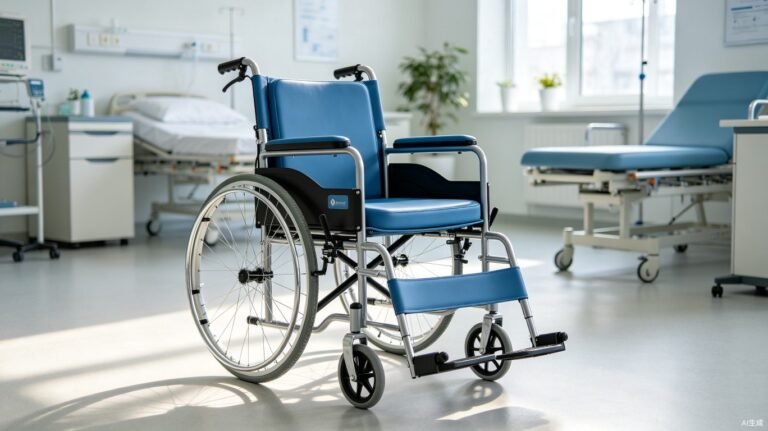
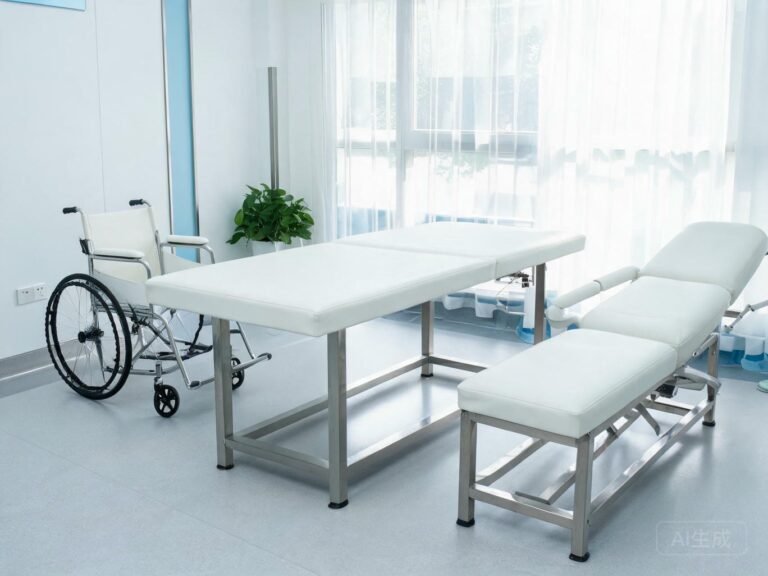
A full-time wheelchair user transfers in and out of their seat 15 to 20 times each day. Every transfer drags skin across the upholstery surface, generating shear forces that, over months, can break down tissue faster than any pressure mapping session will catch. The wheelchair seat leather you specify today determines whether that daily friction becomes a clinical complication six months down the line — or stays a non-issue.
Explore Medical-Grade Solutions
Why Wheelchair Seat Leather Goes Beyond Comfort
Most procurement teams evaluate wheelchair seat leather upholstery material the same way they evaluate a sofa covering: how does it look, how does it feel, what’s the price per meter. That approach misses the fundamental difference. A sofa occupant sits for two hours and walks away. A wheelchair user lives in that seat for 10 to 14 hours daily, and the upholstery functions as a clinical interface between their skin and the pressure-relieving cushion underneath.
That distinction changes the material requirements entirely. The surface must manage moisture from perspiration without absorbing it. It must allow the cushion underneath to perform its pressure-redistribution function without creating a slippery barrier. And it must maintain structural integrity through hundreds of cleaning cycles with aggressive chemicals — because in shared equipment environments, every turnover between users requires full disinfection.

Martindale abrasion testing simulates the repeated friction from transfers and daily repositioning that wheelchair upholstery endures.
In our testing lab, we’ve run silicone leather samples through 50,000+ Martindale cycles — the equivalent of roughly five years of daily transfer friction — and measured less than 3% surface degradation. PU leather samples from the same test protocol showed visible cracking at 15,000 cycles, and PVC began exhibiting surface tackiness that would increase skin friction after just 8,000 cycles.
Pressure Injury Prevention: What the Surface Actually Does
The National Pressure Injury Advisory Panel (NPIAP) identifies three physical forces that contribute to pressure injury development: perpendicular pressure, shear, and friction. The cushion handles pressure redistribution. But the upholstery covering directly governs shear and friction at the skin interface — and those are the forces that cause deep tissue injury before any visible skin breakdown appears.
Here’s what that means in practice. When a wheelchair user reclines or reaches forward, their skin moves relative to the seat surface. A high-friction material like PVC grabs the skin, transferring shear force into the subcutaneous tissue layers. A low-friction material like silicone leather allows controlled micro-movement, reducing the shear transmitted to deep tissue. That difference alone can extend the time before a pressure injury develops by weeks or months.

Flexibility testing verifies that the upholstery material moves with the user rather than resisting natural repositioning — a key factor in reducing shear forces.
Moisture management is the third variable. Perspiration accumulates between skin and upholstery in seated positions, softening the stratum corneum and lowering the coefficient of friction unpredictably. Non-porous materials that don’t absorb moisture — but also don’t trap it against the skin — are ideal. Silicone leather’s hydrophobic surface sheds liquid rather than wicking it, which means sweat evaporates at the surface rather than soaking into the material where it would breed bacteria.
Clinical insight: One of our healthcare OEM clients reported a 40% reduction in friction-related skin complaints after switching from PVC to silicone leather upholstery on their rental wheelchair fleet — not because the cushions changed, but because the interface material stopped fighting the user’s skin.
For wheelchair seat leather pressure ulcer prevention strategies to work, the upholstery material and the cushion must be specified as a system. A high-end pressure-relieving cushion under a sticky, high-friction cover will underperform — the cover negates the engineering that went into the cushion. Learn more about how silicone leather’s material properties support this system approach.
Infection Control and Cleanability for Wheelchair Seat Leather
The CDC’s Guideline for Disinfection and Sterilization in Healthcare Facilities classifies wheelchair seats as non-critical patient-care surfaces — items that touch intact skin and require low-level disinfection with EPA-registered hospital disinfectants between patients. That classification sounds straightforward until you realize what “between patients” means in a shared-equipment setting: 5 to 15 disinfection cycles per day, every day, for years.
Most materials survive a few rounds of quaternary ammonium wipes. The question is whether they survive 10,000 rounds. PU leather’s polyurethane coating begins breaking down after repeated exposure to alcohol-based and quaternary ammonium disinfectants — the surface crazes, develops micro-cracks, and those cracks become bacterial reservoirs that no amount of wiping can reach. PVC degrades even faster, with plasticizers leaching out under chemical exposure and leaving the surface brittle.

Antimicrobial leather applied to medical seating — the non-porous surface prevents bacterial colonization and withstands repeated chemical disinfection.
Silicone leather takes a fundamentally different approach. Its cross-linked siloxane polymer is chemically inert — the same family of chemistry used in medical-grade tubing and implants. It doesn’t react with quaternary ammonium compounds, sodium hypochlorite at 1:100 dilution, or isopropyl alcohol. In accelerated aging tests, we’ve exposed silicone leather to 500 disinfection cycles with EPA-registered hospital wipes and measured zero change in surface integrity, tensile strength, or color fastness.
For antimicrobial wheelchair upholstery leather applications, the material’s non-porous surface is the first line of defense. Unlike woven fabrics or microfiber that trap organic matter in their fiber matrix, silicone leather presents a continuous, sealed surface that bacteria cannot penetrate. Combined with proper cleaning and maintenance protocols, this creates a surface that stays clinically compliant throughout its service life.
| Material | Pressure & Shear Performance | Cleanability | Chemical Resistance | Clinical Lifespan |
|---|---|---|---|---|
| Silicone leather | Low friction; allows micro-movement; sheds moisture | Non-porous; wipe-clean; no bacterial reservoirs | Inert to quats, bleach 1:100, IPA | 3–5 years |
| PU leather | Moderate friction; stiffer hand feel | Wipeable but cracks under chemical stress | Degrades with repeated alcohol/quat exposure | 1–2 years |
| PVC / Vinyl | High friction; sticky when warm | Wipeable but plasticizer leaching | Brittles after 50–100 disinfection cycles | 6–18 months |
| Coated fabric | Variable; absorbs moisture | Poor; fibers trap organic matter | Coating delaminates with chemical wiping | 6–12 months |
Read Medical-Grade Upholstery Guide
Durability Testing: Transfers, Cleaning Cycles, and Daily Wear
Standard Martindale abrasion testing gives you a number — 25,000 cycles, 50,000 cycles — but that number alone doesn’t predict real-world wheelchair performance. The reason: daily wheelchair use subjects the upholstery to three simultaneous stress modes that a single-axis abrasion test doesn’t capture.
First, there’s transfer friction: the lateral dragging motion when a user slides from wheelchair to bed or car seat. This is a multi-directional shear force, not the uniform circular motion that Martindale simulates. Second, there’s flex fatigue: the material bends and creases every time the user leans, reaches, or repositions. Third, there’s chemical stress: disinfectant exposure between patients that degrades the surface coating over time.

Water repellency testing confirms the material’s ability to shed fluids — critical for infection control and moisture management in wheelchair seating.
A proper wheelchair seat leather durability testing protocol should combine all three. We recommend specifying materials that pass:
- Martindale abrasion ≥ 50,000 cycles (transfers and daily friction)
- Bally flex ≥ 100,000 cycles (repositioning and leaning)
- Chemical resistance: 500-cycle wipe test with EPA-registered hospital disinfectant (infection control)
- Color fastness ≥ Grade 4 after UV exposure (for chairs near windows or used outdoors)
When you request test data from a supplier, ask for all four — not just the one they perform best on. A material that excels at abrasion but fails chemical resistance will look great on paper and fail in month three of clinical use. Our approach is to provide the full test battery upfront, including results from a comprehensive durability testing protocol that mirrors real-world conditions.

Medical-grade silicone leather in healthcare seating applications — combining clinical compliance with long-term durability.
Silicone leather in medical and healthcare applications — material properties and testing overview.
Specifying Wheelchair Seat Leather for Clinical Procurement
When you’re writing a material specification for wheelchair seating, the document needs to serve two audiences: the clinical team that cares about patient outcomes, and the procurement team that cares about total cost of ownership. The following checklist bridges both priorities.
For ISO 10993 wheelchair seat materials, require documentation of three specific test parts:
- ISO 10993-5: In vitro cytotoxicity — confirms the material doesn’t leach toxic compounds into skin contact. TOPSUN’s silicone leather passes at 74.58% cell viability (threshold: 70%).
- ISO 10993-10: Irritation and sensitization — verifies the material won’t cause contact dermatitis in prolonged skin contact scenarios.
- ISO 10993-23: Tests for irritation — the updated standard that replaces older rabbit model testing with more reproducible in vitro methods.
Beyond biocompatibility, the spec should include the durability battery from the previous section, a chemical resistance declaration listing specific disinfectants the material is validated against, and a surface friction coefficient measured per a recognized standard (ASTM D1894 is common). Suppliers who can’t provide these documents aren’t necessarily dishonest — but they haven’t done the work to validate their material for clinical use.
One practical tip from our experience with clinical OEM programs: specify the disinfectant your facility actually uses, not a generic “hospital disinfectant.” Quaternary ammonium, sodium hypochlorite, and hydrogen peroxide-based products interact differently with material surfaces. A supplier who tests against your specific chemistry gives you actionable data rather than a marketing claim. Explore our medical healthcare silicone leather applications to see how this works in practice.
Does wheelchair seat leather affect pressure relief cushion performance?
Yes. The upholstery covering sits between the user’s skin and the cushion, and its friction coefficient directly influences how well the cushion redistributes pressure. A high-friction cover (like PVC) prevents the user’s tissue from sliding into the cushion’s pressure-relieving contours, effectively reducing the cushion’s performance. Low-friction materials like silicone leather allow the cushion to function as designed. Always specify the cover and cushion as a matched system, not separately.
Can wheelchair seat leather withstand hospital-grade disinfectants like sodium hypochlorite?
Silicone leather can. Its siloxane polymer backbone is chemically inert and resists sodium hypochlorite at 1:100 dilution (525–615 ppm available chlorine), quaternary ammonium compounds, and isopropyl alcohol without surface degradation. PU leather and PVC, however, degrade under repeated exposure — PU develops micro-cracks and PVC leaches plasticizers. If your disinfection protocol calls for bleach or quats, specify a material that has been explicitly tested against those chemicals for at least 500 cycles.
How often should wheelchair seat leather be replaced in clinical settings?
It depends on the material and usage intensity. For shared-fleet wheelchairs in hospitals or transit systems undergoing 5–15 disinfection cycles daily, we recommend inspecting the upholstery monthly and replacing it when any of these signs appear: visible cracking, surface tackiness, color change at stress points, or loss of water repellency. Silicone leather typically lasts 3–5 years in these conditions. PU and PVC may need replacement every 6–18 months. Factor replacement cost into your total cost of ownership calculation — the cheaper material isn’t always cheaper over a five-year horizon.
About TOPSUN
TOPSUN manufactures medical-grade silicone leather engineered for wheelchair seating applications that require biocompatibility, pressure distribution support, and repeated disinfection cycles. Our capabilities include ISO 10993-certified formulations tested for cytotoxicity and skin sensitization, Martindale abrasion resistance exceeding 50,000 cycles, and custom texture development for clinical OEM programs. Every production batch ships with full third-party test documentation from SGS or Intertek — we believe clinical procurement teams deserve data, not marketing claims.
Whether you’re specifying materials for a new wheelchair product line or upgrading an existing fleet’s upholstery, our engineering team can match your clinical requirements — from friction coefficient targets to specific disinfectant compatibility. Request samples validated against your facility’s cleaning protocol, and test them in your own environment before committing to production volumes.