Fake leather upholstery fabric is the material behind millions of sofas, office chairs, and restaurant booths worldwide. It looks like leather, costs a fraction of the real thing, and ships in any color you can specify. But if you have ever watched a two-year-old sectional start shedding flakes like a snake molting in summer, you know the material has a ceiling. This guide walks designers and specifiers through the trade-offs — what fake leather does well, where it fails, and how to choose a material that will not embarrass you in front of the client three years from now.
Order Upholstery Sample Swatch Kit
Understanding Fake Leather Upholstery Fabric: Types and Composition
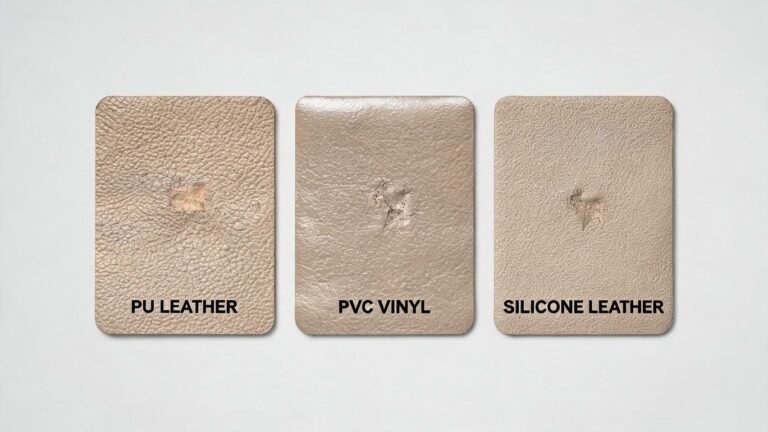
Fake leather upholstery fabric is not one material — it is three. The umbrella term covers polyurethane (PU) leather, polyvinyl chloride (PVC) leather, and microfiber leather, each with a fundamentally different polymer chemistry and performance profile. Knowing which type you are actually specifying is the first step toward setting realistic expectations.
- PU leather — A polyurethane coating applied to a fabric backing. Softer and more breathable than PVC. Susceptible to hydrolysis and cracking in humid environments.
- PVC leather — A polyvinyl chloride coating with plasticizers. More durable and waterproof than PU, but contains phthalates that face increasing regulatory restriction under REACH and California Prop 65.
- Microfiber leather — Ultra-fine polyester fiber base impregnated with PU resin. Closest to genuine leather in feel, but still inherits PU’s hydrolysis vulnerability.
In our production experience, the majority of commercial upholstery projects specify PU leather because it hits a sweet spot between cost and tactile quality. But that same PU chemistry is what causes the peeling and cracking problems that drive replacement cycles. The CDC has documented health concerns related to isocyanates used in PU manufacturing — which is one reason regulatory pressure is pushing the industry toward solvent-free alternatives.

Full swatch display wall — fake leather upholstery fabric options across PU, PVC, microfiber, and silicone categories
Where Fake Leather Wins — and Where It Breaks Down
Let us be honest about the strengths. Fake leather upholstery fabric is affordable, available in enormous color ranges, easy to cut and sew, and requires no animal sourcing. For short-lifecycle products, promotional furniture, or budget residential lines, it does the job. The problem is not that fake leather is bad — it is that the material’s failure modes are time-delayed and invisible until they suddenly are not.
The three most common failure patterns we see in our testing lab:
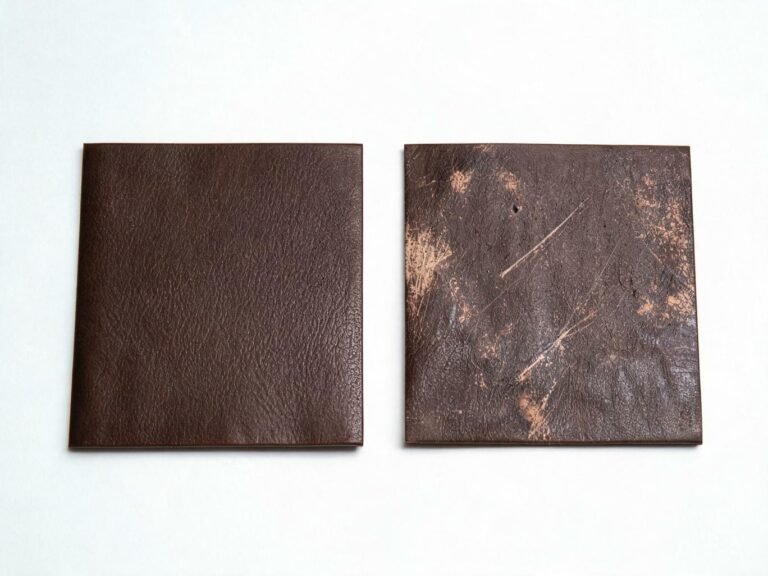
- Peeling — The PU or PVC coating separates from the base fabric. Caused by bond degradation between coating and substrate, accelerated by heat and humidity. Starts as small bubbles, then spreads.
- Cracking — Surface fissures appear along stress points (seat edges, armrests). Caused by loss of plasticizer flexibility over time, especially in PVC. The upholstery industry has documented this as the primary warranty claim category for faux leather furniture.
- Fading and yellowing — UV exposure breaks down the dye system and the polymer itself. More pronounced in PU than PVC, and dramatically worse than silicone-coated alternatives.

Flexibility bending test — repeated flex cycles reveal micro-cracking tendency in PU and PVC upholstery fabrics
A restaurant chain we supplied switched from PVC upholstery to silicone-coated fabric for booth seating and eliminated 90% of reupholstery calls within the first year. The material simply does not peel or crack under daily commercial use.
Design Considerations: Texture, Color, and Tactile Quality
From a designer’s perspective, the appeal of fake leather upholstery fabric is its versatility. Embossing patterns range from smooth nappa to deep lychee grain to exotic reptile textures. Color matching is nearly unlimited — any Pantone reference can be achieved within a production cycle. But the same embossing that looks stunning in a showroom can trap dirt and harbor bacteria in a high-traffic commercial setting.
This is where the tactile comparison matters most. When we run blind feel tests with designers — asking them to rank PU, PVC, microfiber, and silicone-coated leather samples without labels — silicone consistently wins on softness and warmth. The reason is structural: silicone polymers have a lower glass transition temperature than PU or PVC, meaning the material stays supple across a wider temperature range. A PU sofa that feels luxurious at 22°C can feel stiff and plasticky at 10°C. Silicone leather does not have this problem.

Soft-touch layered display — comparing tactile quality across PU, microfiber, and silicone-coated upholstery options

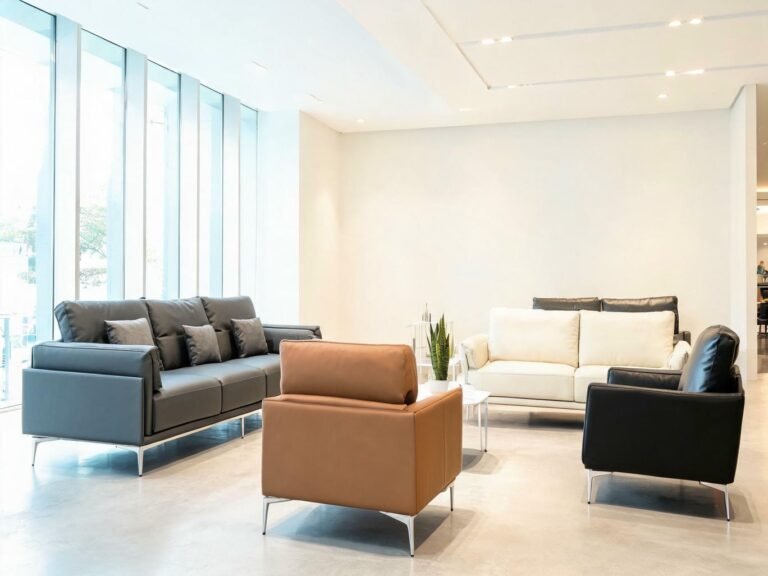
Faux leather sofa upholstery — the material appears flawless when new but peeling typically begins within 2–4 years
Fake Leather Upholstery Fabric vs Silicone: The Specifier’s Dilemma
For specifiers evaluating fake leather upholstery fabric against silicone alternatives for furniture and sofa applications, the comparison comes down to five factors that directly affect the client relationship.
| Factor | Fake Leather (PU) | Silicone Leather |
|---|---|---|
| Tactile quality | Good when new, stiffens over time | Consistently soft, stable across temps |
| Peel resistance | Begins at 2–4 years | No peeling observed at 8+ years |
| Color range | Unlimited | Unlimited, UV-stable pigments |
| Cleaning | Solvent cleaners damage coating | Alcohol and bleach safe, no coating damage |
| Cost per linear meter | $3–8 | $8–15 |
Commercial sofa application overview — see how silicone-coated upholstery fabric performs in high-traffic furniture settings
The cost gap narrows significantly when you factor in replacement cycles. A $5/meter PU sofa that needs reupholstering every 3 years costs more over a 10-year period than a $12/meter silicone sofa that never needs replacement. For commercial projects with warranty obligations, this calculation is critical. Our faux leather furniture durability analysis walks through the full lifecycle math.
Maintenance and Lifecycle: What Designers Should Tell Clients
One of the most overlooked aspects of specifying fake leather upholstery fabric is the maintenance conversation. Clients expect faux leather to be maintenance-free — wipe and go. The reality is that PU and PVC require specific care routines to maximize lifespan, and using the wrong cleaning products accelerates degradation.
- Avoid solvent-based cleaners — Isopropyl alcohol above 70% concentration will dissolve PU coatings. Stick to mild soap and water.
- No abrasive tools — Scrubbing pads and stiff brushes create micro-scratches that collect dirt and accelerate surface breakdown.
- Keep away from direct heat — Radiators and heating vents accelerate plasticizer migration and embrittlement in both PU and PVC.
- For silicone leather — None of the above restrictions apply. Our cleaning and maintenance guide confirms full compatibility with alcohol, bleach, and standard commercial disinfectants.

Water droplet test — evaluating surface hydrophobicity across fake leather and silicone-coated upholstery fabric samples
For projects where cleaning protocols are non-negotiable — healthcare furniture, restaurant seating, public transit — the maintenance advantage of silicone over fake leather is decisive. The faux leather furniture buyer’s guide on our blog covers these scenarios in detail. And if your project involves silicone vs PU specification decisions, our technical team can provide side-by-side swatches for your client presentations.
Frequently Asked Questions
Why does fake leather upholstery fabric peel after a few years?
Peeling occurs when the bond between the PU or PVC coating and the base fabric degrades. This is driven by hydrolysis in PU (moisture breaks the ester bonds) and plasticizer migration in PVC (plasticizers evaporate over time, making the coating brittle). Heat and humidity accelerate both processes. The peeling typically starts at stress points — seat edges, armrests, seam areas — and spreads outward.
Can fake leather upholstery fabric be repaired once it starts cracking?
Minor cracks can be temporarily filled with vinyl repair kits or PU liquid patches, but these are cosmetic fixes that do not address the underlying chemical degradation. Within 6–12 months, the repaired area will typically crack again as the surrounding coating continues to deteriorate. The only permanent solution is full reupholstery — which is why many commercial projects now factor replacement cost into their initial material selection.
Making the Right Specification
Fake leather upholstery fabric remains a legitimate choice for budget-conscious projects with short expected lifecycles. But for commercial furniture, healthcare settings, restaurant seating, or any project where the client expects the upholstery to look good five years from now, the material’s failure modes make it a liability. The cost savings on day one become warranty claims and reupholstery bills on year three.
Silicone-coated upholstery fabric eliminates peeling, cracking, and cleaning limitations while matching fake leather’s design versatility. The upfront cost is higher, but the lifecycle economics — and the client satisfaction that comes with a sofa that still looks new after five years — make the specification worth defending.
Get Custom Upholstery Comparison Samples
About TOPSUN
TOPSUN designs silicone-coated upholstery fabrics that replicate the aesthetic versatility of fake leather while eliminating the peeling, cracking, and VOC emission problems that drive replacement cycles in commercial and residential furniture.
Core capabilities include custom texture development with 200+ embossing patterns, Pantone-matched color systems within Delta E ≤ 1.5, soft-touch silicone formulations tested to 100,000+ Martindale cycles, and flame-retardant certifications for commercial furniture applications.