When your QC team sends back a batch of leather samples that cracked after 8,000 Martindale cycles, the question isn’t just “who supplied this?” — it’s “what performance criteria did we actually specify?” Most B2B buyers we talk to admit they evaluate quality leather goods by touch and appearance first, then scramble to define technical specs after a failure. That reactive approach costs money, delays production, and erodes supplier trust. This guide breaks down the measurable benchmarks, hidden cost factors, and sourcing strategies that separate reliable materials from expensive mistakes — and explains why silicone leather is changing the equation.
What Defines Quality Leather Goods in Modern Manufacturing?
Ten years ago, “quality” in leather meant full-grain hides, hand-burnished edges, and a distinctive smell. Today, B2B procurement teams need something more durable: quantifiable data. If you’re evaluating silicone leather materials alongside traditional options, the definition of quality leather goods shifts from subjective feel to measurable performance — abrasion cycles, tear strength, colorfastness ratings, and hydrolysis resistance. The brands winning in 2026 are those that specify these numbers in purchase orders, not those that rely on a supplier’s assurance that “this is good leather.”
Here’s what we’ve learned from working with procurement teams across automotive, furniture, and fashion: the biggest quality failures come not from bad suppliers, but from vague specifications. When a buyer writes “PU leather, 0.8mm, black” on a PO, they’ve left every critical performance parameter open to interpretation. Learning how to evaluate quality leather goods means translating aesthetic requirements into testable engineering specs — and holding suppliers accountable to them.

Physical testing lab equipment used for evaluating leather material performance
5 Performance Tests Every B2B Buyer Should Request
If you’re spending five figures or more on a leather order, you should never accept a delivery without test data. Quality leather goods performance testing standards exist for a reason — they remove guesswork from procurement. Here are the five tests that matter most for B2B applications, along with the thresholds we recommend based on real-world performance data from our production line.
In our testing lab, we routinely run samples from competitor materials alongside our own silicone leather. One furniture client came to us after their PU upholstery started peeling at 18 months in a high-traffic hotel lobby — the root cause was a Martindale rating of only 12,000 cycles. We supplied silicone leather tested at 50,000+ cycles, and three years later, the same seating still looks new. That’s the difference a test number makes.
| Test Parameter | Genuine Leather | PU Leather | Silicone Leather |
|---|---|---|---|
| Martindale abrasion (cycles) | 25,000–40,000 | 10,000–20,000 | 50,000+ |
| Tear strength (N) | 35–55 | 25–40 | 45–65 |
| Hydrolysis resistance (years) | 3–5 | 1.5–3 | 10+ |
| Colorfastness (ISO 105-B02, grade) | 4 | 3–4 | 4–5 |
Key takeaway: Hydrolysis resistance is the most overlooked metric. PU leather’s ester bonds break down when exposed to ambient moisture — a failure mode that doesn’t show up in a showroom but destroys products in humid climates within 2–3 years.

Martindale abrasion resistance tester evaluating leather durability
Cost Factors Behind Quality Leather Goods Sourcing
The unit price on a supplier’s quote is the smallest number you should care about. Cost factors in quality leather goods sourcing extend far beyond the per-meter rate — and ignoring them is how “budget-friendly” materials become the most expensive choice. Let’s break down what actually drives total cost of ownership (TCO) in B2B leather procurement.
First, there’s the reject rate. A supplier offering PU leather at $4/meter with a 12% defect rate costs more than one offering silicone leather at $8/meter with a 2% defect rate — once you factor in inspection labor, return logistics, and production downtime. Second, warranty exposure: if you’re upholstering commercial furniture or automotive interiors, a material that fails at 3 years means replacement costs, brand damage, and potential liability. Third, minimum order quantities (MOQs) tie up working capital — a supplier demanding 5,000 meters when you need 800 forces you to warehouse excess material that may degrade before use.
We recommend building a simple TCO spreadsheet before any sourcing decision. List the unit price, expected defect rate, warranty period, MOQ, lead time, and estimated lifespan. When you compare silicone versus PU leather this way, the picture changes dramatically. A material that lasts 10 years versus 3 isn’t just 3x better — it eliminates two full replacement cycles, including all the labor and downtime that goes with them.

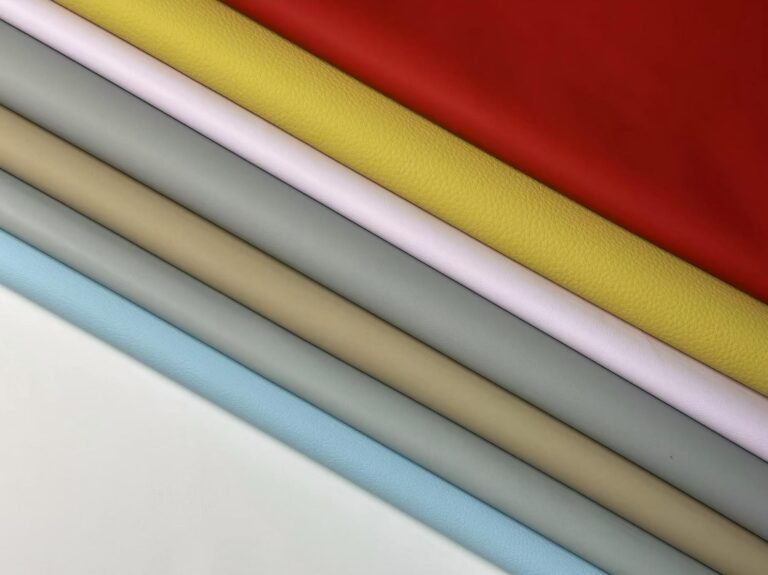
Full-color leather swatch display showing available quality grades and finishes
Why Silicone Leather Outperforms Traditional Materials
Traditional leather — whether genuine, PU, or PVC — shares a common weakness: they all rely on chemical plasticizers or organic substrates that degrade. Genuine leather cracks and requires conditioning. PU leather hydrolyzes. PVC leaches phthalates. When B2B buyers ask us about quality leather goods vs synthetic alternatives, the conversation usually reveals that their past failures stem from these fundamental material limitations, not from poor manufacturing.
Silicone leather solves this at the molecular level. The silicone polymer backbone is inherently stable — it doesn’t hydrolyze, doesn’t require plasticizers, and maintains flexibility from -40°C to 200°C. For brands producing goods across diverse applications from car seats to medical chairs, that thermal stability means one material can serve multiple product lines without reformulation. The Leather Working Group publishes environmental standards that increasingly favor materials with low VOC emissions and long service lives — criteria where silicone leather naturally excels.
For a deeper look at durability testing methodologies, our leather durability testing guide covers specific protocols and pass/fail criteria. And if you’re mapping out a manufacturing workflow, our breakdown of leather goods manufacturing processes explains how material choice impacts every downstream production step.
Watch how silicone leather outperforms traditional materials in side-by-side durability testing
Frequently Asked Questions
Can silicone leather match the aesthetic appeal of genuine leather for quality goods?
Yes. Modern silicone leather supports embossed textures that replicate full-grain, pebbled, and nubuck finishes with high fidelity. The 92-color matching system we use at TOPSUN achieves Delta E values below 1.5, meaning the human eye cannot distinguish color differences between samples. For premium brands concerned about tactile feel, silicone leather’s softness (measured by Obukatex flexibility) can be tuned from 2.0 to 6.0 to match specific hand-feel requirements.
What MOQ should B2B buyers expect when sourcing quality leather goods?
MOQs vary by supplier and material type. Traditional leather wholesalers often require 1,000–3,000 meters per color. Silicone leather manufacturers like TOPSUN can accommodate smaller trial orders starting at 300 meters for custom colors, with standard colors available from stock. We recommend requesting a 1–2 meter sample lot first for physical testing before committing to a production order — this costs roughly $50–$100 and eliminates 90% of sourcing risks.
Making Quality Measurable
The future of quality leather goods lies not in tradition but in testability. Brands that specify Martindale thresholds, hydrolysis ratings, and colorfastness grades in their purchase orders get exactly what they pay for. Those that don’t, get surprises. Silicone leather represents a generational shift — a material engineered from the ground up to pass the tests that traditional leather was never designed to meet. Whether you’re sourcing for automotive interiors, commercial furniture, or fashion accessories, the framework is the same: define the numbers, verify the data, and choose the material that delivers the lowest total cost over the product’s actual lifespan.
Request Quality Leather Samples for Your Next Project
About TOPSUN
TOPSUN manufactures silicone-coated leather materials for B2B brands seeking premium quality leather goods across automotive interiors, commercial furniture, and fashion accessory applications.
92-color precision matching system | Martindale-tested durability exceeding 50,000 cycles | REACH-compliant zero-VOC formulations | OEM-grade batch consistency with full traceability