Walk into a luxury car showroom and you’ll notice it before you even sit down — the smell, the texture, the way the light hits the surface. Automotive interior leather does more than cover seats and door panels; it communicates everything about a brand’s identity. Is it sporty and precise? Warm and inviting? Minimalist and modern? The material choice answers those questions before the driver ever turns the key. For designers and specifiers working with OEMs, choosing the right interior material isn’t just a technical decision — it’s a branding decision with enormous sensory impact.
In this guide, we’ll look at automotive interior materials through a designer’s lens — exploring how texture, color, sheen, and tactile feel shape the user experience, and what specifiers should look for when selecting materials that match a brand’s design language.
The Sensory Language of Car Interiors
People experience car interiors with all their senses, not just their eyes. A great interior design orchestrates touch, sight, even smell into a cohesive experience that reinforces the brand’s identity. When drivers describe a car as “premium,” they’re rarely talking about horsepower — they’re talking about how it feels to be inside it.
Tactile Quality: The First Touch
The moment someone slides into a car seat, their brain is making judgments based on touch. Is the surface soft or firm? Smooth or textured? Warm or cool to the touch? These micro-impressions happen in milliseconds and shape the overall perception of quality. Premium brands spend enormous effort tuning the tactile properties of their interior materials — the grain depth, the surface friction, the way the material gives under pressure. It’s not about making it “as soft as possible”; it’s about matching the feel to the brand’s character. A performance brand might want a tighter, more structured feel that communicates precision, while a luxury brand might aim for a plush, enveloping sensation.
Visual Texture and Light Play
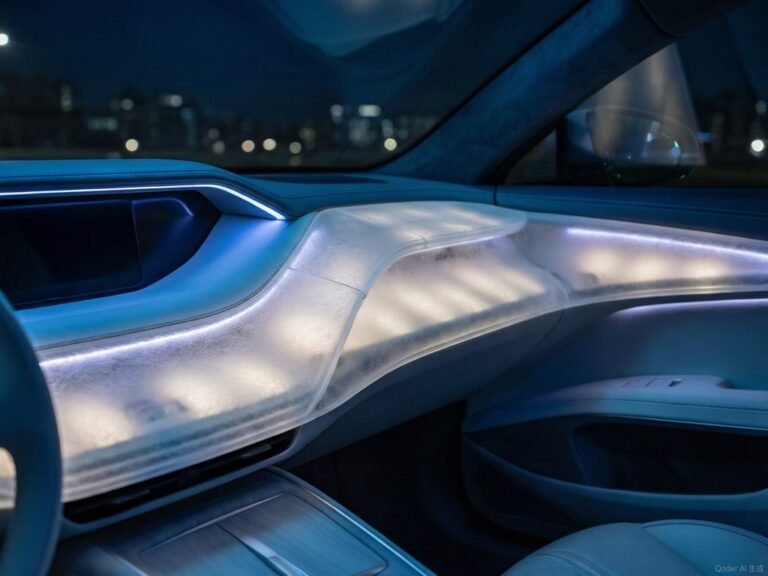
How a material interacts with light is one of the most underappreciated aspects of interior design. A high-sheen material looks different in daylight than it does under interior lighting — it can read as elegant in one setting and cheap in another. Matte surfaces read as modern and sophisticated, but they show grease and dust more obviously. Semi-aniline finishes have a beautiful depth but are less uniform. The grain pattern matters too — a fine, subtle grain reads as refined and technical, while a deeper, more pronounced grain feels more traditional and luxurious. Getting this right means evaluating samples under multiple light sources, not just under showroom lights.
Color Psychology and Brand Identity
Color is the most direct emotional lever in interior design. Black communicates performance and sophistication. Cream and beige feel warm and luxurious. Brown signals tradition and craftsmanship. White and light gray create a sense of space and modernity. But the exact shade matters enormously — the difference between a warm brown with red undertones and a cool brown with gray undertones can shift the entire character of an interior. This is where color customization becomes critical for brand differentiation. When every OEM has access to the same base materials, a precisely tuned signature color is what makes your interior unmistakably yours.

Color fastness testing equipment — ensuring that signature brand color stays consistent across thousands of vehicles and years of UV exposure.
Market perspective: The global automotive interior leather market was valued at approximately $8.2 billion USD in 2024 and continues steady growth, driven by rising demand for premium interiors in both traditional luxury and new EV brands. But the fastest-growing segment isn’t traditional leather — it’s high-performance synthetic alternatives that offer design consistency, low VOC emissions, and vegan positioning, according to industry market analysis.
Design Considerations Beyond Aesthetics
Beautiful materials that don’t perform don’t stay beautiful for long. The best automotive interior materials balance design intent with real-world durability and functional requirements. Here’s what designers and specifiers need to balance.
Wear and Aging Gracefully
A car interior that looks stunning on day one but shows wear after 10,000 miles is a design failure. The challenge is that durability and aesthetics often pull in opposite directions — the most durable surface treatments can look and feel plasticky, while the most beautiful finishes can be delicate. The solution is understanding how the material ages. Does it develop a patina that looks intentional, or does it look worn out? Does the color fade evenly, or does it patch? Quality materials age gracefully — the seat bolsters show use, but it reads as character rather than neglect.
Formability and Manufacturing Aesthetics
A material that looks beautiful as a flat swatch might not look as good once it’s stretched over a complex seat contour or wrapped around a door panel. The way a material behaves during manufacturing — how it stretches, whether it holds its shape, how the grain distorts around curves — affects the final visual quality. This is why prototyping with the actual production method matters so much. You can’t fully evaluate a seat material from a 10x10cm swatch; you need to see it on a real seat form, with the actual stitching pattern and foam density it will have in production.
Interior Air Quality and Sensory Cleanliness
The “new car smell” that was once a selling point is now being reexamined. Consumers and regulators are increasingly concerned about interior air quality and VOC emissions. Premium brands are shifting toward low-VOC materials not just for compliance, but because clean, odor-free interiors feel more premium than heavily scented ones. This is an area where silicone-based materials have a significant advantage — their inert chemistry means virtually zero VOC emissions, creating an interior that smells fresh and neutral rather than chemical. For EV brands targeting health-conscious consumers, this is a meaningful differentiator.

Physical testing laboratory — automotive materials undergo rigorous validation for durability, strength, and performance before reaching production.
Material Options and Their Design Personality
Today’s automotive interiors have more material options than ever, each with its own design character and brand associations. Here’s how the major categories stack up from a design perspective.
| Material | Design Personality | Best For | Design Trade-offs |
|---|---|---|---|
| Genuine Leather | Traditional luxury, craftsmanship, organic feel | Premium and luxury brands | Natural variation, higher cost, VOC concerns |
| PVC Vinyl | Durable, practical, budget-friendly | Entry-level and commercial vehicles | Can feel plasticky, high VOC, poor low-temp flexibility |
| PU Leather | Modern, versatile, good value | Mid-range and EV interiors | Can crack over time, hydrolyze in humid climates |
| Silicone Leather | Clean, modern, technical luxury, health-forward | Premium EVs, wellness-focused brands, high-performance | Higher cost, newer category, less traditional |
| Alcantara / Microfiber | Sporty, technical, grippy feel | Performance and supercar brands | Shows wear patterns, harder to clean |
What’s interesting about the current market is the fragmentation of “premium.” It used to be that leather = premium, full stop. Today, vegan interior materials like silicone leather are redefining what premium means — not in imitation of leather, but as a distinct material category with its own aesthetic values: clean, precise, healthy, and technically sophisticated.

The intersection of material, form, and light — great interior design creates an experience that feels greater than the sum of its parts.
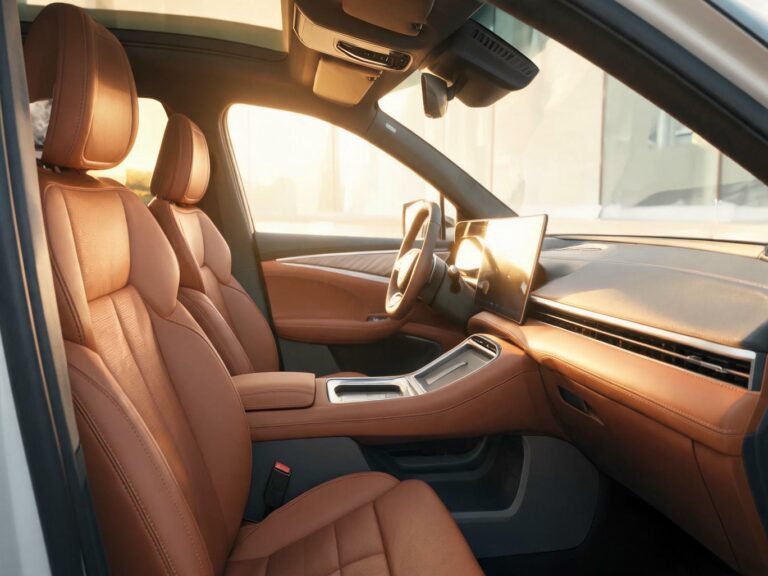
Silicone leather in automotive interior applications — see how the material brings together design, durability, and low-VOC performance.
The Specifier’s Checklist for Material Selection
When you’re specifying interior materials for a vehicle program, these are the design-critical items you should evaluate beyond the standard performance specs.
- Color accuracy and consistency — Can the supplier match your exact brand color, and maintain that match across 100,000 units? Request color tolerance data and batch-to-batch consistency records.
- Grain uniformity — How consistent is the surface texture across the material and after forming? Look for samples that show the material on actual formed parts, not just flat swatches.
- Sheen level in multiple lighting conditions — Evaluate samples under natural daylight, LED interior lighting, and direct sunlight. The gloss level should stay within acceptable range in all conditions.
- Sewability and stitch appearance — The quality of the stitching line affects perceived quality more than you’d think. Test with your actual thread and stitch pattern to ensure clean, consistent results.
- Aging characteristics — What does the material look like after 5 years of simulated use? Ask for accelerated aging samples so you can design for the entire lifecycle, not just day one.
- Odor and VOC profile — Smell the material yourself. Have it tested to OEM VOC standards. A clean, neutral interior is becoming a key premium differentiator.
Designer’s insight: The most successful interior programs we’ve worked on involve material suppliers early in the design process, not just at the sourcing stage. When you collaborate with a material partner during concept development, they can help you push the boundaries of what’s possible — custom grains, unique color effects, special surface treatments — rather than working within the constraints of a standard catalog.
Design the Experience, Not Just the Material
Automotive interior leather — or whatever material you choose — is the most direct connection between the driver and the brand. It’s what they touch every time they get in the car, what they see in their peripheral vision, what they smell when they close the door. Getting it right means thinking beyond the specification sheet and considering the whole sensory experience: how it looks, how it feels, how it ages, and what it says about the brand.
For design teams working on automotive interiors — whether traditional luxury or cutting-edge EV — silicone leather opens up new design possibilities: precise color matching, consistent texture across every part, zero-VOC interior air quality, and a clean, modern aesthetic that stands apart from the leather-and-wood formula of the past.
About TOPSUN
TOPSUN develops premium silicone leather materials for automotive interior applications, working with OEM design teams and Tier 1 suppliers to achieve precise color matching, consistent texture, and low-VOC performance that meets modern vehicle interior standards.
Custom color matching to Pantone or OEM standards, grain texture development for design programs, VOC testing per VDA 277 and ISO 10580, prototype support for concept vehicles, batch-to-batch color consistency of ΔE < 1.0.