Ambient light glows softly through a car door panel — except the surface isn’t plastic or glass. It’s leather. LED integrated leather is one of the most counterintuitive materials in modern product design: a surface material known for opacity and warmth now doubles as a light-diffusing medium. The enabler is silicone leather — the only leather type with sufficient translucency to allow controlled light transmission while maintaining the tactile warmth, grain texture, and durability that designers require. This guide explores what LED integrated leather actually is, where it’s already being deployed, and what material properties make it possible.
Explore Smart Material Samples
What Is LED Integrated Leather?
LED integrated leather is a composite material system that embeds light-emitting elements within or behind a leather surface, creating illuminated upholstery and trim panels. Unlike surface-mounted LED strips that sit on top of materials, true LED integrated leather makes the leather surface itself the visible light element — light passes through the material from beneath, creating a soft, diffuse glow across the entire panel.
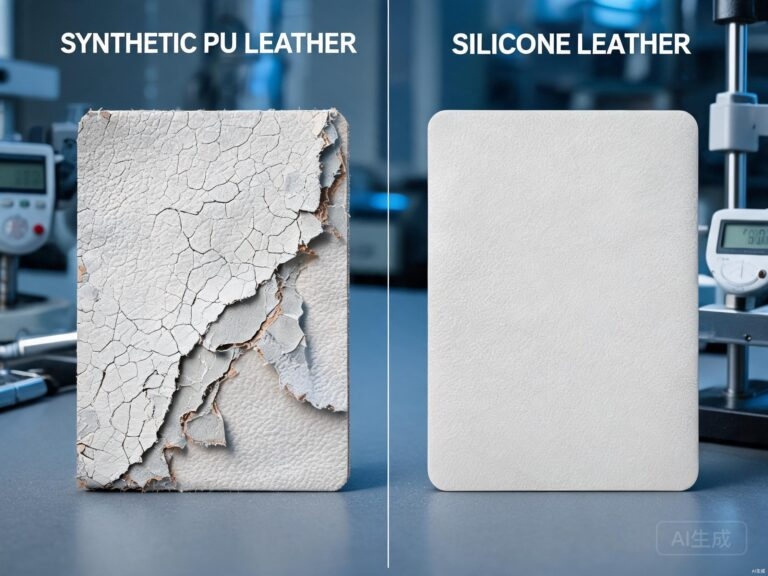
The concept sounds simple, but it requires a fundamental material property that traditional leather doesn’t possess: controlled light transmission. Standard full grain leather, PU leather, and PVC leather are all opaque — light cannot pass through them. This is why LED integrated leather has only become viable with the emergence of silicone leather as a smart material. Silicone polymer can be formulated to specific translucency levels, allowing precise control over how much light passes through and how it diffuses across the surface.

Silicone leather material lifecycle — the base polymer’s tunable properties enable light transmission
Where LED Integrated Leather Is Already Being Deployed
This isn’t a concept material — it’s already in production across three major application categories, each driven by different design requirements:
Automotive ambient lighting. The largest and fastest-growing application. Premium vehicle OEMs are replacing traditional ambient lighting — which used fiber optics or LED strips behind plastic trim — with LED integrated leather panels on door inserts, dashboard surfaces, and seat bolsters. The advantage is visual: light glowing through leather creates a warmer, more premium ambiance than light reflecting off plastic. The 2026 automotive interior trends show smart surfaces with integrated lighting as a top priority for next-generation cabins.
Design insight: One of our automotive OEM clients replaced backlit plastic trim with LED integrated silicone leather on their EV platform. The result: a 40% improvement in perceived interior quality scores during customer clinics — because the light felt like it was emerging from a natural material rather than shining through plastic.
Fashion and wearable technology. LED integrated leather is appearing in high-fashion accessories — handbags with illuminated panels, jacket elements with subtle backlighting, and performance wear with visibility-enhancing light features. The key requirement here is flexibility: the material must bend, fold, and drape without cracking or losing light transmission consistency. Silicone leather’s inherent flexibility (elongation >200%) makes it uniquely suited for wearable applications where rigid substrates aren’t an option.
Architectural and entertainment design. Hotels, restaurants, and entertainment venues are using LED integrated leather for illuminated wall panels, backlit reception desks, and ambient seating. The material’s fire resistance (EN 13773 compliance) is critical for these public applications — most alternative light-diffusing materials (polycarbonate, acrylic) don’t meet public space fire codes without chemical additives.

Silicone leather’s flexibility enables LED integration on curved surfaces — door panels, seat bolsters, and architectural elements
Material Requirements: Why Only Silicone Leather Works for LED Integration
LED integration imposes a set of material requirements that eliminate most leather types from consideration. Here’s why silicone leather is the only viable base material:
| Requirement | Natural Leather | PU / PVC | Silicone Leather |
|---|---|---|---|
| Light Transmission | Opaque — 0% | Opaque — 0% | Tunable — 5–40% |
| Flexibility (for curved surfaces) | Limited | Moderate | Excellent (>200% elongation) |
| Heat Resistance (near LED elements) | Moderate | Poor (PU softens at 60°C+) | Excellent (stable to 200°C) |
| Color Uniformity When Lit | N/A | N/A | Consistent diffusion |
| Durability Around LED Components | Cracks near heat sources | Degrades near heat | 10–15+ years |
The heat resistance point deserves emphasis. LED elements generate localized heat. PU leather begins softening at 60–80°C — a serious problem when LED components are embedded directly behind the material. Silicone leather remains stable up to 200°C, eliminating any thermal degradation risk around the LED array. This is why silicone leather for automotive interiors has become the default substrate for LED integrated applications.
Silicone leather’s versatility extends to smart material applications — see how the material platform enables next-generation integration
Design Considerations for LED Integrated Leather Projects
If you’re specifying LED integrated leather for a product, here are the key design parameters to work through with your material supplier:
Translucency level. The amount of light you want to pass through determines the silicone formulation. Lower translucency (5–10%) creates subtle accent lighting. Higher translucency (20–40%) produces more pronounced illumination. The optimal level depends on LED brightness, viewing distance, and the ambient light conditions of your application.
Texture and grain pattern. The surface texture affects how light scatters when it exits the material. Fine grain patterns (like nappa or smooth finishes) produce more uniform light distribution. Heavy grain patterns (like lychee or ostrich) create interesting light diffusion effects but may produce visible hot spots if not engineered correctly.

Smart cabin concept with LED integrated silicone leather surfaces — the future of automotive ambient lighting
Color options. Silicone leather can be pigmented in any color, and the color affects how transmitted light appears. White and light-colored silicone leather produces the most neutral light transmission. Darker colors filter the light, creating tinted glow effects. The custom color program allows precise matching of both the surface color (unlit) and the transmitted light color (lit).
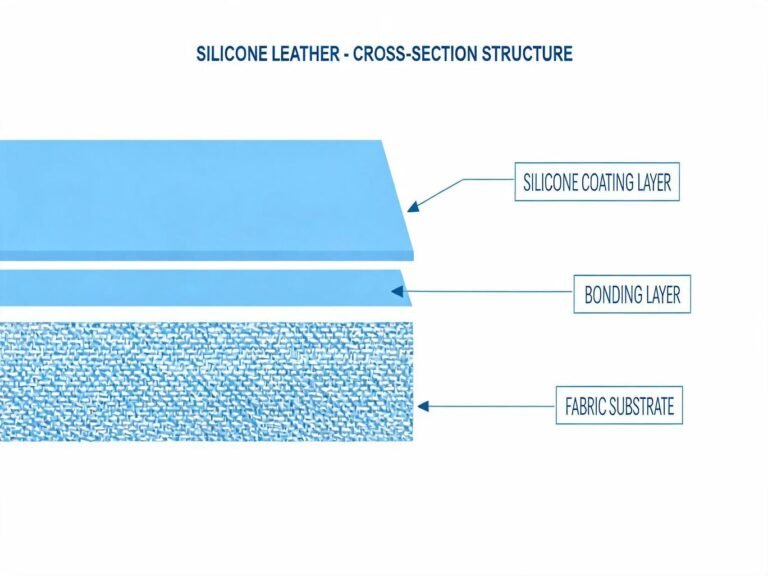
Substrate bonding. LED integrated leather systems require the silicone leather to be bonded to a light-diffusing substrate that houses the LED array. TOPSUN’s engineering team works directly with OEM design teams to optimize the bond layer for both adhesion and light transmission — a critical interface that determines the final visual quality.

Lamination process — precision bonding is critical for LED integrated leather composite systems
Frequently Asked Questions
Can LED integrated leather be used in outdoor applications?
Yes, with proper IP-rated LED components. Silicone leather itself is inherently UV-stable and waterproof — it won’t degrade from sun exposure or moisture. The limiting factor is the LED system behind the leather, which needs appropriate ingress protection for outdoor use. Several marine and outdoor hospitality projects have already deployed LED integrated silicone leather with IP67-rated LED arrays.
How long do the LED elements last compared to the leather?
Modern LED elements typically last 50,000+ hours (approximately 15–20 years at normal usage). Silicone leather’s service life is 10–15+ years. In practice, the LED elements and the leather have comparable lifespans — neither is likely to fail before the other in a well-designed system. This is a significant advantage over systems that pair LEDs with degradable materials like PU, where the leather would need replacement long before the LEDs reach end of life.
Where Light Meets Leather
LED integrated leather represents a convergence of materials science and design ambition. What was impossible with traditional leather — making the surface itself glow — is now achievable with silicone leather’s unique combination of translucency, flexibility, heat resistance, and durability. Whether you’re designing the next generation of automotive ambient lighting, illuminated fashion pieces, or architectural features, the material platform exists today.
Discuss Your Smart Material Project
About TOPSUN
TOPSUN develops translucent silicone leather formulations specifically engineered for LED integration — providing the optical clarity, thermal stability, and design flexibility that smart material applications require across automotive, fashion, and architecture.
Custom translucency tuning | 200+ texture options | OEM design partnership | ISO 10993 · REACH · EN 13773 certified