Nobody sits on a sofa expecting to feel sticky after twenty minutes. Yet that is exactly what happens when a breathable leather material gets overlooked during sourcing. Breathability is not a luxury feature. It is the difference between upholstery that people want to use and upholstery that they want to replace.
The challenge is real. Most buyers assume that synthetic leather either lets air through or blocks water — but rarely both. In this guide, we break down why breathability matters across key applications, how silicone leather handles moisture differently from PU, and what numbers you should actually look for when evaluating samples.
The Comfort Paradox: Breathability vs Water Resistance
Here is the problem most sourcing teams run into. PU leather can be engineered for breathability — but that means creating microscopic pores in the coating. Those same pores become pathways for liquid water. You get comfort in a showroom but stains the moment someone spills a drink.
The alternative? Seal the surface completely. Now you have waterproof faux leather solutions that repel spills beautifully. But the trapped heat and moisture build up against the user’s skin. For automotive interiors, furniture, and marine applications, that trade-off is a real headache.
We have seen this play out dozens of times. A furniture brand selects PU material with decent breathability specs. Six months later, complaints arrive about sweaty cushions in warmer climates. Switching to a coated variant fixes the moisture issue — but kills the airflow. A lose-lose scenario with polyurethane.
Key takeaway: With PU leather, breathability and water resistance exist on a sliding scale. Improving one almost always means sacrificing the other. Silicone leather breaks this trade-off entirely.
If you want a deeper look, our silicone leather vs PU comparison covers abrasion, chemical resistance, and lifespan side by side.
How Silicone Leather Achieves Both
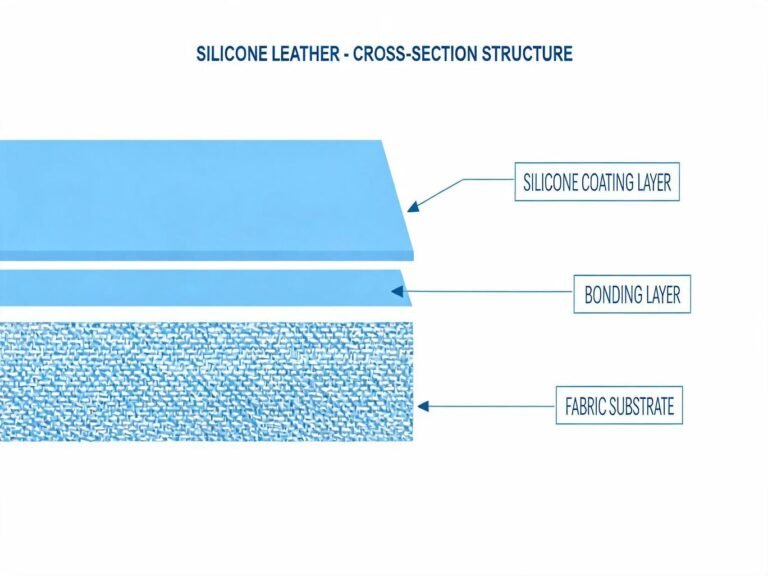
Silicone leather is built on a fundamentally different chemistry. The surface layer uses polydimethylsiloxane (PDMS) — a silicon-oxygen polymer with high rotational freedom. This creates a dense but flexible matrix at the surface.
What does that mean in practice? The surface is compact enough to block liquid water. A spilled coffee cannot penetrate. Yet individual water vapor molecules are small enough to diffuse through the gaps between silicone chains. Sweat escapes, spills stay on the surface.
PDMS has one of the highest gas permeability coefficients among common coating polymers. According to Textile World‘s coverage of advanced textile membranes, silicone-based coatings are recognized for this dual-performance trait.

In our lab, we have tested hundreds of samples over the years. Silicone leather consistently shows MVTR in the range of 2,000–4,000 g/m²/24h depending on backing fabric and thickness. That puts it well within the comfort zone for extended seating — without any waterproofing trade-off.
For a full breakdown of the structural differences, check out our detailed silicone vs PU analysis covering polymer chains, coating processes, and performance data.
| Property | Silicone Leather (PDMS) | Conventional PU Leather |
|---|---|---|
| Water Resistance | Excellent — dense surface blocks liquid | Varies — pores compromise waterproofing |
| Moisture Vapor Transmission | High — vapor diffuses through PDMS chains | Moderate — depends on micropore structure |
| Comfort in Warm Climates | Consistent — no sticky buildup | Degrades as pores clog over time |
| Long-term Breathability | Stable — no pore collapse | Declines with wear and dirt |
Where Breathability Becomes a Deal-Breaker
Let’s look at three real-world scenarios where air permeable leather directly impacts end-user satisfaction — and your return rate.
Automotive seating. A car interior can reach 60 degrees on a sunny day. If the seat covering does not breathe, the driver ends up pressed against a heat trap. Heated seats worsen the problem in winter. For automotive interiors, breathable faux leather with moisture wicking capability is now a minimum spec for tier-one OEMs.

Furniture and hospitality. Hotel lobbies, restaurant booths, and residential sofas all face the same issue. In humid regions, a non-breathing upholstery material becomes uncomfortably warm within minutes. For furniture and sofa applications, moisture wicking leather helps regulate the microclimate between user and cushion — reducing complaints and extending perceived quality.
Marine and yacht interiors. Constant humidity and salt spray can clog the micropores in PU leather over time. Ventilated leather that maintains airflow without relying on pores is a significant advantage. Silicone leather handles both moisture transfer and salt exposure without degradation.

From our testing data: In a 48-hour controlled humidity test at 40°C and 90% RH, silicone leather samples showed less than 5% moisture absorption on the surface, while maintaining an MVTR above 2,500 g/m²/24h. Comparable PU samples either absorbed significantly more moisture or showed vapor transmission rates below 1,200 g/m²/24h.
Testing Breathability: Key Metrics for Sourcing Teams
If you are evaluating materials for a new project, here are the specific numbers worth requesting from your supplier. Do not settle for vague claims like “highly breathable.” Ask for test data.
- Moisture Vapor Transmission Rate (MVTR): Measured in g/m²/24h. For comfort-focused applications, look for 2,000+ g/m²/24h. This is the single most important metric for breathability.
- Water Resistance Rating: Check the hydrostatic head test (AATCC 127 or ISO 811). A rating above 10,000 mm indicates strong waterproofing performance.
- Air Permeability: Measured in mm/s or L/m²/s per ISO 9237. Higher values indicate faster airflow through the material.
- Moisture Absorption at Surface: Critical for real-world comfort. Low surface absorption (under 5%) means the material feels dry to the touch even in humid conditions.
We recommend requesting independent lab reports. In-house data is useful, but third-party verification carries more weight with OEMs and government buyers. Standards published by ISO provide internationally recognized testing methods for direct supplier comparisons.
Frequently Asked Questions
Can silicone leather really be both waterproof and breathable?
Yes. The PDMS matrix blocks liquid water while allowing water vapor to pass through. This is a structural property of the silicone chains, not an engineered compromise. Our lab data confirms MVTR above 2,000 g/m²/24h alongside hydrostatic head ratings exceeding 10,000 mm.
How does breathability affect material lifespan?
Breathable materials that manage moisture well tend to last longer. Trapped moisture accelerates mold growth, backing fabric deterioration, and delamination. A breathable leather material that allows vapor to escape reduces these failure modes — especially in marine or tropical environments.
What MVTR number should I target for automotive seating?
For automotive seating, we recommend a minimum MVTR of 2,000 g/m²/24h. Premium OEM programs often specify 3,000+ for hot-climate markets. Always confirm with the vehicle manufacturer’s specification team.
Comfort Is Not Optional
Breathability sits at the intersection of comfort, durability, and user satisfaction. The old trade-off — breathe or waterproof, pick one — no longer applies. Silicone leather delivers both through its PDMS-based structure, and the data backs it up.
For procurement teams, a breathable leather material is not a nice-to-have. It directly influences product performance and user experience. The right choice reduces warranty claims and builds brand trust.
If you are preparing a material shortlist, we would be happy to send samples along with full test data. Seeing and feeling the difference in person beats any spec sheet.
About TOPSUN
TOPSUN is a leading manufacturer of organic silicone leather, founded in 2018. With a cumulative production exceeding 600 million meters and 233 patents, we serve OEM buyers across automotive interiors, furniture upholstery, marine, medical, and consumer electronics. Every material is backed by independent lab testing and custom-engineered to your specifications.
Certifications: REACH, RoHS, FDA, ISO 10993, EN 13773, FAR 25.853