Every upholstery buyer has lived the same nightmare. A client calls weeks after delivery. Coffee soaked into a sofa cushion. Ink bled into a headrest. The warranty claim lands on your desk. For procurement teams sourcing stain resistant leather, surface protection is not a nice-to-have. It is the feature that decides whether a product line succeeds or gets buried in returns.
Here is the reality most manufacturers do not advertise. Traditional water-resistant coatings sit on top of the material like a thin shell. They crack. They peel. They trap VOCs. Volatile organic compounds (VOCs) off-gas for months. After a year of real use, that “protected” surface looks worse than an uncoated one.
Silicone leather changes the rules entirely. The stain resistance is not sprayed on. It is baked into the molecular structure. At TOPSUN, we have spent 12 years refining this technology across 8 production lines. The result is a surface that actively repels liquids, resists soil, and wipes clean with nothing but water. In this article, we will show you exactly how it works — and what to look for when you source it.
Why Stain-Resistant Leather Is Now Standard in Upholstery
The demand for water resistant leather has shifted from premium tier to baseline expectation. hospitality buyers, automotive OEMs, and furniture distributors now specify cleanability before they discuss color or texture. The math is simple. A stain that cannot be removed in under 60 seconds costs more in service calls than the original material margin.
Different sectors face different enemies:
- Healthcare & medical: Blood, iodine, and disinfectants attack porous surfaces. Seams become bacterial harbors.
- Automotive interiors: Coffee, sunscreen, and denim dye transfer are daily threats. Headrests and bolters take the worst hits.
- Marine & outdoor: Salt spray, fish blood, and mildew demand surfaces that clean fast and dry faster.
- Furniture & hospitality: Wine, ketchup, and marker pens test every surface on opening weekend.
Conventional waterproof faux leather solutions rely on polyurethane topcoats. These work — for a while. But UV exposure breaks down the polymer chains. Repeated cleaning strips the finish. Within 18 to 24 months, the protection is gone and the substrate underneath yellows and cracks.

The Chemistry Behind Self-Cleaning Silicone Surfaces
Silicone leather is built from polydimethylsiloxane (PDMS), a silicone polymer with a unique molecular backbone. Unlike carbon-based plastics, the Si-O bond is highly stable. It does not oxidize under UV. It does not hydrolyze in water. And critically for stain resistance, it presents a densely packed, low-surface-energy finish.
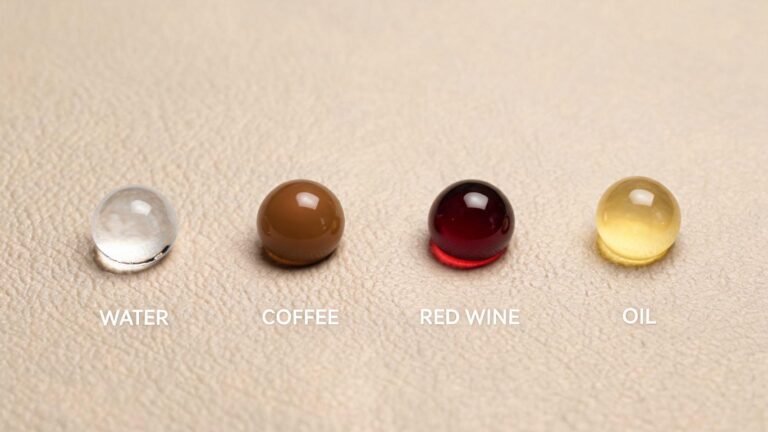
What does low surface energy mean in practice? Liquids cannot spread. A droplet of coffee or red wine beads up rather than soaking in. The contact angle on quality silicone leather exceeds 100 degrees. That is hydrophobic territory. Dirt and pigments stay on the surface where they belong, instead of wicking into fibers or pores.
Here is where silicone differs from coated alternatives. The protection is not a layer. It is the material itself. You could abrade the surface and the layer underneath behaves identically. There is no coating to fail. No seam where protection stops. No delamination after 10,000 flex cycles.
At TOPSUN, we manufacture silicone leather through a solvent-free casting process. Raw silicone is mixed with colorants, coated onto premium backing fabrics, and cured at controlled temperatures. No solvents. No plasticizers. No phthalates. The material ships clean and stays clean.
Watch silicone leather repel coffee and wine in real time — no coating, no residue.
Waterproof Faux Leather vs. Conventional Water-Resistant Coatings
Buyers often confuse “water resistant” with “waterproof.” They are not the same. And the difference costs money.
Water-resistant coatings slow down absorption. Given enough time or pressure, liquid still gets through. Waterproof faux leather, when engineered from silicone, blocks liquid entirely. The backing fabric may breathe, but the silicone face acts as a continuous barrier.
| Property | PU Coated Faux Leather | Silicone Leather |
|---|---|---|
| Stain resistance mechanism | Surface spray coating | Integral material property |
| Durability of protection | Degrades 12-24 months | Lifespan of product (10-15+ yrs) |
| Cleaning method | Specialized cleaners, conditioners | Water and soft cloth |
| VOC emissions | Present from solvents & adhesives | Zero VOC, solvent-free |
| UV stability | Yellowing & embrittlement | Resists fading & degradation |
| Abrasion (Martindale) | 30,000-80,000 cycles | Up to 200,000+ cycles |
The takeaway? If you are specifying material for high-traffic furniture and sofa upholstery or public seating, coatings are a temporary fix. Silicone is the structural solution.
Real-World Testing: How Stain-Resistant Leather Handles Daily Abuse
We have run thousands of hours of abuse testing at our 20,000 square meter facility. Not in a lab with pipettes. In conditions that mimic what happens when a delivery driver drops a sofa in a family home or a hospital installs 200 new chairs.
Here is what easy clean leather actually sees on our test benches:
- Coffee & tea: Left for 4 hours. Wiped with plain water. Zero residual pigment. No odor retention.
- Red wine: Blotted, not rubbed. Surface tension prevents penetration. No staining after 24 hours.
- Iodine & betadine: Critical for medical upholstery. Cleaned with standard disinfectant. No discoloration.
- Marker pens & ballpoint ink: Isopropyl alcohol removes traces in two passes. Material finish unaffected.
- Motor oil & grease: Common in marine and automotive interior programs. Wipes off without leaving an oily film.

The testing protocols go beyond visual inspection. We run Martindale abrasion to 200,000 cycles, then repeat the stain tests. We subject samples to 250 hours of UV exposure in a Q-SUN xenon chamber, then check hydrophobicity. We flex material around a mandrel 100,000 times, then verify that no micro-cracks have formed where liquid could ingress.
This is not theoretical. It is the validation work that separates a material you can warranty from one you cannot. In our experience, procurement teams who visit the factory and watch these tests leave with a completely different risk assessment. The numbers on a datasheet are one thing. Seeing red wine bead up on a sample that has already survived 150,000 abrasion cycles is another.
Choosing Soil Resistant Fabric for Your Application
Not all soil resistant fabric is created equal. When you evaluate suppliers, look past the marketing language. Ask for specifics. A legitimate manufacturer will have answers.
Back to Top of Mind Checklist:
- Thickness range: Does the supplier offer 0.23mm to 2.0mm to match your application? Ultra-thin for 3C electronics, heavier gauges for furniture?
- Abrasion rating: Is the Martindale result certified by a third-party lab, or self-reported?
- Backing options: Can they pair the silicone face with polyester, cotton, or breathable medical-grade substrates?
- Flame retardancy: Do they hold FAR 25.853 or EN 13773 Class 4 certification for aviation and public seating?
- Chemical compliance: Is the material REACH, RoHS, PAHs, and FDA compliant for food contact or medical use?
- Customization depth: Can they match a specific Pantone, emboss a proprietary texture, or adjust gloss levels?

At TOPSUN, we produce six distinct product lines because no single formulation covers every use case. Our High Performance collection hits 200,000+ Martindale cycles for public transit and heavy-duty furniture. The Ultra-Thin collection starts at 0.23mm for precision electronics wraps. The Super Flame Retardant line meets the strictest aviation and rail standards.
If your project demands a specific cleaning and maintenance protocol, we validate compatibility before production. We have seen too many buyers specify a beautiful material only to discover later that their client’s hospital-grade disinfectant degrades the finish. Test first. Produce second.
Frequently Asked Questions
Does silicone leather need a protective spray after installation?
No. The stain resistance is inherent to the material. Adding topical sprays can actually interfere with the natural hydrophobic surface and may introduce VOCs. For recommended care, see our synthetic leather cleaner care guide.
How does silicone leather perform against mold and mildew?
Silicone is naturally resistant to microbial growth. Unlike porous fabrics or organic leather, it provides no nutrient source for mold. Combined with its waterproof nature, this makes it ideal for humid environments like marine cabins and tropical hospitality projects.
Can I get custom textures and colors that still carry the stain-resistant properties?
Yes. The silicone formulation is consistent across our Classic, Designer, and custom collections. Embossing depth and gloss level can be adjusted without compromising surface protection. We match Pantone references and produce custom textures from client-supplied molds.
Is Stain-Resistant Leather Right for Your Next Project?
Stain resistant leather is no longer a niche upgrade. It is the standard that reduces warranty exposure, cuts maintenance costs, and extends product life cycles. Silicone technology delivers this performance without the compromises of coated alternatives — no delamination, no VOCs, no special cleaning products.
If you are evaluating materials for a upcoming furniture, automotive, or medical project, the fastest way to validate performance is to test the material yourself. We ship free swatches globally with full technical data sheets and certification documentation.
About TOPSUN
TOPSUN is a leading silicone leather manufacturer with 12+ years of B2B custom production experience. Our 20,000 m² factory operates 8 automated production lines with an annual output exceeding 2,000 tons. We serve OEM and bulk buyers across furniture, automotive, marine, medical, and consumer electronics sectors in 30+ countries.
Certifications: FDA, REACH, PAHs, RoHS, EN 71, ISO 9001, ISO 10993, EN 13773 Class 4, FAR 25.853.