42% chroma loss after 1,200 hours of xenon arc exposure. That’s what independent lab testing found in pre-2022 yellow leather dye formulations — well below the 2,000-hour benchmark for premium automotive leather. Yellow ranks among the top 2026 synthetic leather color trends, but the vivid shades that catch a buyer’s eye on day one can turn sickly greenish by month eighteen. Here’s what causes yellow leather fabric to fade, which testing standards actually predict real-world performance, and how silicone-based formulations solve the UV stability problem that PU and PVC cannot.

Color fastness tester — the machine that separates suppliers who test from those who guess
| Material | UV Stability (hrs) | Color Fastness Grade | Chroma Loss @ 1,200h |
|---|---|---|---|
| Silicone Leather | 1,000+ hrs no fading | Grade 4–5 | < 5% |
| PU Leather (pre-2022) | 200–400 hrs | Grade 2–3 | 42% |
| PVC Leather | 100–300 hrs | Grade 2 | 50%+ |
Why Yellow Leather Fades Faster Than Other Colors
Yellow pigments face a uniquely harsh UV degradation curve. The molecular structure of yellow azo and diarylide pigments — the most common yellow colorants in PU and PVC leather — breaks down under UV radiation at a faster rate than red, black, or brown counterparts. When UV energy cleaves the azo bond, the conjugated system that produces yellow coloration collapses, shifting the reflected wavelength toward green or brown. This isn’t a surface coating issue; it’s a chemistry problem embedded in the pigment itself.
In our UV resistance testing using ASTM G154 standards, silicone leather samples in Pantone-matched yellow showed no visible fading or yellowing after 1,000+ hours of accelerated weathering. The difference comes down to the carrier system: silicone polymers are inherently UV-stable because their Si-O backbone doesn’t absorb UV radiation in the 290–400nm range that degrades carbon-based polymers. PU and PVC rely on UV stabilizers and absorbers added to the formulation — additives that migrate, deplete, and eventually leave the pigment unprotected.

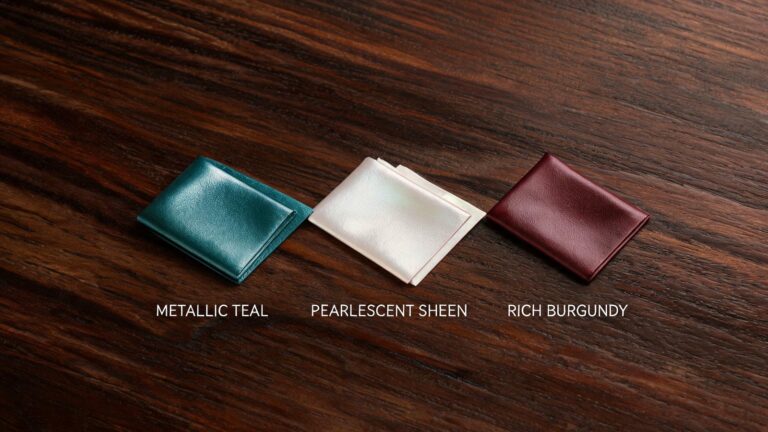
Multi-color swatch rack — yellow samples must survive the same UV tests as every other shade
The Color Fastness Standards That Actually Matter for Yellow
When sourcing yellow leather fabric for furniture or upholstery applications, three testing standards predict whether your product will maintain its color through warranty period:
- ISO 105-B06 (Color fastness to light): The baseline standard. Premium yellow leather should achieve Grade 4–5 (minimal color change). Anything below Grade 3 means visible fading within 12–18 months of indoor exposure.
- ASTM G154 (Accelerated weathering): Simulates UV exposure with fluorescent lamps. We test to 1,000+ hours and measure Delta E — values below 1.0 indicate color stability that’s imperceptible to the human eye.
- EN ISO 105-B02 (Xenon arc fading): The European furniture standard requires Grade ≥6 for indoor use and ≥7 for outdoor. Many suppliers skip this test entirely for yellow shades.
Designer’s note: Yellow leather fabric for sofa applications faces double exposure — UV through windows and body oils from daily contact. Request both ISO 105-X12 (rubbing fastness) and ISO 105-B06 (light fastness) test reports. If your supplier can produce only one, you’re getting half the story.
Yellow Leather Fabric for Car Seats: The Harshest UV Test
Automotive interiors present the most demanding environment for yellow leather. Cabin temperatures can reach 80–90°C in parked vehicles, and UV radiation through windshields is concentrated at wavelengths that accelerate pigment breakdown. The ASTM D4303-22 standard referenced in yellow Mercedes leather analysis confirmed that pre-2022 formulations lost 42% chroma after 1,200 hours of xenon arc exposure — below the 2,000-hour industry benchmark. For B2B buyers specifying yellow leather for car seats, this data point should be a screening question: “What is your chroma loss percentage at 1,200 hours xenon arc?”
We’ve seen this failure pattern firsthand. A client specified a vivid yellow PU leather for a furniture line targeting hospitality interiors — within 14 months, the sun-facing booth seats had shifted from warm gold to greenish brown while the shaded side remained original. The root cause was a PU formulation using unstabilized diarylide yellow pigment with no UV absorber package. The fix wasn’t changing the color; it was changing the carrier chemistry to silicone-based formulations that don’t require UV stabilizers because the polymer itself is UV-transparent.
How to Choose Yellow Leather Fabric That Lasts
The color customization process for yellow leather should include batch-to-batch consistency verification. Pantone matching with Delta E ≤ 1.0 is the standard for premium grade — but that spec means nothing if the color drifts after installation. Here’s what to verify before committing to a yellow leather fabric order:
- Request ISO 105-B06 test data — minimum Grade 4 for indoor applications, Grade 5 for automotive or sun-exposed environments
- Ask for ASTM G154 accelerated weathering results — 1,000+ hours with Delta E < 3.0 for acceptable color stability
- Demand rubbing fastness data (ISO 105-X12) — yellow pigments are particularly susceptible to crocking; require Grade 4–5
- Verify the polymer system — silicone-based carriers inherently resist UV; PU and PVC require additive packages that deplete over time
- Check Martindale abrasion data — yellow leather fabric should achieve 50,000+ cycles minimum for furniture, 100,000+ for high-traffic applications

Color palette display — yellow shades must be tested individually, not assumed from generic color fastness data
The Bottom Line
Yellow leather fabric doesn’t have to be a recall risk. The combination of silicone polymer chemistry, verified ISO 105-B06 color fastness data, and ASTM G154 UV testing at 1,000+ hours delivers a material that holds its warm, optimistic hue for a decade — not 18 months. If your supplier can’t produce these test reports for yellow specifically, the color you’re buying isn’t the color your customers will keep.
Watch silicone leather color fastness testing — see how yellow holds up under accelerated UV exposure
About TOPSUN
TOPSUN engineers silicone leather in unlimited custom colors including UV-stable yellow formulations for furniture, automotive, and hospitality interiors. Production facilities span 60,000+ m² with Pantone matching accuracy of Delta E ≤ 1.0.
1,000+ hrs UV resistance verified | ISO 105-B06 Grade 4–5 | ASTM G154 tested | 100+ yellow shade options available