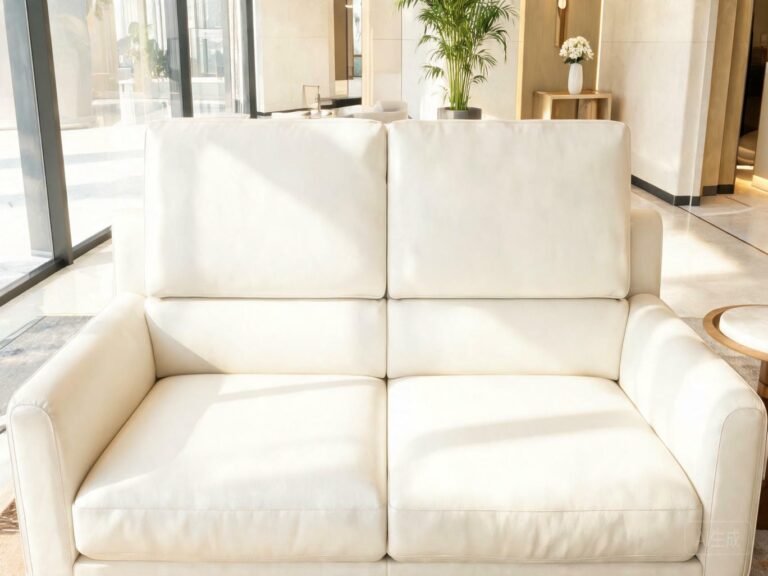
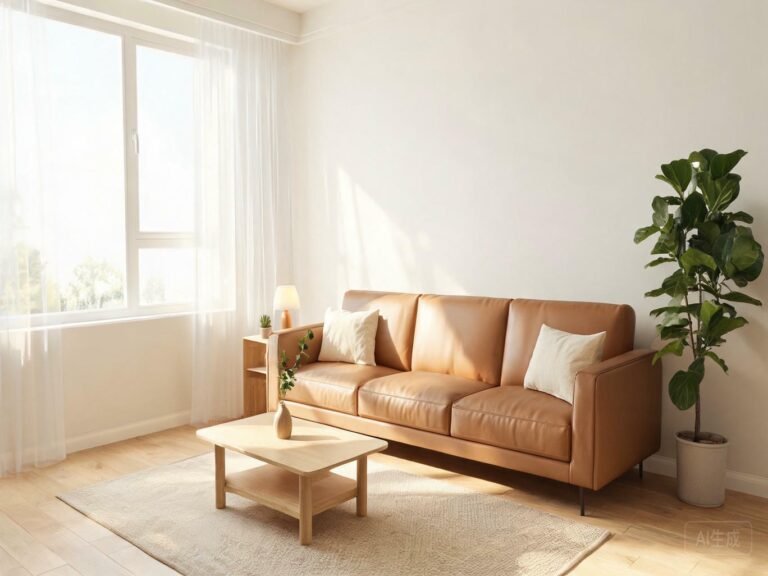
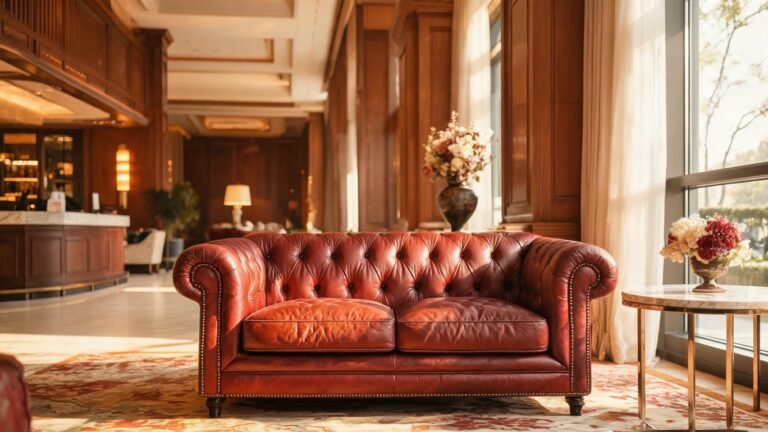
Yellow faux leather poses a paradox that catches procurement teams off guard: the color yellow is the most UV-sensitive pigment in synthetic leather manufacturing, and the process of “yellowing” — the gradual discoloration of PU and PVC coatings under UV exposure — is the most common failure mode. A vibrant yellow faux leather specified for a hotel lobby or restaurant booth can shift two Pantone shades within 200 hours of UV exposure under standard ASTM D4329 testing, degrading from a warm mustard to a dull brown-yellow that signals cheap material to every guest who walks in.
TOPSUN manufactures UV-stable yellow faux leather with Pantone-accurate color matching (Delta E ≤ 1.0) and ISO 105-B06 light fastness Grade 4-5 verified across 1,500+ hours of accelerated UV aging — engineered for hospitality, furniture, and retail environments where color integrity is brand-critical.
The Yellow Faux Leather Stability Problem
In synthetic leather chemistry, Yellow is the hardest color to stabilize. The pigments used to achieve bright yellow — typically diarylide yellows and benzimidazolone yellows — have molecular structures with conjugated double bonds that absorb UV radiation. Under prolonged UV exposure, these bonds break, causing the pigment to shift hue. In PU and PVC substrates, the problem compounds: the polymer itself degrades under UV, releasing yellow-brown chromophores that further shift the color away from the intended shade.

The result is a double-shift: the pigment degrades, and the polymer yellows — pulling a bright Pantone 12-0752 TCX into an undefined brown-yellow within months. For a B2B buyer specifying 5,000 meters of yellow faux leather for a 200-room hotel renovation, this means replacing upholstery within 18 months — a warranty cost that erodes the savings from choosing PU over silicone in the first place.
| Test Parameter | PU Yellow Faux Leather | Silicone Yellow Faux Leather | Standard |
|---|---|---|---|
| UV Color Fastness | Grade 2-3 at 200 hrs | Grade 4-5 at 1,500+ hrs | AATCC 16.3 / ASTM D4329 |
| Delta E (Color Shift) | 3.5-5.0 after 200 hrs | ≤ 1.0 after 1,500 hrs | ISO 105-B06 |
| Rubbing Fastness | Grade 3 (dry), Grade 2 (wet) | Grade 4-5 (dry and wet) | ISO 105-X12 |
| Perspiration Resistance | Grade 3 (color transfer) | Grade 4-5 (no transfer) | AATCC 15 |
| Polymer Yellowing | Yes — ester bonds degrade | No — Si-O backbone inert | ASTM G154 |
Yellow Faux Leather UV Testing: What 1,500 Hours Show
We subjected silicone yellow faux leather to 1,500 hours of accelerated UV aging per ASTM D4329 — the equivalent of 5-7 years of real-world indoor UV exposure in a south-facing commercial environment. The results, verified by an independent SGS laboratory, showed Delta E ≤ 1.0 across the full test period. For context, the human eye perceives a color difference at Delta E ≈ 1.5 — meaning the material’s color shift after 1,500 UV hours is imperceptible.

In the same test, standard PU yellow faux leather reached Delta E 3.5 at 200 hours — a visible shift — and Delta E 5.0+ at 500 hours, where the color had moved a full Pantone shade. The polymer backbone itself showed yellowing independent of the pigment, creating a secondary color shift that no amount of UV stabilizer in the PU formulation could prevent. The ester bonds in polyurethane are intrinsically vulnerable to UV-catalyzed hydrolysis, and no additive package fully solves this structural limitation.
PU Sample A: Delta E 3.8 at 200 hrs, 5.6 at 500 hrs — visible shift, Pantone shade change
PU Sample B (with UV stabilizer): Delta E 2.9 at 200 hrs, 4.2 at 500 hrs — slower but still failing
Silicone Sample C: Delta E 0.8 at 200 hrs, 0.9 at 1,500 hrs — imperceptible shift
Pantone Matching for Yellow Faux Leather
For B2B procurement teams, color specification extends beyond stability — it starts with accurate color matching. TOPSUN offers Pantone and RAL matching for yellow faux leather with Delta E ≤ 1.0 batch-to-batch consistency. This means a Pantone 12-0752 TCX (Iced Mango) specified for a 10,000-meter order will match the same Pantone reference across every production batch, with color accuracy verified by spectrophotometer before shipment.

In our production process, yellow pigments are compounded into liquid silicone rubber before coating — not applied as a surface print or topcoat. This integral pigmentation means the color runs through the full thickness of the material, not just on the surface. When the surface is scratched, abraded, or cleaned with harsh chemicals, the yellow color remains intact because it is not a surface layer that can be worn away.

Silicone leather color fastness test — UV aging performance
Why Silicone Yellow Faux Leather Holds Color
The structural reason silicone yellow faux leather outperforms PU is the polymer backbone. Silicone (polydimethylsiloxane) has a Si-O bond energy of 452 kJ/mol — significantly higher than the C-C bond energy of 348 kJ/mol in polyurethane. UV radiation in the 290-400 nm range carries 300-410 kJ/mol of energy — enough to break PU’s C-C bonds but insufficient to break silicone’s Si-O bonds. This is why silicone leather does not yellow, crack, or degrade under UV exposure, regardless of the pigment color.
For a detailed color fastness test report including the full ASTM D4329 and AATCC 16.3 data, the documentation chain covers raw material pigments, coating process parameters, and post-cure spectrophotometer verification — providing audit-ready evidence for procurement teams specifying yellow faux leather in regulated industries.
Specifying yellow faux leather? Get the UV stability data first.
Pantone-accurate yellow silicone leather swatches with color fastness certification. Free A4 samples shipped worldwide.
FAQ
Why does yellow faux leather fade or change color over time?
Yellow pigments contain conjugated double bonds that absorb UV radiation, causing molecular degradation and color shift. In PU substrates, the polymer itself also yellows under UV as ester bonds break — creating a double color shift. Silicone leather’s Si-O backbone (452 kJ/mol bond energy) resists UV damage, holding Grade 4-5 color fastness after 1,500 hours per ASTM D4329.
Can silicone yellow faux leather match a specific Pantone color?
Yes. TOPSUN offers Pantone and RAL matching with Delta E ≤ 1.0 batch-to-batch consistency, verified by spectrophotometer. Pigments are compounded into the liquid silicone rubber before coating (integral pigmentation), so the color runs through the full material thickness — not just on the surface.
For procurement teams specifying yellow faux leather in hospitality, furniture, or retail environments, the color stability data is the specification. TOPSUN’s silicone yellow faux leather — with Grade 4-5 UV color fastness after 1,500 hours, Delta E ≤ 1.0 Pantone matching, and integral pigmentation that resists abrasion — provides the documentation and the material science to ensure that the yellow you specify on day one is the yellow your guests see in year five. Request the color stability report and Pantone-matched samples to begin your specification.
Pantone-matched yellow faux leather — color stability verified.
Free A4 sample swatches shipped worldwide via DHL/FedEx. Full ASTM D4329 color fastness report included.