Last spring, a contract furniture brand approved a textile fabric design on a 30-centimeter swatch. The color matched the mood board, the litchi grain earned nods around the table, and the program moved to production. Four months later, the first rolls arrived warmer than the approved sample. The grain had flattened where the coating ran heaviest. Nothing in the artwork had changed between approval and delivery.
That failure was not an art problem. It was a verification gap, and it is getting more expensive as customization accelerates. Digital printed fashion fabrics alone are projected to reach $7.85 billion by 2032, up from $3.44 billion in 2025. That 12.5% CAGR is driven largely by faster design-to-market cycles. Speed removes exactly the checkpoints that catch weak decisions. This article walks through the four places where designs break after approval. It also maps the lab tests that catch each one while fixing is still cheap.

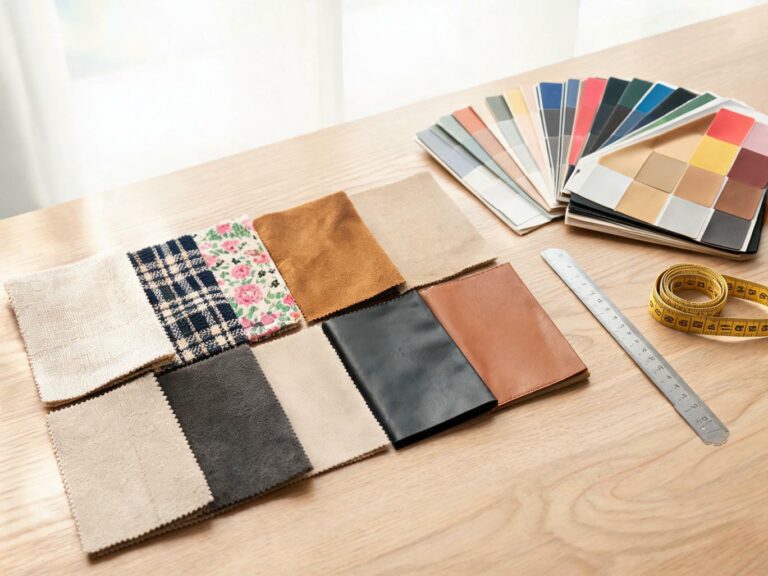
Modern upholstery programs increasingly spec custom colors and textures at production width.
Where Textile Fabric Design Breaks After Approval
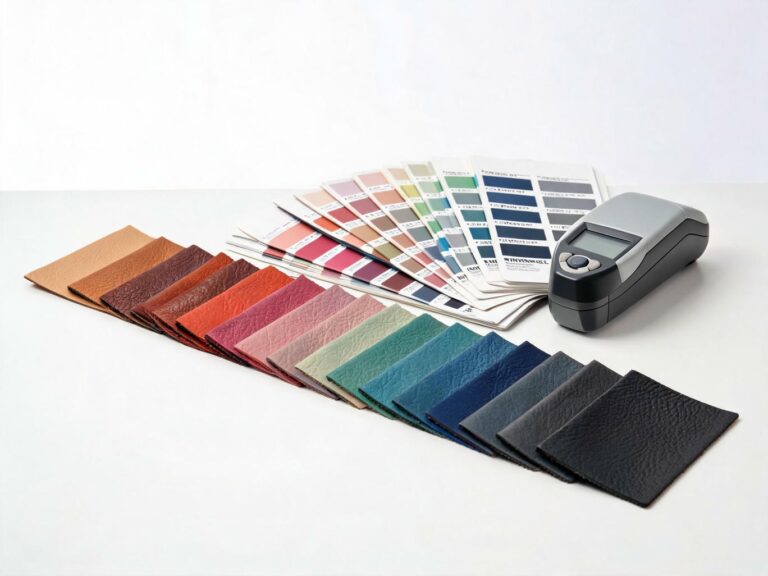
Post-approval failures concentrate in three gaps, and none of them show up on a screen proof. First is color. Artwork approved under daylight-balanced lamps in a meeting room enters production under different line conditions. In our spectrophotometer logs, uncontrolled runs drift by Delta E of 2 to 3. That reads as a visible mismatch against the master swatch.
Second is texture depth. Embossed and release-paper textures depend on coating thickness. Run the line heavy and the grain fills in; run it light and the pattern sharpens beyond intent. Last quarter we received an RFQ for a custom printed fabric with Pantone codes but no tolerance band. The file also omitted a texture reference and a thickness window.

Physical master swatches anchor color tolerance long before production runs.
Third is repeat and substrate mismatch. Pattern repeat has to survive roll width, cutting layout, and seam matching on the finished piece. A repeat drawn without construction in mind wastes yield and breaks alignment across panels. The substrate underneath decides most of this. Review what silicone-coated construction does to texture depth and color before locking artwork.
Lab Tests That Catch Weak Design Decisions
Every one of those gaps has a bench test that exposes it before tooling. The practical move is to map each design decision to a verification method. Make sample evaluation part of the approval packet, not a courtesy afterward. The table below is the mapping we walk through with first-time OEM buyers.
| Design Decision | Lab Verification | What It Catches |
|---|---|---|
| Color standard | Spectrophotometer Delta E against the physical master | Batch drift invisible on screen proofs |
| Texture depth | In-line coating thickness monitoring plus a production-width panel | Grain fill-in at heavy coating weights |
| Surface durability | Martindale abrasion to ISO 12947 at the target grade | Seating surfaces wearing through in year one |
| Flexing zones | Bending and flex cycling on finished panels | Cracking at seams, edges, and corners |

Flex cycling on finished panels exposes seam and edge cracking before launch.
The abrasion row deserves extra attention because it is where budgets get quietly broken. Designer-grade material tests at 50,000+ Martindale cycles, Classic at 20,000+, and High Performance contract grades at 200,000+. In our abrasion lab, visually identical swatches routinely separate by a factor of four. The difference usually comes from the backing or the coating stack. A design approved on the wrong grade is a warranty claim in waiting.
Approve the grade, not just the look. The substrate decision is the warranty decision.
None of this works as a final inspection step. Thickness monitoring, cure verification, and Delta E color control run continuously on our coating and calendering production line. A drift caught at hour two costs meters; the same drift caught at delivery costs a program.
Request Design-Stage Samples with Test Reports
What a Production-Ready Textile Fabric Design Looks Like
A production-ready spec covers the full stack, not just the artwork. Before artwork lock, the packet should carry:
- A physical color master with a written Delta E tolerance
- A texture reference pulled from the release-paper library
- A thickness window inside the 0.23 to 3.0 mm range
- A substrate chosen for the application and its cleaning regime
For fabric design for upholstery in humid or outdoor programs, add three more lines. Color fastness must hold at Grade 4-5, and UV stability needs to pass 1,500 hours without fading. Hydrolysis resistance calls for verification at 85°C and 85% relative humidity for 14 weeks without delamination.

Texture references translate artwork into repeatable surface depth at width.
Watch how pattern customization moves artwork from brief to production-ready surface.
The economics support the discipline. The printed textile market reached $12.4 billion in 2025. Forecasts put it at $24.6 billion by 2035, a 7.1% CAGR, with technical textiles the fastest-growing application. Volume is shifting toward programs that can document performance, not just show a pretty repeat. When we receive a design brief, our engineers quote back a test plan before they quote a price. That order matters.
Four Checks Before You Sign Off a Design
Before the next approval meeting, put four items on the checklist:
- Approve a physical master standard, never a screen proof, and write the Delta E tolerance into the purchase order.
- Ask for a production-width trial panel, not a hand-cut lab swatch, so repeat and edge behavior are visible.
- Match the Martindale grade to the application before artwork lock, since the grade drives substrate and cost together.
- Put hydrolysis, cleaning, and flame requirements in writing for any commercial or vehicle program.
Textile fabric design succeeds or fails on verification, not inspiration. The brands that ship consistent product are the ones that test the decisions nobody thinks to question. These four checks cost days; skipping them has cost whole programs.
About TOPSUN
TOPSUN engineers silicone-coated textile fabrics for furniture, automotive, and fashion programs that ship custom colors and textures at production scale.
100+ release-paper textures, Pantone and RAL color matching verified by spectrophotometer, Martindale up to 200,000+ cycles, and 500 m MOQ with 7-15 day delivery.
References
1. https://www.emergenresearch.com/industry-report… – Printed textile market $12.40B in 2025 to $24.60B by 2035, 7.1% CAGR (2025)
2. https://pmarketresearch.com/worldwide-digital-p… – Digital printed fashion fabrics $3.44B in 2025 to $7.85B by 2032, 12.5% CAGR (2026)